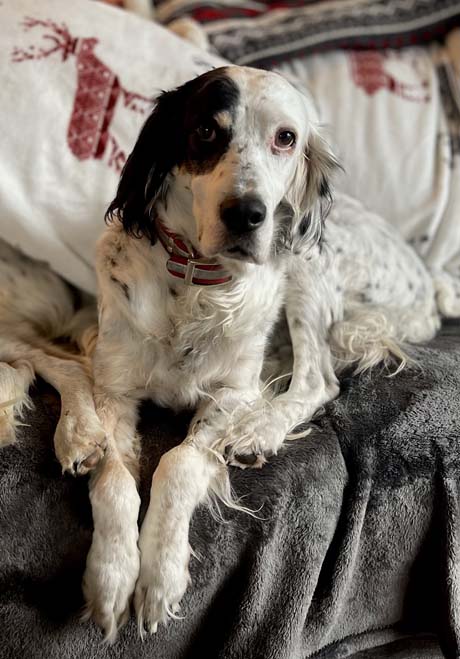
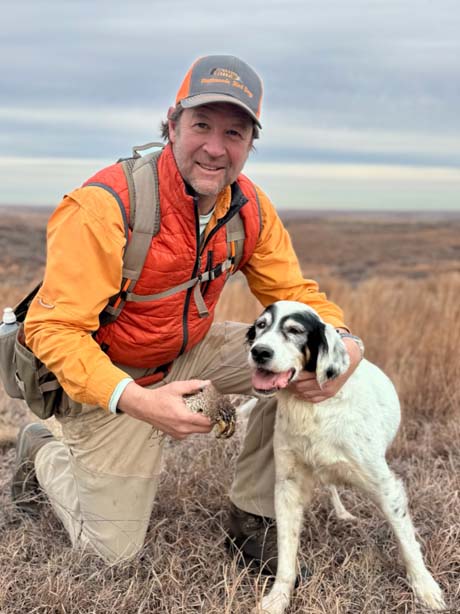
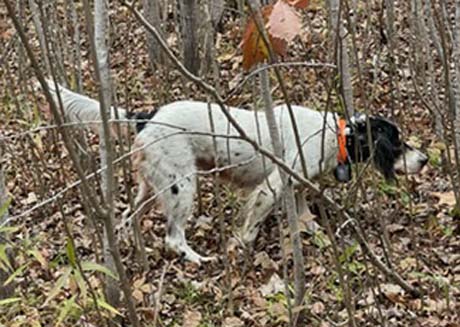
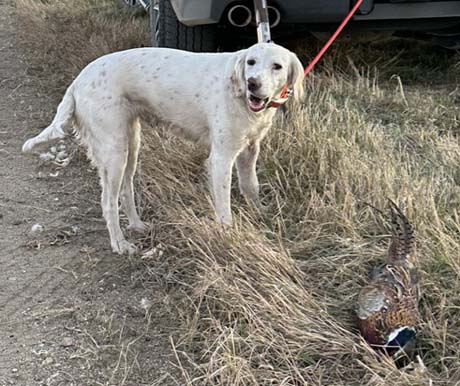
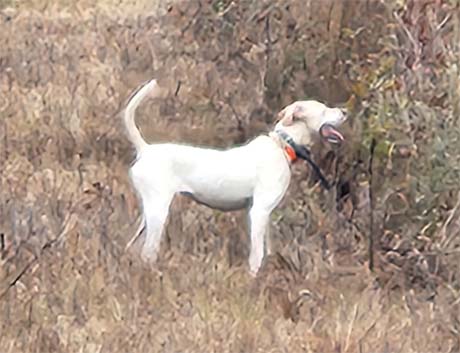
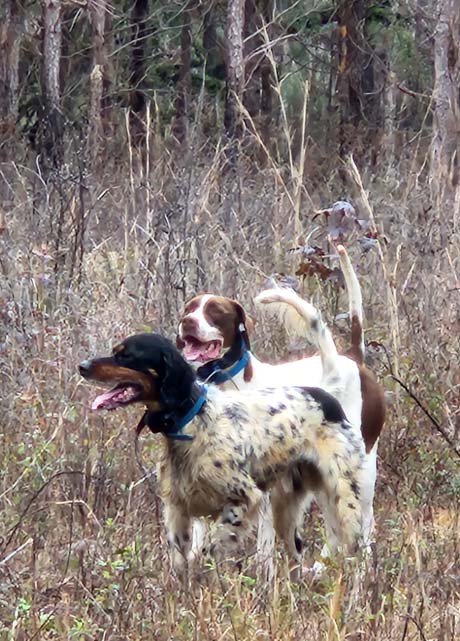
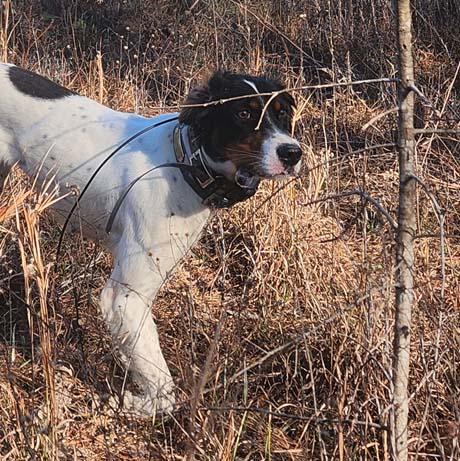
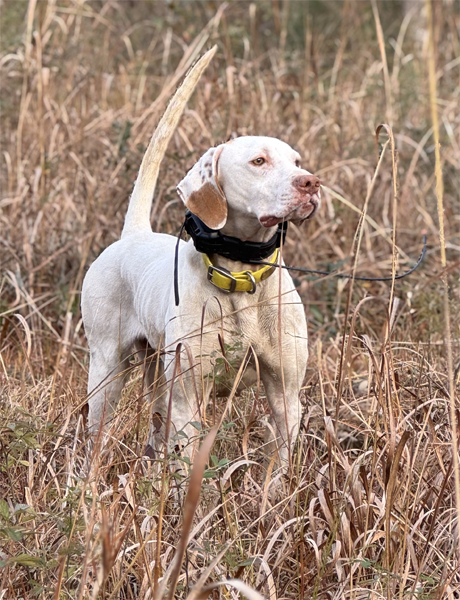
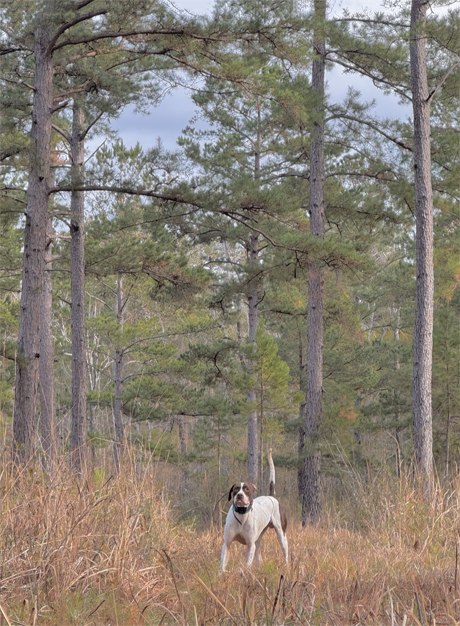
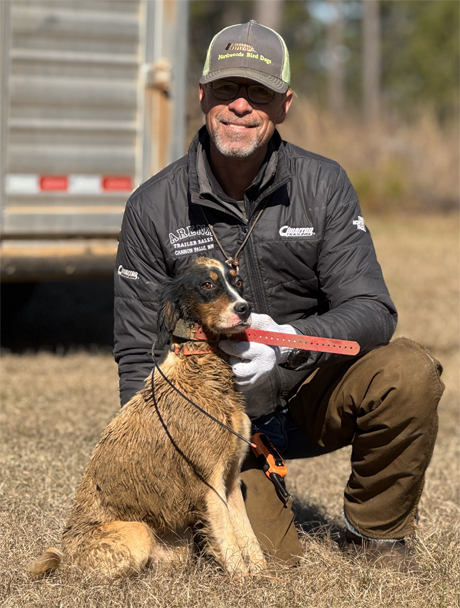
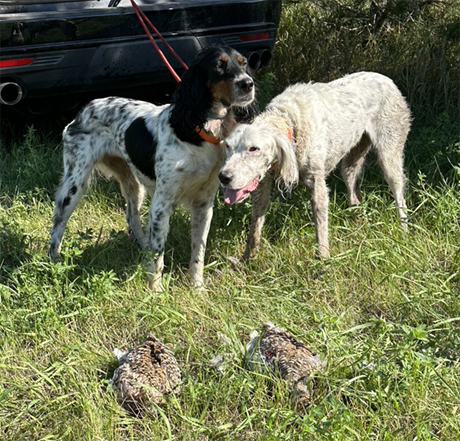
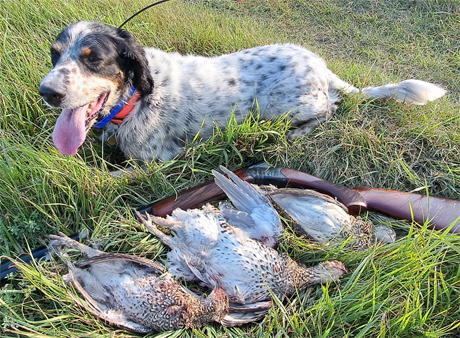
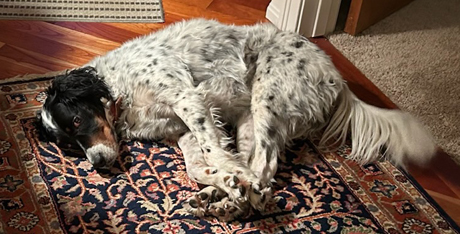
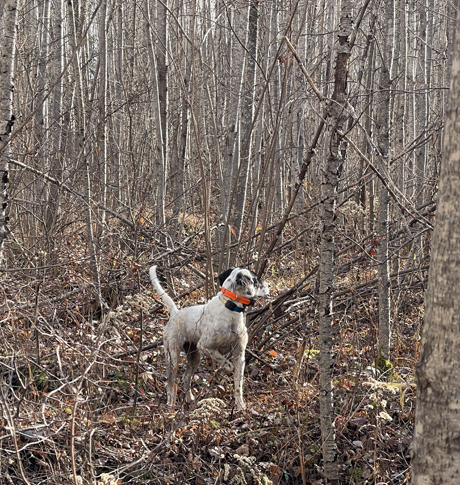
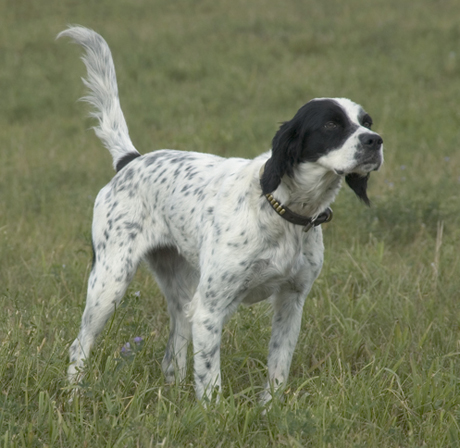
Jerry and Northwoods Vixen (CH Westfall’s Black Ice x Northwoods Prancer, 2011)
A dog lives fifteen years, if you’re lucky. ~ Mary Oliver
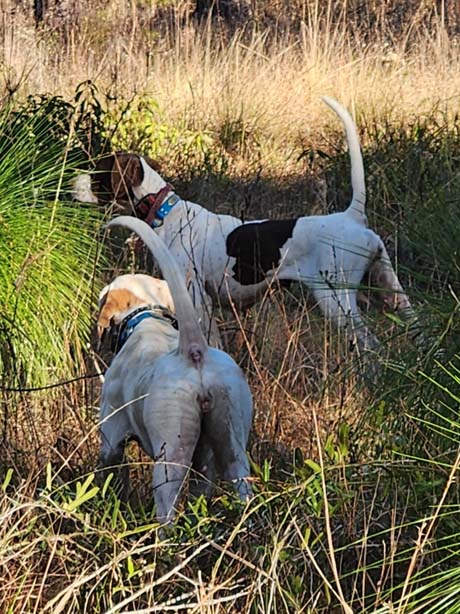
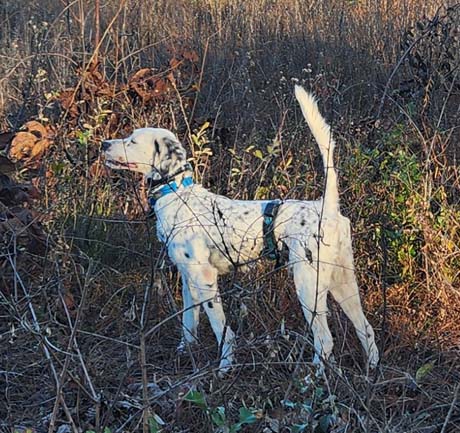
Jerry and I feel lucky. Vixen, the fourth of our reindeer-named pointers, will be 15 years old in a couple weeks. We’ve had many dogs, setters and pointers both, live to be 13 and 14 but Vixen is our first dog to live to age 15.
With age comes particular virtues. Words like wise and noble come to mind. My dictionary defines noble as “exalted in character…grand, stately, and magnificent in appearance.” Noble comes from the Latin nobilis which means knowable.
Noble is the perfect adjective.
We’ve noticed a few outward physical changes. Vixen’s striking orange mask has faded but, interestingly, she’s retained color on her ears. There is eyesight and hearing loss but her personality, brain, heart and nose aren’t noticeably diminished. In the woods and fields, Vixen has lost a bit of style on point but her desire hasn’t waned.
Over cocktails on a recent evening, Jerry and I started thinking about other old Northwoods dogs. A setter female came to mind as the oldest. At 16 years of age, Northwoods Highclass Kate (Northwoods Blue Ox x Houston’s Belle’s Choice) was whelped in 2010.
Northwoods Highclass Kate (Northwoods Blue Ox x Houston’s Belle’s Choice, 2010) ~ Barry and Jill Frieler, Minnesota
Some dogs out of Vixen inherited her longevity. Three female littermates from her breeding to Elhew G Force in 2013 are 13 years of age.
Northwoods Blue Ox was not only the sire of Highclass Kate but, through Kate, those longevity traits were passed to two littermate males that are now 14 years old. Blue Shaquille sired dogs to live to 15 and 14; and he lived to 14 years of age.
Here is a list of old dogs that we know about. We’re certain all owners would agree their dogs are noble. And that they feel lucky.
One 16-year-old setter female Northwoods Highclass Kate (Northwoods Blue Ox x Houston’s Belle’s Choice, 2010) ~ Barry and Jill Frieler, Minnesota
Besides Vixen, a 15-year-old setter male Jeter (Blue Shaquille x Houston’s Belle’s Choice, 2011) ~ Sam and Kate Gary, Colorado
Three 14-year-old setters, two of which are littermates Northwoods Rob Roy (Northwoods Blue Ox x Northwoods Chablis, 2012) ~ Chris Bye and Roberta Scherf, Wisconsin Northwoods So Crisp (Northwoods Blue Ox x Northwoods Chablis, 2012) ~ Brad and Susan Gudenkauf, Minnesota Northwoods White Russian (Blue Shaquille x Snyder’s Liz, 2012) ~ Tim and Tia Esse, Minnesota
Northwoods Rob Roy (Northwoods Blue Ox x Northwoods Chablis, 2012) ~ Chris Bye and Roberta Scherf, Wisconsin “Roy always had the ability to pace himself and as an old dog he finds his pace and keeps at it. He still gets around the woods even if I need to be a bit more selective where I run him.”
Northwoods So Crisp (Northwoods Blue Ox x Northwoods Chablis, 2012) ~ Brad and Susan Gudenkauf, Minnesota “Tana hunted right alongside RIgby this season and I was treated to many honored points by each dog. She will be in the field this October.”
Northwoods White Russian (Blue Shaquille x Snyder’s Liz, 2012) ~ Tim and Tia Esse, Minnesota “Tasha doesn’t waste energy doing young dog stuff. She has had 6 dogs come and go during her time and has gotten along with them all. She does like her solo time on the dog couch.”
13 years old: Three pointer littermates and 2 setter littermates Penny (CH Elhew G Force x Northwoods Vixen, 2013) ~Sam & Kate Gary, Colorado Ginger & Smooch (CH Elhew G Force x Northwoods Vixen, 2013) ~ Wayne Grayson, Mississippi Watson ((CH Houston’s Blackjack x Northwoods Highclass Kate, 2013) ~ Jonathon and Allison Long, Ontario, Canada Jack (CH Houston’s Blackjack x Northwoods Highclass Kate, 2013) ~ Barry and Jill Frieler, Minnesota
~ Penny (CH Elhew G Force x Northwoods Vixen, 2013) Sam & Kate Gary, Colorado
Watson ((CH Houston’s Blackjack x Northwoods Highclass Kate, 2013) ~ Jonathon and Allison Long Family, Ontario, Canada “Watson is a bit slower than he used to be but he’s still surprisingly active for his age. He got out hunting a few days last fall and his nose still works great, even though his eyes aren’t as sharp.”
Jack (CH Houston’s Blackjack x Northwoods Highclass Kate, 2013) ~ Barry and Jill Frieler, Minnesota
The #1 dog on our string is liver-and-white female pointer Northwoods Comet (HOF CH Rock Acre Blackhawk x Northwoods Vixen, 2018). She is backed by another HOF-bred pointer female, Northwoods Confidante (HOF CH True Confidence x Red Sunshine, 2022).
The quarry for Jerry, me and our dogs in southwestern Georgia near Thomasville is bobwhite quail—wild bobwhite quail.
Bobwhites are small birds that weigh only 6 ounces. They live in flocks, or coveys, of about 15 birds. For protection from both predators and hunters, bobwhites form a circle with tails pointing toward the center and heads facing out.
A particular, thrilling aspect of a bobwhite quail hunt is when a covey flushes, commonly called a rise. As David Allen Sibley explains in The Sibley Guide to Birds, coveys “flush all together at close range in an explosion of noisy wingbeats.” The rise happens fast and the birds scatter even faster.
A bird dog on point doesn’t get much prettier than Northwoods Snow Bunny (CH Ponderosa Mac x Northwoods Redbreast, 2022).
This marks the twelfth season that Jerry and I have lived in this region of Georgia. While we train a few dogs from clients, now we mostly train, develop and condition our own dogs.
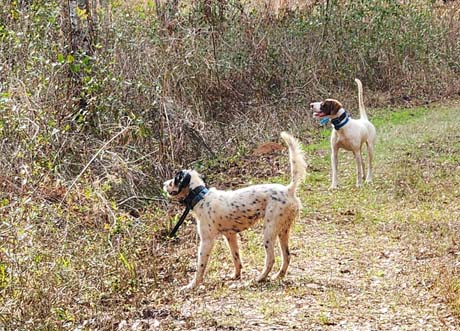
Two males, Northwoods Eddie Setter (CH / RU-CH Northwoods Sir Gordon x Northwoods Valencia, 2023), in front, and Northwoods Rudolph (CH Southern Confidence x Northwoods Comet, 2023), stopped within feet of each to back another dog on point.
During the quail season, though, we work for our client who leases four-day hunts on an 11,000-acre plantation in northern Florida. The day’s schedule is dependent on weather but generally six braces of dogs are run—three in the morning and three in the afternoon. Jerry handles our dogs and an employee from the plantation handles theirs. While our string includes half pointers and half setters, 90% of the plantation’s dogs are pointers.
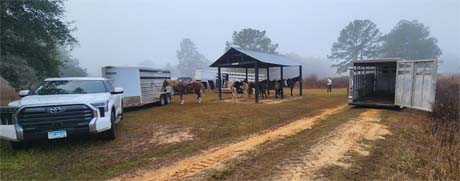
On a foggy morning in January, dog handlers meet to saddle their own horses and horses for the guests and otherwise prepare for the morning hunt.
These hunts adhere to traditions handed down through many generations of hunters. Handlers and hunters ride Tennessee walking horses and an open, customized Jeep carries dogs not being run. In addition, a pair of cocker spaniels are on board for retrieving birds.
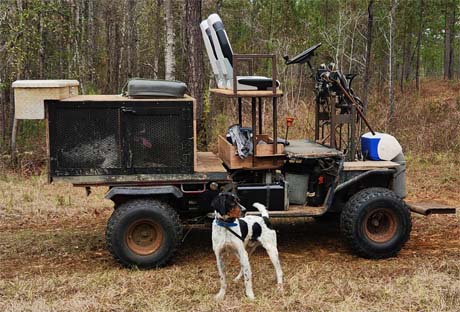
Hunts conducted on the plantation where we live are conducted off a pair of very cool, customized 30-year-old Kawasaki mules. Before the breakaway, dogs are clipped to the mule while those awaiting their turn to hunt ride in the roomy spaces under the rear bench seat.
We also handle our dogs on hunts on the plantation where we live. The owner of the plantation and her family and guests eschew horses and instead drive 30-year-old modified Kawasaki mules. A number of their dogs are brought along including, among others, Labrador retrievers and a springer spaniel.
Intensity and style on point aren’t trainable attributes. Eyes blazing and ear flipped back, Northwoods Snow Queen (RU-CH Northwoods Atlas x Houston’s Nelly Bly, 2023) points a huge covey of wild bobwhite quail.
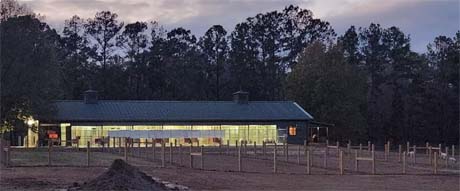
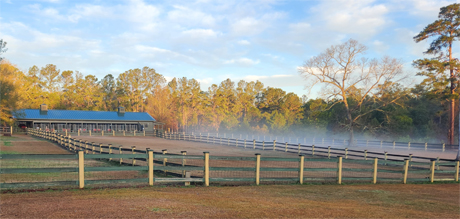
Our main kennel building is a nicely renovated horse barn. Four large, fenced-in exercise pens are easily accessible from the kennel runs.
Running a late afternoon brace of puppies is one of our favorite things to do. Our main goal is exposure to birds—lots of birds. Northwoods Cassiopeia (Cold Creek Hank x Northwoods Stardust, 2025) has the find and Northwoods Something Royal (CH Confident Nation x Northwoods Comet, 2025) naturally backs.
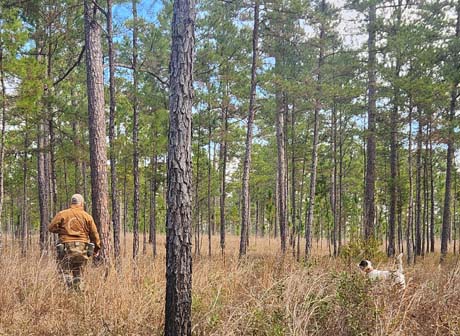
Under the classic canopy of longleaf and loblolly pines, Greg Johnson flushes for his derby Northwoods Rip Roy (CH Woodville’s Yukon Cornelius x Northwoods Redbreast, 2024).
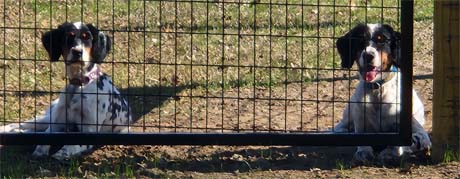
Northwoods Four Roses (CH Rufus Del Fuego x Northwoods Valencia, 2021), on right, and her daughter, Andromeda, by Northwoods Homer relax by the gate in an exercise pen.
Sage (CH Miller’s Upgraded Version x Northwoods Comet, 2024), on left, and her half-sister Juniper (HOF CH True Confidence x Northwoods Comet, 2021) ~ Joey Paxman and Amanda Allpress, Montana
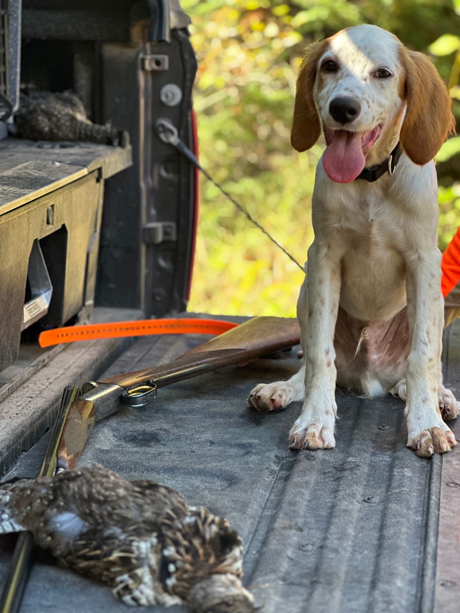
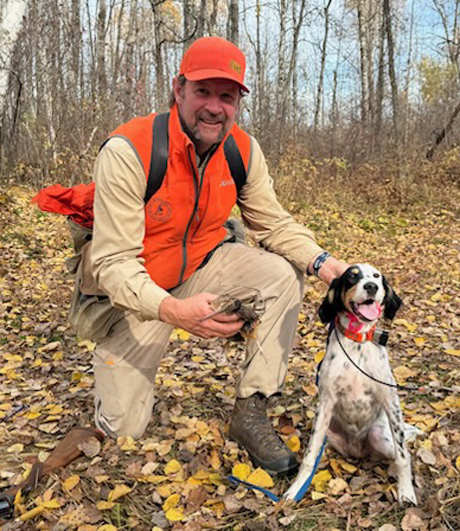
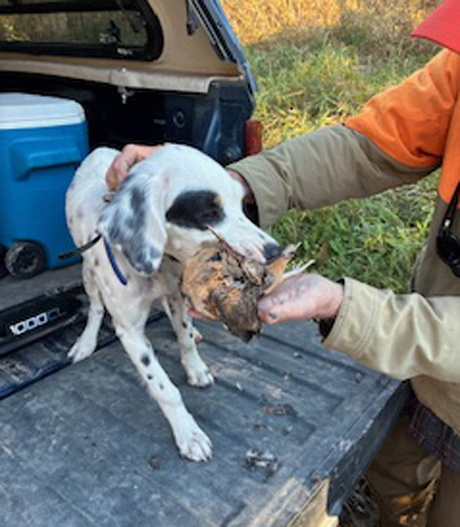
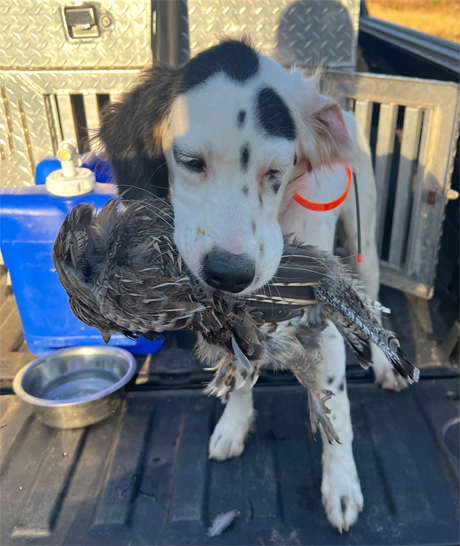
By the dozens, Northwoods Bird Dogs have recently been afield across the country. No matter the age of the dog—whether young puppies whelped this year or experienced older dogs—many birds were pointed, retrieved and bagged. The photographs below are filled with blaze orange, big smiles and tired dogs.
Filly (May’s Pond Hank x Northwoods Stardust, 2024) ~ Tom and Lauren Strand Family, Minnesota
Rip (Northwoods Louis Vuitton x Houston’s Dancing Queen, 2022) ~ Mark FItchett, Kansas
Nelly, on left, and her littermate, Jones (CH Northwoods Sir Gordon x Northwoods Valencia, 2022) ~ Gregg and Sherrie Knapp Family, Wisconsin ~ Chris and Laura Miller, Illinois
Sweep (CH Northwoods Sir Gordon x Northwoods Valencia, 2023) ~ Tim Esse, Minnesota
Annie (CH Rufus del Fuego x Northwoods Valencia, 2021) ~ Chip Sligh Family, Georgia
Ruby (CH Confident Nation x Northwoods Comet, 2025) ~ Frank Ilijanic, Michigan
Sky (Northwoods Homer x Northwoods Four Roses, 2025) ~ Tom and Ashton McPherson, Pennsylvania
Will (Northwoods Homer x Northwoods Four Roses, 2025) ~ Chris and Mary Dombrowski Family, Montana
Finn (Northwoods Homer x Northwoods Four Roses, 2025) ~ Joe and Britta Parpala Family, Minnesota
Poppy (Cold Creek Hank x Northwoods Stardust, 2025) ~ Chris Bye and Roberta Scherf, Wisconsin
Smoke (Cold Creek Hank x Northwoods Stardust, 2025) ~ Mike Watson, Pennsylvania
Mace (Cold Creek Hank x Northwoods Stardust, 2025) ~ Marc Austof Family, Michigan
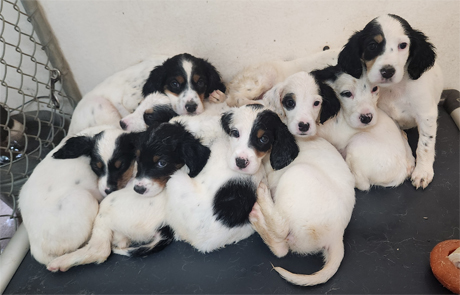
At six weeks of age, the nine puppies out of Northwoods Stardust by Cold Creed Hank still sleep in a pile.
Of the chores Jerry and I do around the kennel, some are fun and some are not so fun. In the latter category are the daily hosing of the kennel runs (Jerry) and cleaning up the play yard with a little rake and shovel (me).
However, we agree unequivocally that the most enjoyable chores involve puppies.
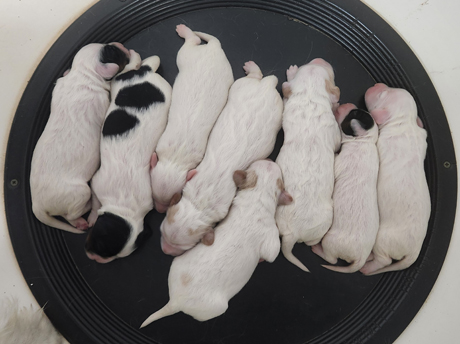
Four-day-old puppies out of Northwoods Four Roses by Northwoods Homer cuddle while they sleep on the heated nest.
We got a huge dose of it this spring. Comet, Stardust and Four Roses came into season within a couple weeks of each other. They were each bred and then nine weeks later whelped their litters on May 2, May 13 and May 17, respectively.
The total was 20 puppies—3 pointers and 17 setters.
Since there were only three puppies out of CH Confident Nation x Northwoods Comet and they got plenty of food, they were always substantially larger than than the other two litters.
Even though it’s our business and, as previously mentioned lots of “enjoyable” work, there is another dimension to puppy chores. Every day for eight weeks, we watch them, care for them, play with them and get to know each one individually. From the very first day when each weighs less than one pound and are totally helpless until they have grown and developed into little dogs, we watch them.
Puppies out of Northwoods Homer x Northwoods Four Roses are eight weeks old and ready to go to their new homes.
Then, in a bittersweet blink, the puppies are eight weeks old and we send them off into the world. Excited new owners drove or flew from all over the country—New York, New Jersey, Maryland, Pennsylvania, Ohio, Michigan, Illinois, Wisconsin, Minnesota, Texas and Montana—to pick up their puppy.
As each puppy left with their owner, we said, a la Gandalf, “Fare well!”
Caddie (CH Southern Confidence x Northwoods Comet, 2023) and Brian Smith, her owner.
What’s a bird dog to do when the hunting season has long passed and any spring work is also over?
Caddie (CH Southern Confidence x Northwoods Comet, 2023), on left, and Lacey (CH Elhew G Force x Northwoods Vixen, 2016) ~ Brian Smith, Pennsylvania
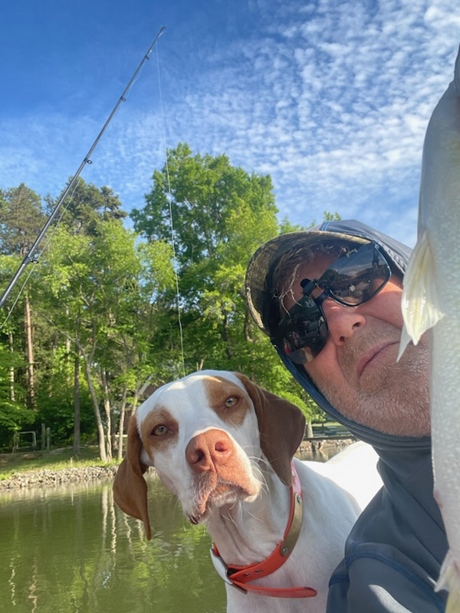
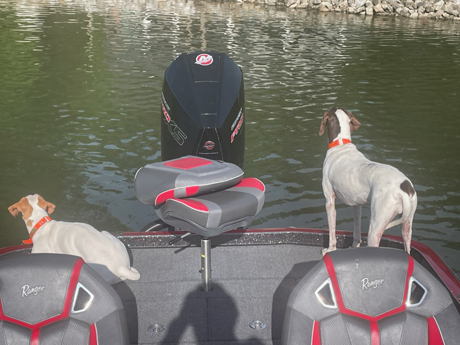
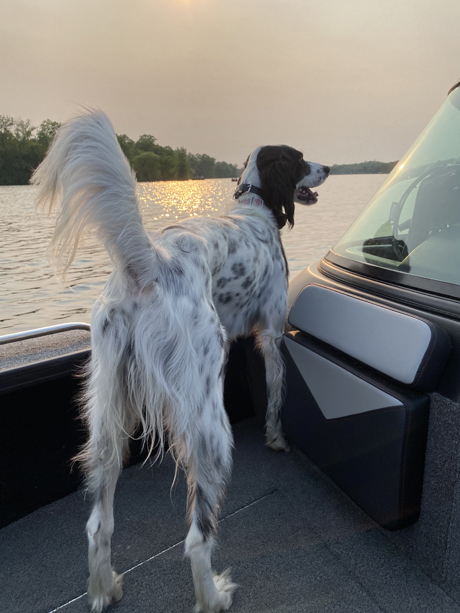
Whether setter or pointer, some lucky Northwoods dogs are invited onto their owners’ boats. Two pointer females from Pennsylvania assisted their owner on a fishing trip. One setter watched her champion skier practice on a Georgia lake.
Annie (CH Rufus del Fuego x Northwoods Valencia, 2021) ~ The Sligh Family, Georgia
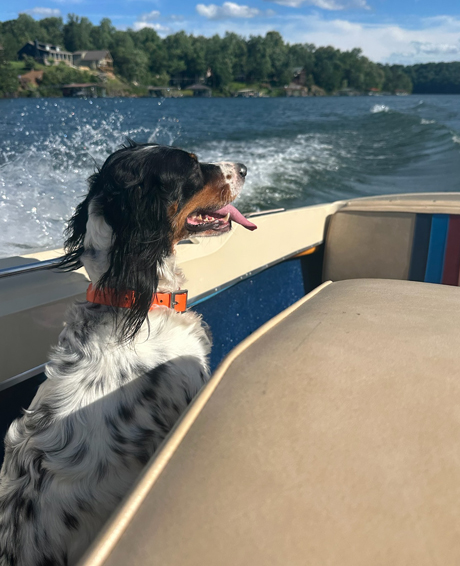
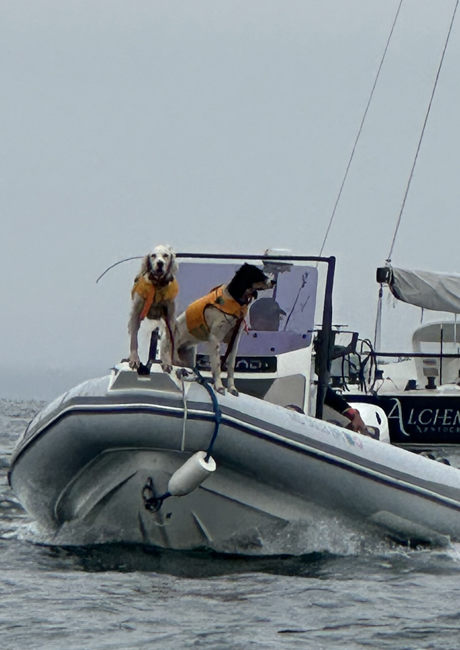
In the Atlantic Ocean off Nantucket, two setter females, experienced on sailboats and Zodiacs, rode in the bow. One setter simply enjoyed an afternoon cruise on a lake in Minnesota.
Lacey (Northwoods Grits x Northwoods Minerva, 2020), on left, and Maisy ( RU-CH Northwoods Atlas x Houston’s Nelly Bly, 2023) ~ Zenas and Susanne Hutcheson, Massachusetts
Tally (May’s Pond Hank x Northwoods Stardust, 2024) ~ Joe and Deb Wech, Minnesota
On a cold, cloudy day in late March, Jerry and I took our one-year-old female setter Dilly (CH Woodville’s Yukon Cornelius x Northwoods Redbreast, 2024) to a nice woodcock spot of young aspen and sparse undergrowth.
Dilly was exuberant—whether due to her age or the conditions or both—but we knew she was hunting. We were all rewarded when, within about 20 minutes, we found Dilly on point.
The woodcock were back.
For many upland hunters and dog owners, the return of the woodcock is an important part of the natural rhythm of things. It confirms the seasonal shift from winter to spring.
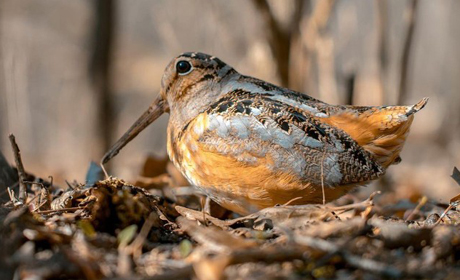
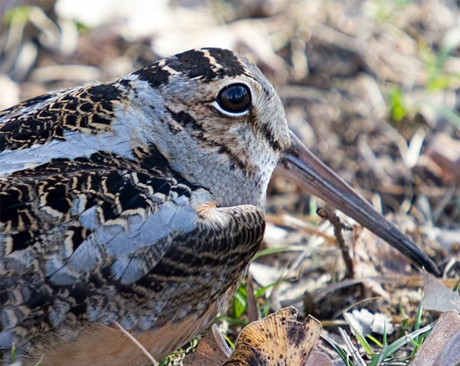
And how can one not be excited about that return? How can one not be enchanted by woodcock and delight in their oddities? There aren’t many birds that have a cuter, rounder body or a longer beak. Breast meat is dark and leg meat is white. A woodcock’s brain is, basically, upside down. Ears are placed under its eyes, which are situated far back on its head.
And those eyes! In “Making Game: An Essay on Woodcock,” Guy De La Valdene writes that a woodcock’s eyes are “black and limpid, not eyes to dwell on if one intends to keep hunting.”
Taxonomy The scientific name of the American woodcock is Scolopax minor. It is the only upland bird in the large Scolopacidae family, a major shorebird family. Other members include sandpipers, curlews, godwits, dowitchers and snipe.
Besides the American woodcock, there are seven other members of the Scolopax genus. Eurasion woodcock, S. rusticola, is native across Europe and Asia from Ireland to Japan. There are six other species, each native to their own small island.
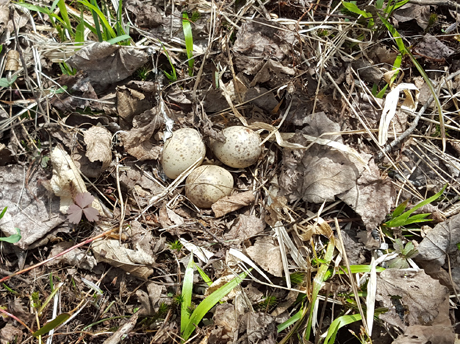
Woodcock nest
All family members are ground nesters and usually the nest is just a scrape. It might not seem like ample protection but the camouflage is ideal. Generally, 2-4 eggs are laid and are colored and spotted to blend in. At birth, precocial young are covered with down and, with the help of a parent, are mobile enough to leave the nest within hours.
Evolution Birds date to the Cretaceous period (135 – 66 million years ago) of the Mesozoic era, a.k.a., the age of dinosaurs. Birds with beaks survived the asteroid-induced mass extinction at the end of that period most likely because they could eat plants.
The first woodcock fossil discovery was from about 20 million years ago. When the glaciers began retreating during the later Pleistocene epoch of the Cenozoic era (about 20,000 – 30,000 years ago), woodcock followed. They ended up in their current locales at the end of that retreat.
Range and Habitat The woodcock population in the U.S. is divided into two major groups: Eastern (from the Appalachian Mountains to the east) and Central (west of the Appalachians to western edge of the Minnesota/Iowa/Missouri borders). The Eastern birds generally migrate along the Atlantic coast and the Central population usually follows the Mississippi River.
Woodcock like successional deciduous forests where there is rich soil. In addition, they need open areas–fields, grasslands or forest clearings–and shrubby areas.
Woodcock roost, forage and practice their mating ritual—the sky dance—in open areas. They move to the cover of a forest during the day to forage and to avoid predation.
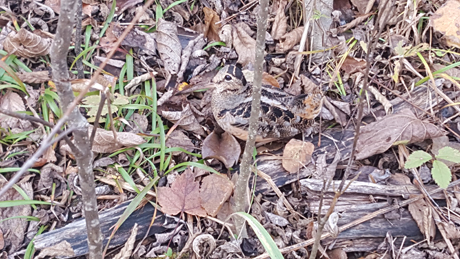
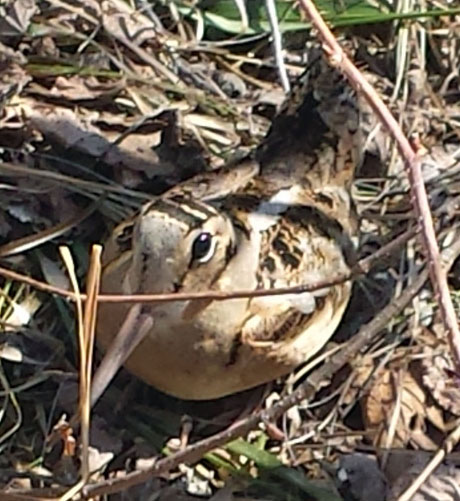
Excellent camouflage
Avoiding predation A woodcock’s prime methods of predator evasion are freezing and camouflage. Countless times while training young dogs, Jerry and I would stop to listen for the bell of the errant dog. Within about a minute and usually no more than 15 feet away, a woodcock flushed, thinking we had moved on.
A woodcock’s approximately 1,000 feathers are flawlessly arranged in various patterns that perfectly mimic the accumulated detritus of the forest floor. The colors of those feathers, as described in De La Valdene’s book, include “cream, cinnamon, ochre, black, burnt umber, raw sienna, brown and auburn” and five shades of gray.
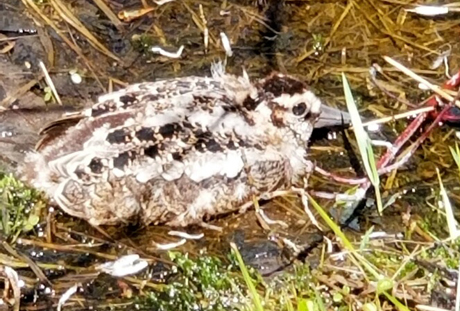
Woodcock chick
Fun facts about food, nesting and migration • Males and females have similar feather arrangement and colors. Females, called hens, are a little larger and have slightly longer wings and bills. • Woodcock are solitary birds and except when breeding or rearing chicks spend their days alone. • Woodcock eat worms…lots of worms. Estimates vary but somewhere between 60-90% of their diet is worms, which are high in protein, fat and water. Other foods include insects, grubs and larvae. • When walking through the woods, woodcock bob and rock back and forth and look, somewhat, like they’re dancing the two-step. One theory is they are causing vibrations in the soil which can cause worms to come to the surface. • In addition to peents and chirps of the sky dance, males cackle to warn off other males. A whistle noise is made by their fast-beating wings, such as when they flush. • Snow and heavy rains during nesting can be detrimental. • When woodcock eggs hatch, the eggs are split lengthwise. • Hens will use the “broken wing” trick to lure predators away from their nests. • Woodcock take it easy when they migrate. In general, they’re not rushing either north or south and often are the last bird to migrate in the fall. • Snowstorms, thunderstorms and strong winds impact migration. Woodcock will simply wait for the weather to improve before continuing.
Spring woodcock
Saving the best for last: The Sky Dance Most male members of the Scolopacidae family have some sort of aerial display for breeding. Woodcock are renowned for their ritual, nicknamed the “sky dance.” I’ve heard it many times and in many spring seasons around our house and kennel.
Aldo Leopold exquisitely describes it in “A Sound County Almanac.”
“He flies in low from some neighboring thicket, alights on the bare moss, and at once begins the overture: a series of queer throating ‘peents’ spaced about two seconds apart, and sounding much like the summer call of the nighthawk.
“Suddenly, the peenting ceases and the bird flutters skyward in a series of wide spirals, emitting a musical twitter. Up and up he goes, the spirals steeper and smaller, the twittering louder and louder, until the performer is only a speck in the sky. Then, without warning, he tumbles like a crippled plane, giving voice in a soft liquid warble that a March bluebird might envy. At a few feet from the ground he levels off and returns to his peenting ground, usually to the exact spot where the performance began, and there resumes his peenting.”
On a find in the middle of a block, Northwoods Confidante (HOF CH True Confidence x Red Sunshine, 2022), call name Sophie, oozes confidence and style. Photo by Ben McKean.
Jerry and I have reached the age when many of our siblings, friends and clients are retired. Some head off to winter places in Florida, California and other warmer regions with a couple pieces of luggage and few responsibilities.
Not so for us.
While we do head south, we haven’t retired. Our destination isn’t sandy beaches or country clubs. Instead, our vehicles and a horse trailer are stuffed with dogs, training equipment, horse tack, office supplies and all sorts of boots, jackets and hats. We spend the winter training dogs and otherwise taking care of our business.
A decade ago, Jerry and I discovered a small corner of southwestern Georgia. It has a perfect climate, park-like woods to train our dogs and Thomasville, a nearby, charming small town complete with a brick main street, bird dog/hunting vibe and wonderful restaurant and shopping choices. There’s even a health club with a 6-lane, 30-meter, outdoor swimming pool.
But what primarily drew us to this region were wild birds. Beginning in the late 1800s, dozens of vast plantations were established which were devoted exclusively to wild bobwhite quail. Even though ownership and boundaries of many plantations have changed, quail management and hunting traditions remain strong.
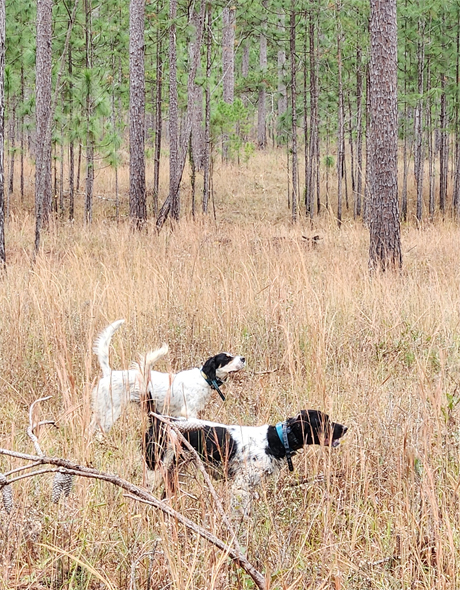
Two-year pointer male Northwoods Rudolph (CH Southern Confidence x Northwoods Comet, 2023, call name Rudy, points on a chopper trail amidst statuesque loblolly pines. Photo by Ben McKean.
Other reasons keep us going back. The majestic overstory of the woods are native longleaf and loblolly pines. The undergrowth, perfect quail habitat, is managed through periodic fires. Buildings—whether houses, horse barns or dog kennels—are landscaped with massive live oaks, dogwoods, redbuds, magnolias, azaleas and camellias.
These trees and shrubs are home to a large, noisy collection of songbirds. A favorite is the native, tiny brown-headed nuthatch that walks up, down and around the pine trunks and branches.
On a chilly morning, mist rises from a small lake bordering the kennels and exercise pens.
All these inducements aside, though, the bobwhite quail are the true magnets. From the first, we fell for their cute size, their calls, incredible camouflaged feathering and covey habits. Most thrilling is the sound of a covey rise when 10-20 birds flush.
Please enjoy the video below of our favorite sound in southwestern Georgia. It was edited during our 2020 winter. Also below are more photographs.
The woods were dry this winter but muddy ponds and puddles were still handy. Layla (RU-CH Northwoods Atlas x Houston’s Nelly Bly, 2023) is normally a beautiful tricolor female with a white body. Photo by Ben McKean.
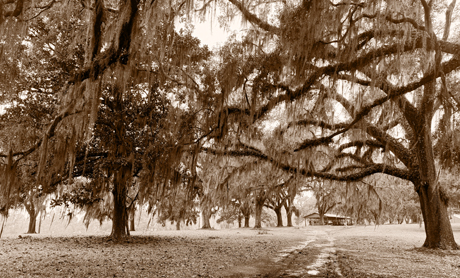
A tunnel of live oaks, draped with native Spanish moss, leads toward a horse barn. Photo by Ben McKean.
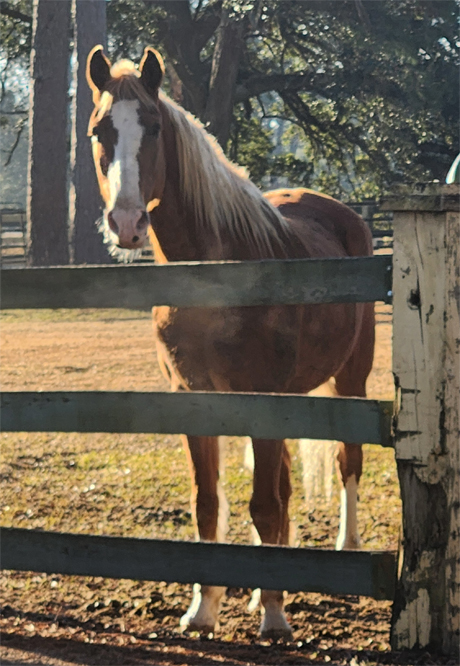
The tradition of training bird dogs and hunting quail off horseback dates to the origin of quail plantations. Blaze, a 16-hands-high Tennessee walking horse, greets us at the corner of his paddock.
Jerry usually trains a brace of dogs and often pairs a young dog with an experienced one. Northwoods Stardust (RU-CH Erin’s Prometheus x Northwoods Carly Simon, 2019), call name Dusty, and Northwoods Snowswept (CH/RU-CH Northwoods Sir Gordon x Northwoods Valencia, 2023), call name Sweep, share point.
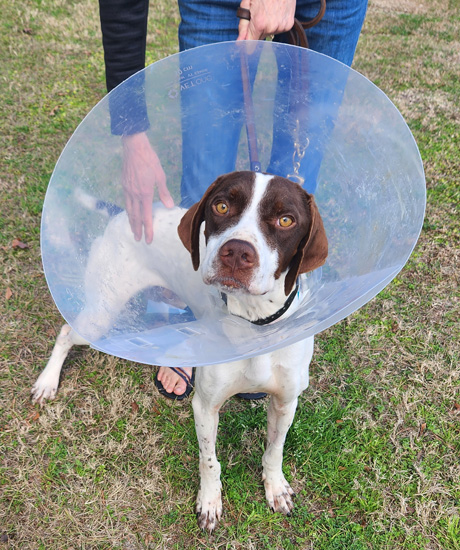
Northwoods Rudolph (CH Southern Confidence x Northwoods Comet, 2023), a.k.a., Rudy, a.k.a., Goober, is recovering from serious abdominal surgery.
Be an advocate for your dog.
Jerry and I needed this advice recently as we struggled with a serious injury with Rudy, our big, handsome, two-year-old pointer male.
Not all veterinarians are created equal. As in any other profession, they range from outstanding to poor—whether considering knowledge, experience, competence, concern or care–and also considering equipment, staff and other resources.
We weren’t satisfied with Rudy’s care at the vet clinic that initially did the surgery and aftercare. On his behalf, we decided we needed to do something last week. We removed him from that clinic and then drove him—in his very ill, weakened state—to another clinic.
It was a bold move for us—and one that wasn’t entirely comfortable. But since we were convinced that Rudy was quickly digressing and could have died at the first clinic, the decision was straightforward.
We’re happy to report that Rudy had a second surgery and expert care at the new clinic. He is now home and on the path to a full recovery.
Be an advocate for your dog. It could save a life.
Piper (CH/RU-CH Northwoods Sir Gordon x Houston’s Nelly Bly, 2021) is owned by the Tom McPherson family of Pennsylvania.
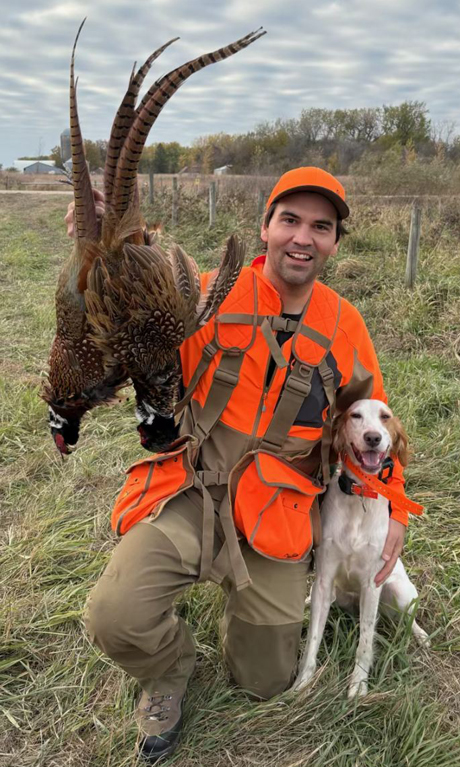
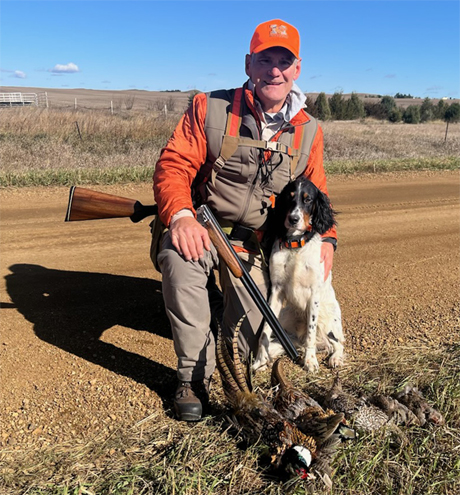
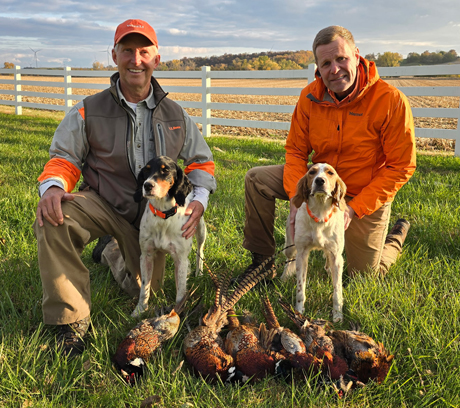
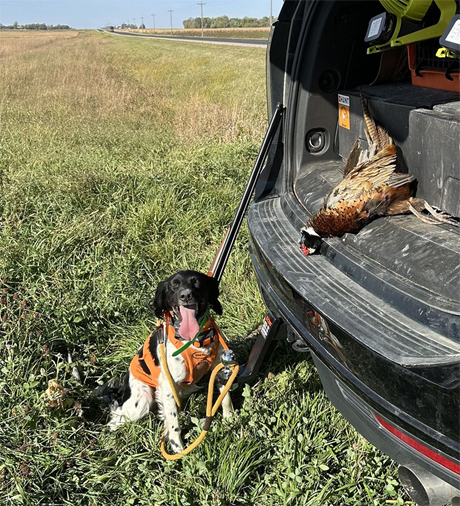
Autumn is a hunter’s favorite season of the year. It’s also when Jerry and I hear from happy dog owners around the country. They head out with their dogs as often as they can—sometimes with friends and family and other times by themselves with just one dog. They hunt as long as they can—from early season when foliage is still lush until the snow falls.
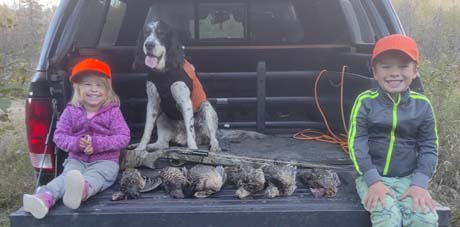
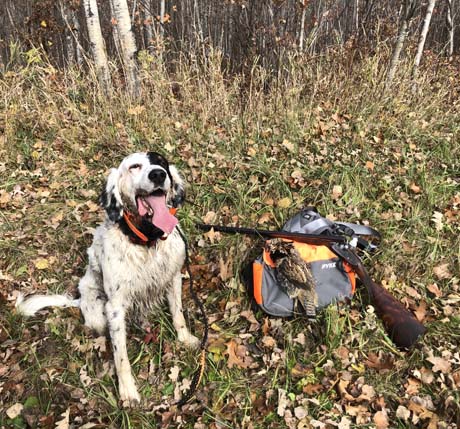
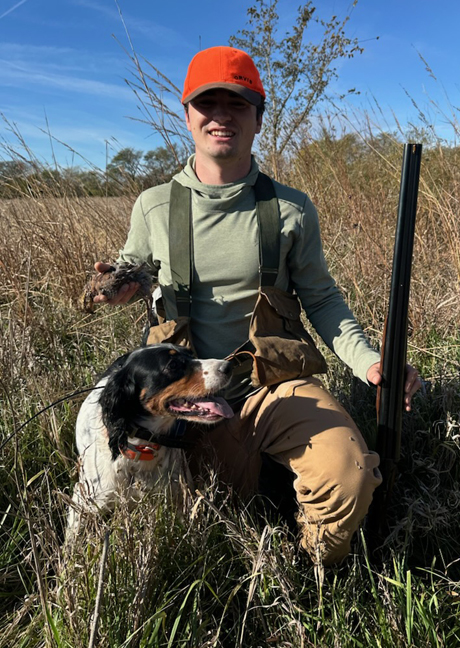
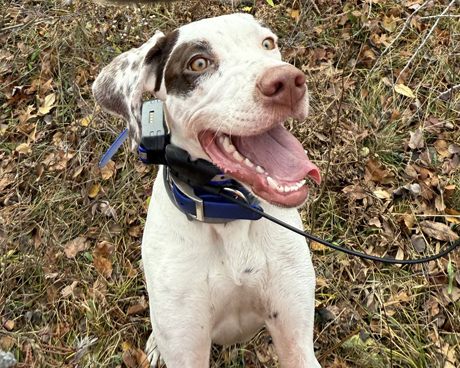
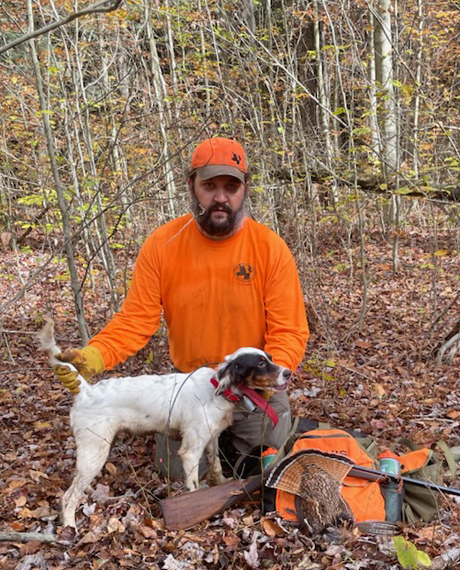
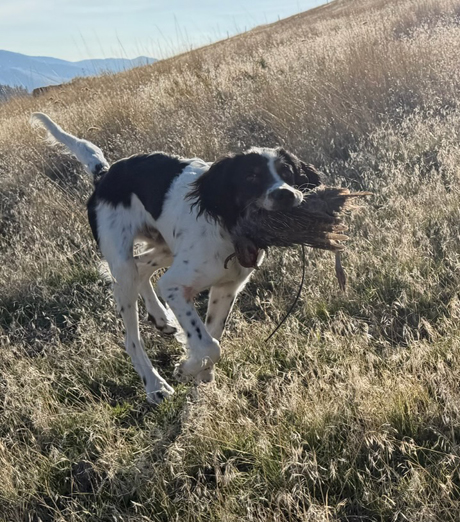
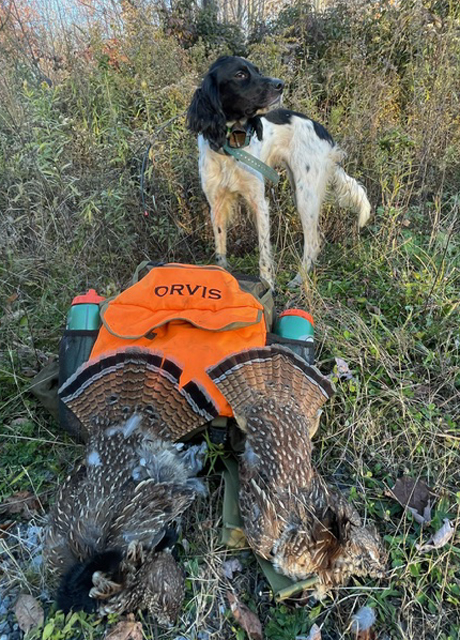
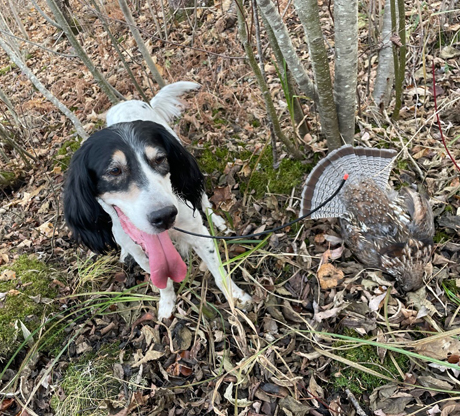
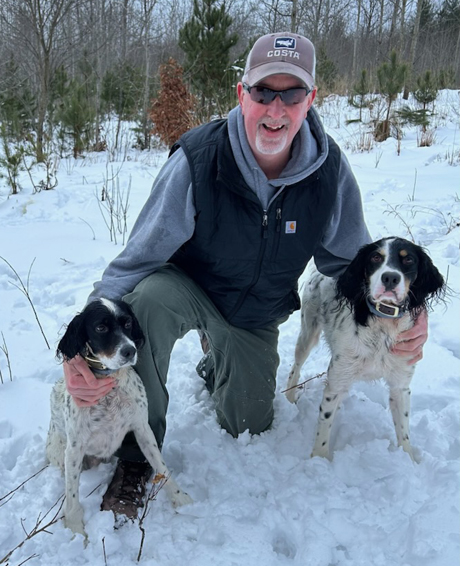
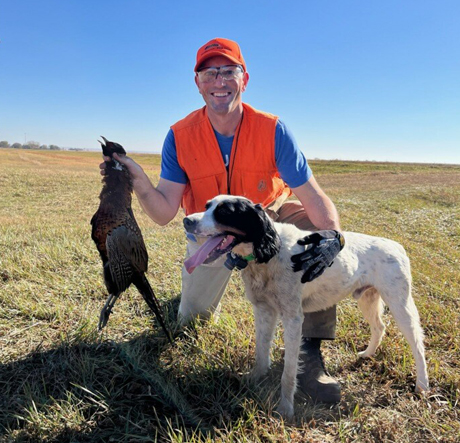
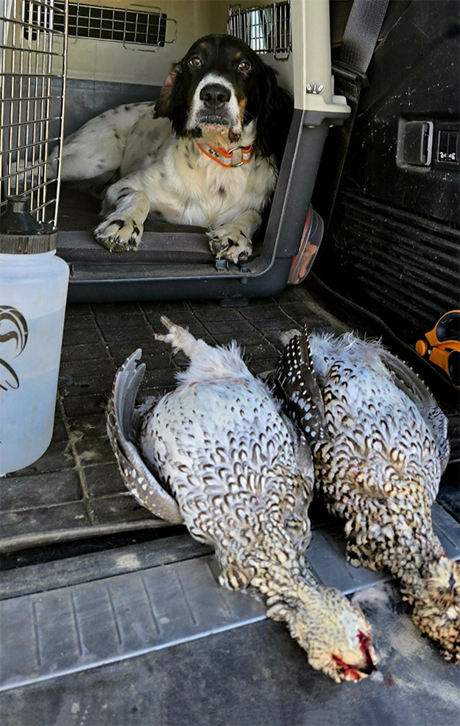
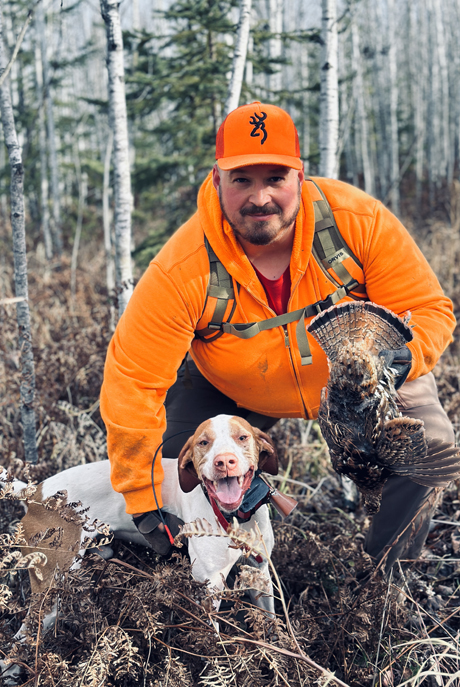
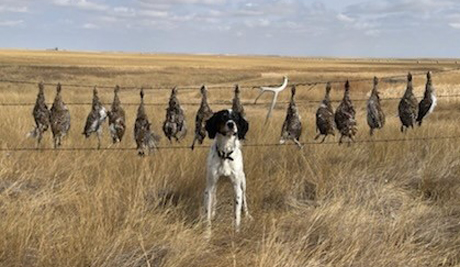
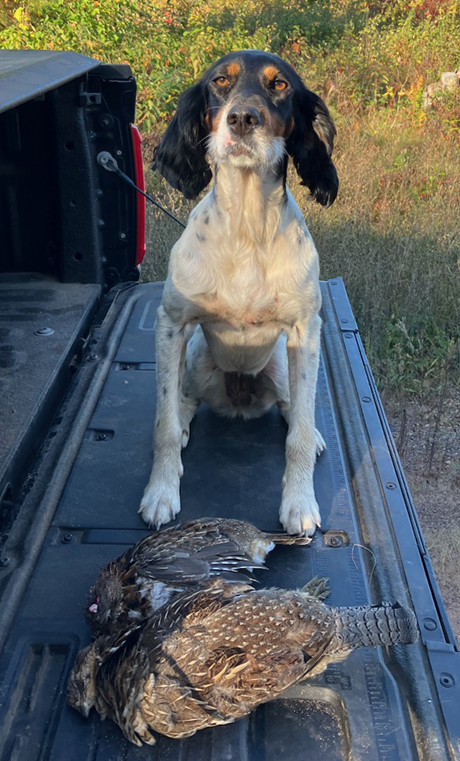
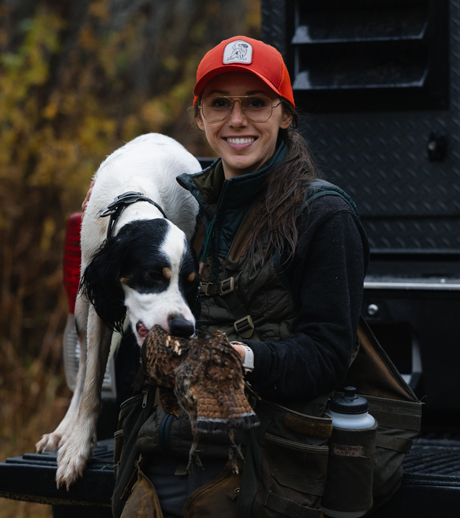
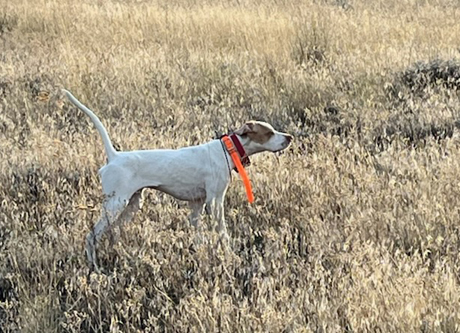
Here are photos from some of those hunts. The locations vary from West Virginia and Pennsylvania, to the Lake States, Dakotas and mountains. The birds vary, too, including that most difficult of birds—the ruffed grouse—to woodcock, pheasants, sharp-tailed grouse, chukars, and to perhaps the prettiest of them all, the Hungarian partridge.
What’s especially gratifying is that no matter how old the dogs are and even if their eyebrows are turning gray, they still love to hunt. The ages of dogs in the photos range from six months to 12 years of age.
Many thanks to our dog owners for sharing the photographs. They are arranged in chronological order of the whelp date—from the eldest to the youngest.
Tana (Northwoods Blue Ox x Northwoods Chablis, 2012) is owned by the Brad Gudenkauf family of Minnesota.
Valencia (Northwoods Grits x Northwoods Carbon, 2017), on left, and Tasha (Blue Shaquille x Snyder’s Liz, 2012) are owned by Tim and Tia Esse of Minnesota.
Finn (Northwoods Blue Ox x Northwoods Chablis, 2014) is owned by the Todd Wiedmann family of Minnesota.
Jenny (CH Shadow Oak Bo x Northwoods Carbon, 2016) is owned by John and Jeri Cleverdon of Michigan.
Rae (Sunny Hill Sam x Northwoods Carly Simon, 2016) is owned by the Gregg Knapp family of Wisconsin.
Luna (RU-CH Northwoods Nirvana x Northwoods Carbon, 2017), on left, and Pep (RU-CH Northwoods Atlas x Houston’s Nelly Bly, 2023) are owned by the Mike McCrary family of Michigan.
Oz (Northwoods Grits x Northwoods Carbon, 2017) is owned by the Ryan Gould family of Minnesota.
Earl (Northwoods Rolls Royce x Northwoods Valencia, 2020) is owned by Craig and Karen Purse of Wisconsin.
Rickey (HOF CH True Confidence x Northwoods Comet, 2021) is owned by the Jake Beveridge family of Minnesota.
Boone (CH Rufus Del Fuego x Northwoods Valencia, 2021) is owned by the Brady Miele family of Minnesota.
Char (Northwoods Louis Vuitton x Houston’s Dancing Queen, 2022) is owned by Stu McIntosh of Wisconsin.
Brego (RU-CH Northwoods Atlas x Houston’s Nelly Bly, 2023) is owned by Amanda and Sam Ballengee of West Virginia.
Racer (CH Miller’s Upgraded Version x Northwoods Comet, 2024) is owned by Doug and Nicole White of Oregon.
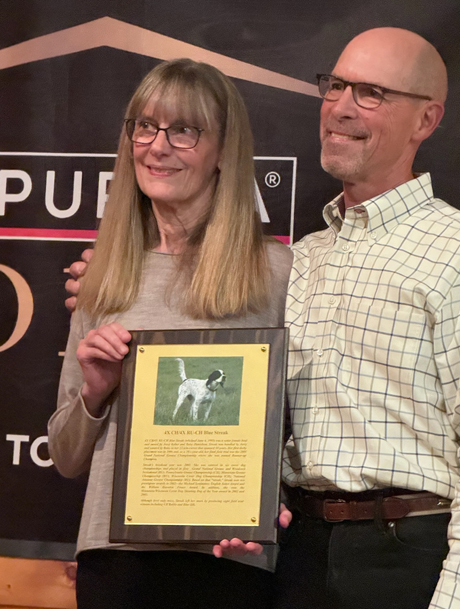
At the banquet preceding the 82nd running of The Grand National Grouse Championship held in early November in the Eau Claire County Forest near Eau Claire, Wis., our 4X CH/4X RU-CH Blue Streak was named this year’s Legends of Coverdog.
Legends of Coverdog is a special award given by The Grand to dogs “that have had a profound impact on the sport of coverdog field trials.” Streak joins only six other bird dogs to earn this award. Jerry and I were shown a commemorative plaque that will be hung in the National Bird Dog Museum in Grand Junction, Tenn.
It was an evening we’ll never forget. We were, at once, honored, thrilled and humbled for Streak to have achieved such distinction.
Blue Streak (Spring Garden Tollway x Finder’s Keeper, 1995) was a setter female Jerry and I bred and owned her entire life. We called her Little because she was the smallest in her litter. But apart from her 36-lb. frame, everything else about her was big—her heart, her drive, her fire and her bird finding.
“She is independent, adaptable and has bottomless guts. What great qualities!” ~Craig Peters, reporter, 2001 Pennsylvania Grouse Championship
Streak’s 22-win career spanned 10 years. She was handled by Jerry and scouted by me. Her first derby placement was in 1996 and, as a 10½-year-old, her final field trial was the 2005 Grand National Grouse Championship where she was named Runner-up Champion.
“Her considerable effort, featuring a pair of good grouse finds added to by a woodcock find, stood up for the runner-up position despite the challenge of 80 other contenders.” ~Dave A. Fletcher and Ryan Frame, reporters, 2005 Grand National Grouse Championship
Streak’s breakout year was 2001. She was entered in six cover dog championships and placed in five: Grand National Grouse and Woodcock Invitational (RU); Pennsylvania Grouse Championship (CH); Minnesota Grouse Championship (RU); Wisconsin Cover Dog Championship (CH); National Amateur Grouse Championship (RU).
Based on that “streak,” Streak won two prestigious awards in 2002: the Michael Seminatore English Setter Award and the William Harnden Foster Award. In addition, she won the Minnesota/Wisconsin Cover Dog Shooting Dog of the Year award in 2002 and 2003.
“Streak finished this brace to the front and hauling the mail. It is seldom that I witness an hour I will never forget, but this will be one that is stamped in my memory. Fantastic!” ~Steve Studer, reporter, 2002 Minnesota Grouse Dog Championship
Although bred only twice, Streak left her mark by producing eight field trial winners including CH Bobby Blue and Blue Silk. Blue Silk won the 2001 Minnesota/Wisconsin Cover Dog Derby of the Year and produced winners CH I’m Blue Gert and CH Satin From Silk.
Of prime significance, Blue Silk’s sons, Blue Shaquille and NorthwoodsBlue Ox, are foundation sires for our setter breeding program. Through these grandsons, Blue Streak’s legacy continues in 5X CH/5X RU-CH NorthwoodsCharles, CH/RU-CH Erin’s Three Leaf Shamrock, CH/RU-CH NorthwoodsSir Gordon, RU-CH Northwoods Atlas, CH/RU-CH Northwoods Cedar, RU-CH Northwoods Nirvana and RU-CH Cody’s Sadie Bell.
“In her hour, Blue Streak showed us bird savvy, style, race, endurance and excellent manners.” ~Brett Edstrom, reporter, 1999 Region 19 Amateur Shooting Dog Championship
“She had two grouse finds, four woodcock and a back. Combined with a strong, forward easy handling race, it truly was a championship performance.” ~Rod Lein, reporter, 2001 Wisconsin Cover Dog Championship
A personal note from Jerry: Blue Streak challenged me more than any dog before or since. Her tremendous desire to hunt game—whether feathers or fur—along with her endless stamina would sometimes get the best of her. In the days before GPS tracking, this led to her spending a night or two alone in the woods! Streak gave me the highest highs and the lowest lows, but she also taught me important lessons. If you believe in your dog, forge a bond and put in the effort, you can go farther than you ever imagined. In fact, it can change your life.
From Betsy: From the beginning, Little was destined. I remember our first puppy walk with her. Instinctively, right out of the dog topper, Little was off. She charged into the woods, independent but hunting, and she didn’t want to stop. A lifetime of memories also come to mind but my final time with her was especially poignant. More than ten years later when Little had serious lung complications, I stayed up with her all night as she struggled to breathe. Her big heart simply would not quit.