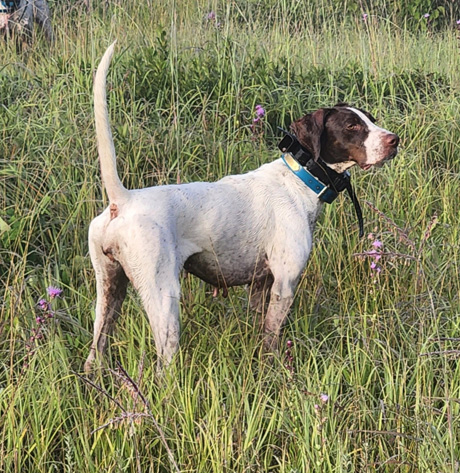
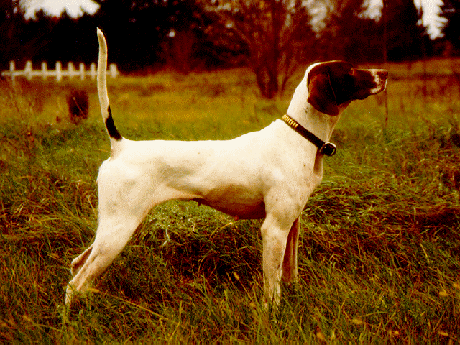
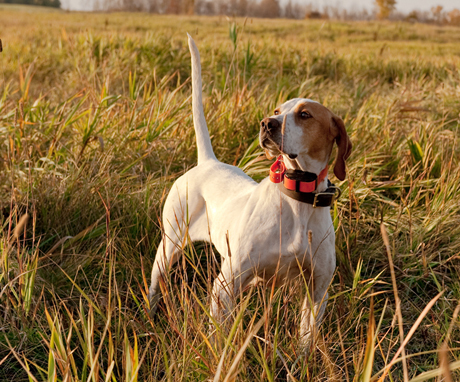
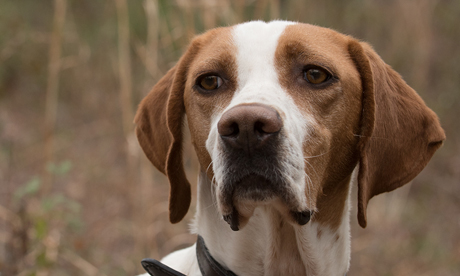
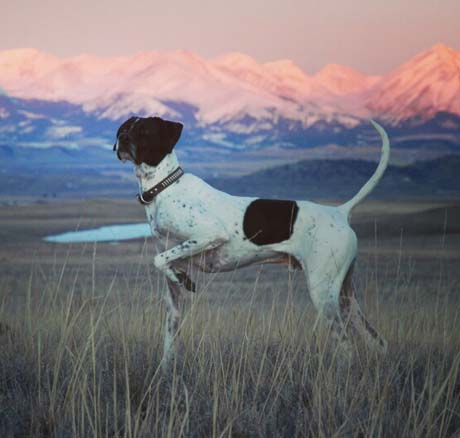
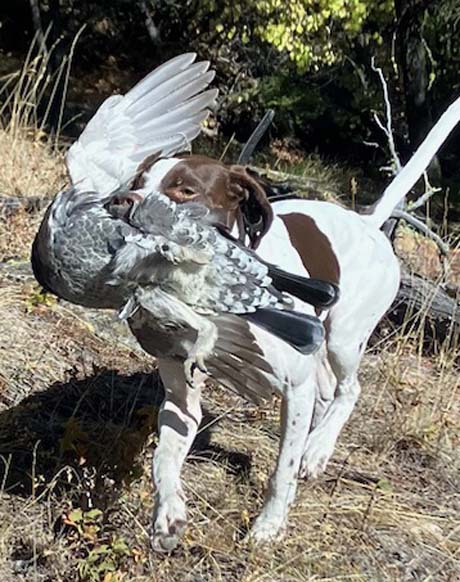
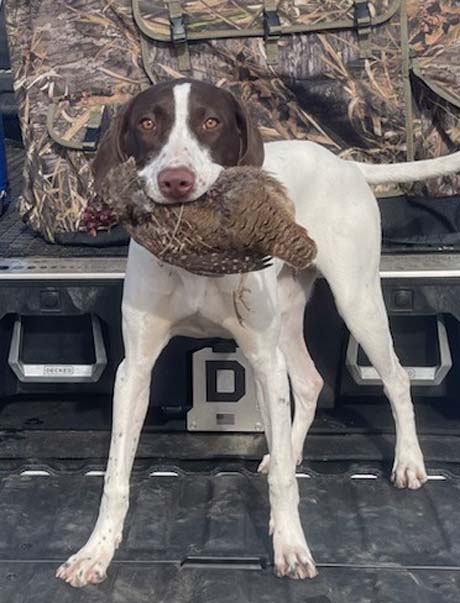
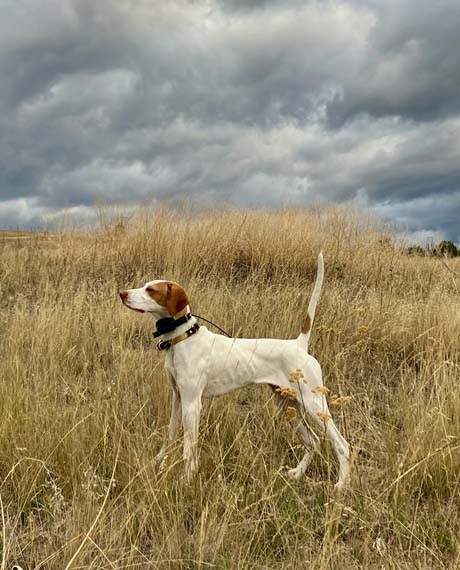
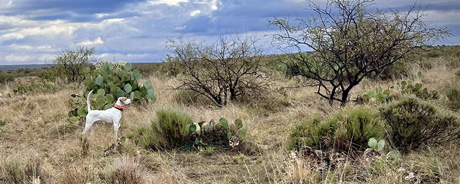
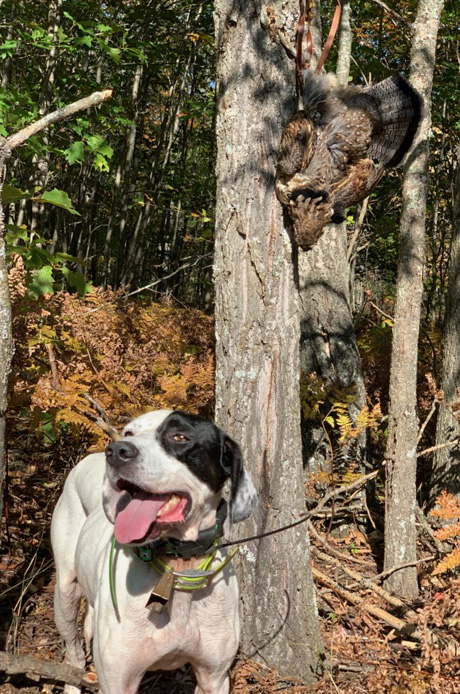
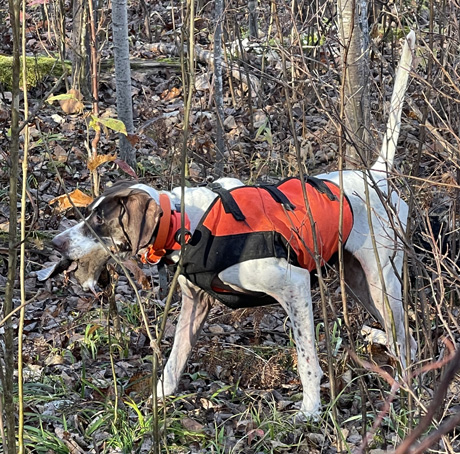
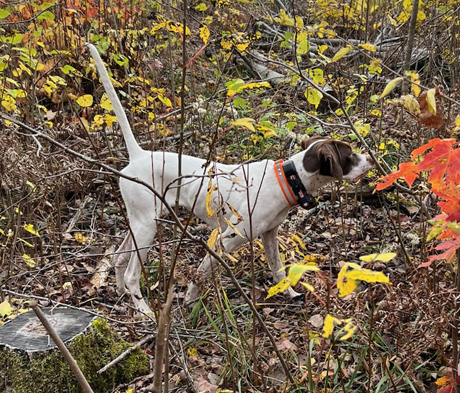
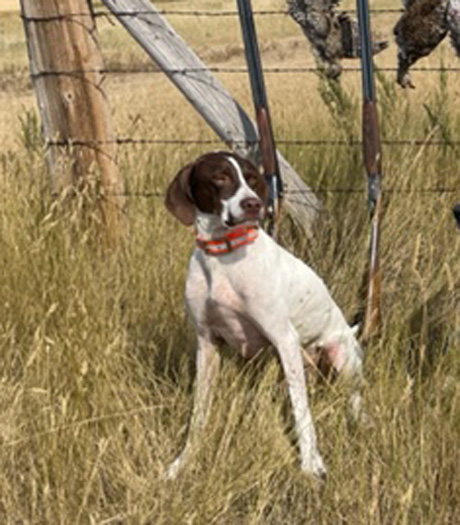
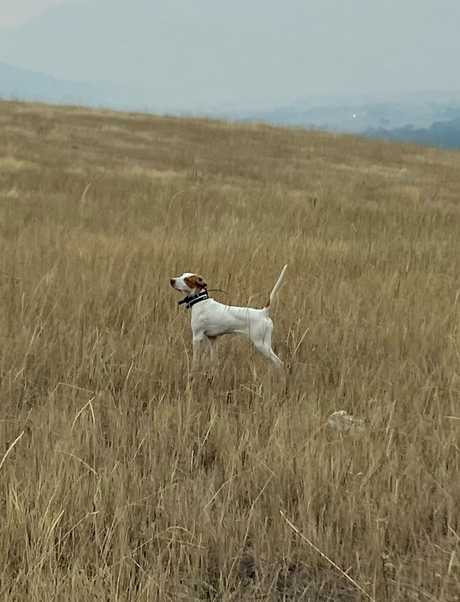
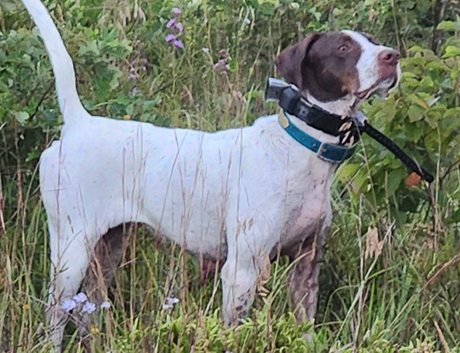
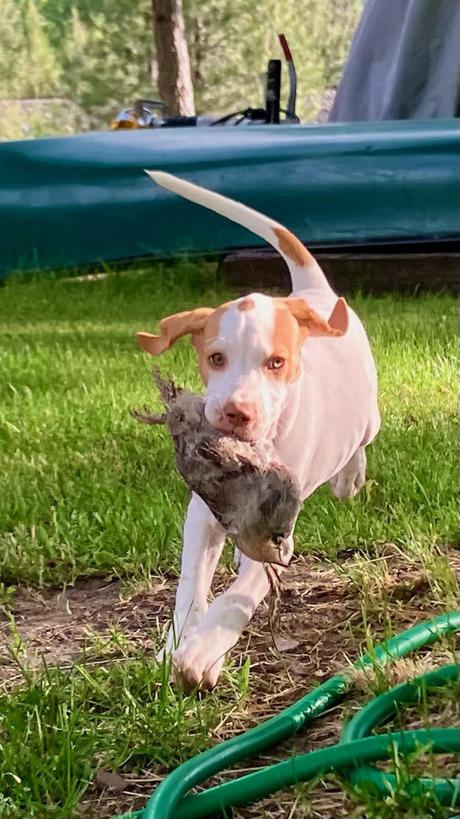
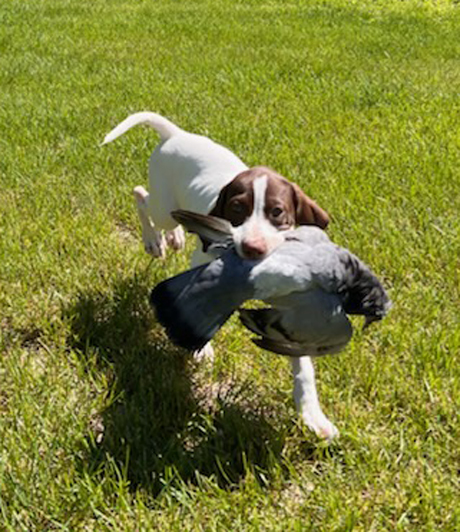
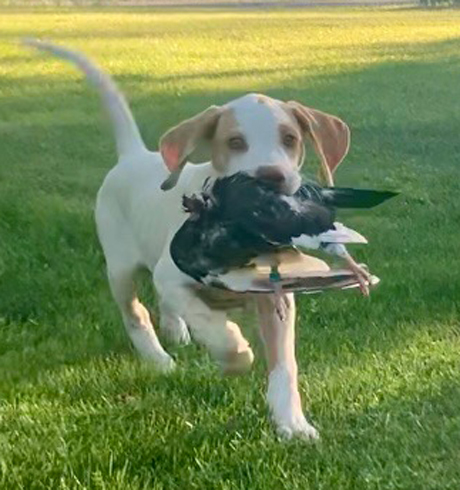
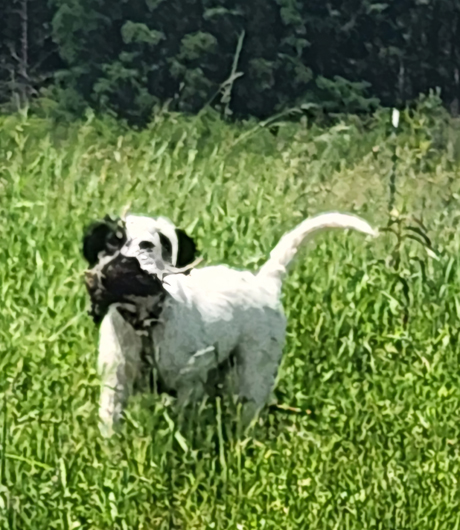
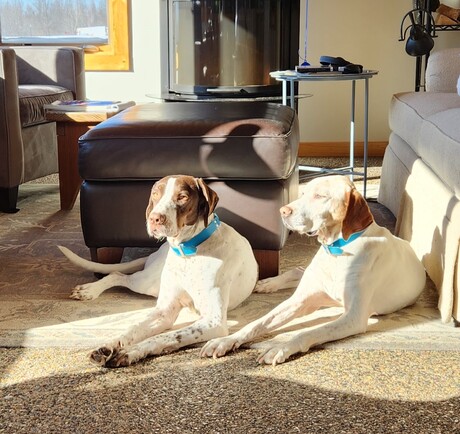
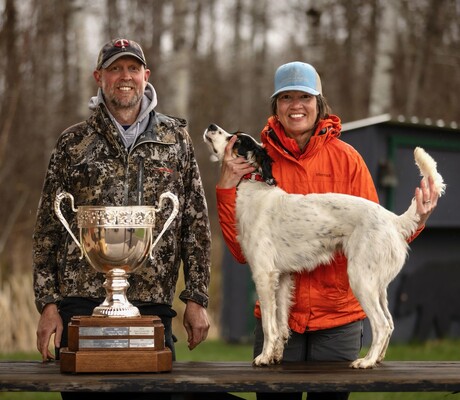
Northwoods Comet (HOF CH Rock Acre Blackhawk x Northwoods Vixen, 2018)
Even though Jerry and I are primarily known for breeding setters, we also have had a line of pointers for 27 years. It doesn’t have the breadth of our setter breeding program but there is length and incredible strength.
It began inadvertently.
When we started in the 1990s, not only were we neophytes in trialing but in breeding, too. We were fortunate, though, to own an extraordinary liver-and-white pointer female, registered as Dance Smartly. We called her Dancer. Her sire, CH Northern Dancer, was a grouse champion and her dam was ultra talented 6X CH Vanidestine’s Rail Lady. Besides her parents, the top and bottom of her pedigree included three HOF males—Smart, Pork Roll and Guard Rail.
Dancer was a beautiful dog with an evenly masked head and near-perfect conformation. She had intelligence, strength, grace and incredible bird-finding ability. Dancer was stunning on point—confident, composed, nose in the air, eyes on fire. She loved people and couldn’t wag her tail fast enough when anyone got within petting distance.
For a span of three years, Dancer dominated the grouse field trial circuit in our region. She won the 1995 Minnesota Grouse Championship and the 1996 Wisconsin Woodcock Championship. Before the Wisconsin trial was a championship, she was named runner-up in 1994 and won first place in 1995.
Dancer was invited to the Grand National Grouse and Woodcock Invitational three times and was named Minnesota/Wisconsin Cover Shooting Dog of the Year in 1994, 1995 and 1996.
Jerry and I were novices in breeding knowledge and experience, but we knew Dancer was worthy. Since we had a strong female line as a start, we looked to the best-of-the-best field trial champions for sires. Two are Hall of Fame males—Rock Acre Blackhawk and True Confidence—and all but one are champions in various venues. The lone non-champion was Dasher, our own dog out of the Dancer’s first litter. Dasher was rarely competed but did have several field trial placements. Most importantly, we valued his qualities and strengths—and he proved crucial to the line’s continuation.
Perhaps it was beginner’s luck or serendipity, or both, but our strategy worked. Through almost three decades, we’ve continued our pointer line and are now producing the sixth generation.
We’ve kept the reindeer theme blithely started with Dancer. Just this year with our youngest female, we ran out of reindeer so Dahlia is the first of our flower-themed pointers.
Dancer (CH Northern Dancer x CH Vanidestine’s Rail Lady, 1991) Dasher (CH Brook’s Elhew Ranger x CH Dance Smartly, 1997) Prancer (Dashaway x Fallset Fate, 2008) Vixen (CH Westfall’s Black Ice x Northwoods Prancer, 2011) Blitzen (CH Elhew G Force x Northwoods Vixen, 2016) Comet (HOF CH Rock Acre Blackhawk x Northwoods Vixen, 2018) Cupid and Rudolph (CH Southern Confidence x Northwoods Comet, 2023) Dahlia (CH Miller’s Upgraded Version x Northwoods Comet, 2024)
Cupid and Dahlia are next in line to continue our pointer breeding program and will, hopefully, produce the seventh generation.
Passionate hunters from states in all parts of the country—east to west, north to south and every place in between—own pointers from our breeding. Jerry and I are thrilled to give our pointer puppies their best lives possible with these truly wonderful people.
Murphy (CH Elhew G Force x Northwoods Vixen, 2016) ~ Tony and Cheryl Follen, Montana
Northwoods Juniper (HOF CH True Confidence x Northwoods Comet, 2021) ~ Joey Paxman and Amanda Allpress, Montana
Northwoods Timber (CH Miller’s Upgraded Version x Northwoods Comet, 2024) ~ Randy Ott and Kim Olson, Minnesota
Northwoods Easy Keeper (CH Miller’s Upgraded Version x Northwoods Comet, 2024) ~ Joey Paxman and Amanda Allpress, Montana
Attie (CH Southern Confidence x Northwoods Comet, 2023) ~ Jeff and Carol Hintz, Arizona
Jade (HOF CH Rock Acre Blackhawk x Northwoods Vixen, 2015) ~ Frank Ilijanic, Michigan
Jordy (CH Elhew G Force x Northwoods Prancer, 2014) ~ Mark and Janie Fouts, Wisconsin
Belle (CH Southern Confidence x Northwoods Comet, 2023) ~ Kevin Sipple, Wisconsin
Lacey (CH Elhew G Force x Northwoods Vixen, 2016) ~ Brian Smith, Pennsylvania
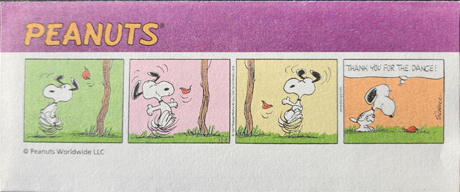
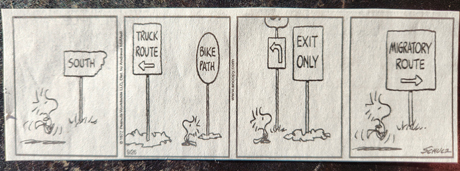
Here are two depictions of autumn as imagined by the brilliant Charles M. Schulz. Only he could have conceived of and drawn Snoopy dancing with a falling leaf.
In the second strip, Woodstock reviews various signs and finds the correct way to fly south.
Even though Schultz died in 2000, the wonderful characters he created are still available in myriad forms, including books, buttons, calendars, lunchboxes, magnets, pins, stuffed animals, memorable television specials (“A Charlie Brown Christmas” is a holiday tradition in our house) and even on spatulas from Williams-Sonoma.
There’s 355 million—the number of world-wide readers of “Peanuts” according to Schulz’s obituary in The New York Times–reasons “Peanuts” is still wildly popular. In addition, Schulz created about 18,250 strips in his almost 50 years of drawing the daily comic and his work has been translated into 20 languages.
“There are two kinds of hunting: ordinary hunting, and ruffed-grouse hunting.
“There are two places to hunt grouse: ordinary places, and Adams County.
“There are two times to hunt in Adams: ordinary times, and when the tamaracks are smoky gold.”
Thus opens the chapter titled “October” in A Sand County Almanac and Sketches Here and There by Aldo Leopold. He ranks among the very best nature writers of all time. Not only did he deeply understand the true nature of nature but he simply, yet with eloquence and elegance, describes its splendor.
What grouse hunter doesn’t relish the month of October? Previous months can be taken up with various preparations—training and conditioning the dogs, gear preparation, travel plans—but, still, everything is focused on October. It is the perfect time to be walking along a tote road in the woods with dogs.
Leopold continues:
“The tamaracks change from green to yellow when the first frosts have brought woodcock, fox sparrows, and juncos out of the north. Troops of robins are stripping the last white berries from the dogwood thickets, leaving the empty stems as a pink haze against the hill. The creekside alders have shed their leaves, exposing here and there an eyeful of holly. Brambles are aglow, lighting your footsteps grouseward.”
Several paragraphs later, Leopold notes:
“The tamaracks grow not only in the swamp, but at the foot of the bordering upland, where springs break forth. Each spring has become choked with moss, which forms a boggy terrace. I call these terraces the hanging gardens, for out of their sodden muck the fringed gentians have lifted blue jewels. Such an October gentian, dusted with tamarack gold, is worth a full stop and a long look, even when the dog signals grouse ahead.”
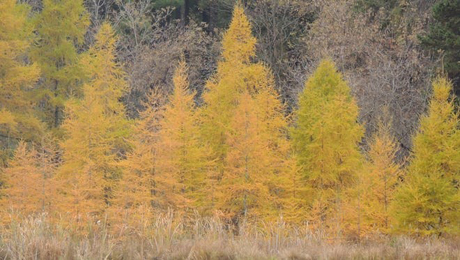
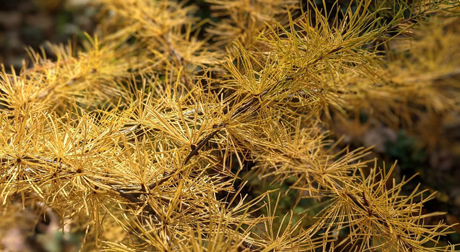
Tamarack (Larix laricina) is a member of the Larix, or Larch, genus and Pinaceae, or Pine, family. Another name is the Eastern Larch. While the tree is a conifer (cone-bearing) and produces needles, it isn’t an evergreen. Instead, this genus is cool because its needles are deciduous and so are shed in the fall. Photo courtesy of Grand Traverse Regional Land Conservancy
Leopold finishes the first section:
“Lunch over, I regard a phalanx of young tamaracks, their golden lances thrusting skyward. Under each the needles of yesterday fall to earth building a blanket of smoky gold; at the tip of each the bud of tomorrow, preformed, poised, awaits another spring.”
Leopold’s final sentence of the chapter:
“I sometimes think the other months were constituted mainly as a fitting interlude between Octobers, and I suspect that dogs, and perhaps grouse, share the same view.”
The process of developing a puppy into an experienced bird dog should be an enjoyable and rewarding experience. That process begins with the all-important first season. Not only is the young dog at an impressionable age, but the experience and knowledge gained from that time in the woods and fields will create a foundation the dog will depend on and use in future seasons.
The first year is primarily about exposure. The goal is to have the puppy hunt for and find wild birds. Owners shouldn’t worry if the dog doesn’t point the bird or hold point for long. Both will come with repeated exposure, maturity and training.
The key is wild birds Most of what a dog needs to know about finding and pointing wild birds is learned from the birds themselves. The owner’s job is to put the young dog into birds—lots of birds.
The puppy will learn key details about birds. • Where they’re most likely to be found. • How to differentiate where the bird is as opposed to where it was, i.e., old scent vs. new scent. • How close is too close before the bird flushes. • It can’t catch the bird. • How to follow running birds.
Handling in the woods and fields Handling is often a big issue with owners. Jerry and I have a simple handling theory. As long as the young dog goes with us and looks to us for direction, we say the minimum necessary to control it. Over-handling, in terms of too much calling, whistling or constant encouragement, can distract and confuse the dog. We only use two commands: HERE and calling its name. HERE means come to us. When we want the dog to turn, we call its name. At a certain point we enforce the commands with an ecollar
Expecting your puppy to be always in sight or range at a certain distance is unrealistic and, in fact, can inhibit its bird finding. As long as it’s checking in and hunting in the direction we’re headed, we don’t say anything.
In this field, Sage (CH Miller’s Upgraded Version x Northwoods Comet, 2024) looks staunch on point. But was there a bird? If so, did she hold point until owner Joey Paxman of Montana could flush?
Puppy mistakes Expect your puppy to make mistakes—flush birds, chase rabbits, not pay attention and, at times, just act like the immature dog it is. Be patient. Remember it is still just a young dog. Take a break. Call it in to you, talk calmly and stroke its back.
Be prepared A few important points need to considered prior to the hunting season. The foremost is proper introduction to birds and gunfire. The young dog should be conditioned to an ecollar for the basic HERE command and for turning. A GPS collar is excellent for peace of mind.
Also, the young dog should be accustomed to wearing a bell or beeper and comfortable both with being in a crate and riding in a vehicle.
Proper physical condition is always crucial. The young dog should be at the proper weight. A couple extra pounds can make a big difference, especially on those hot, early season days.
Finally, remember! Have fun with your young dog. And savor this first, special season.
Jerry and I wrote a piece for the September 15, 2013, issue of the Minnesota StarTribune. Some parts of that have been reprinted here.
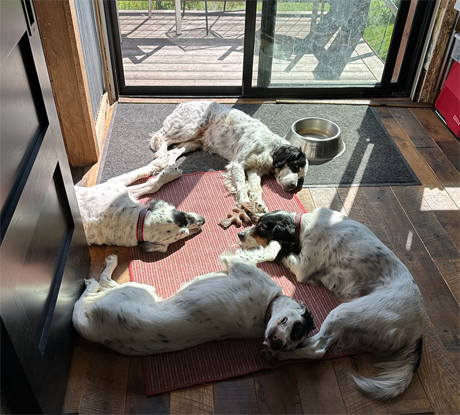
Beginning with their first dog in the late 1990s, Barry and Jill Frieler have owned six setters out of our dogs. On a recent afternoon in their Minnesota home, the current pack found a sunny spot for napping. Clockwise from top: Northwoods Highclass Kate (Northwoods Blue Ox x Houston’s Belle’s Choice, 2010), Madison (Northwoods Grits x Northwoods Nickel, 2018), Ellie (CH Ponderosa Mac x Northwoods Redbreast, 2022) and Jack (CH Houston’s Blackjack x Northwoods Highclass Kate, 2013).
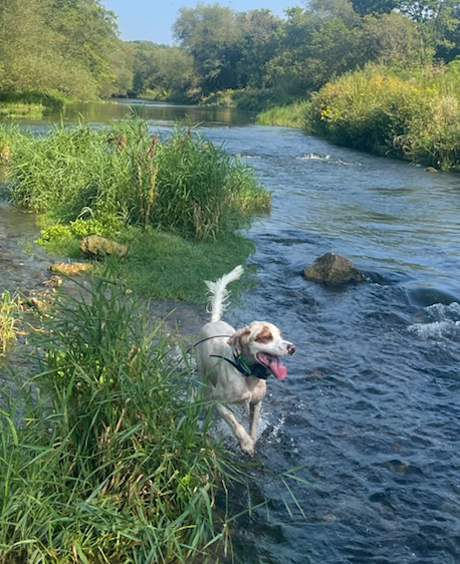
When Sig (Northwoods Rob Roy x Northwoods Minerva, 2019) isn’t in the grouse woods or in wide open Montana places, he accompanies his owner Chris Bye of Wisconsin on trout streams.
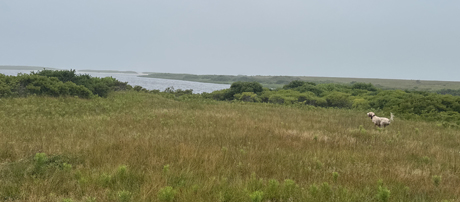
Lacey (Northwoods Grits x Northwoods Minerva, 2020) flies across an open field on Nantucket where owner Zenas Hutcheson conditions her for the hunting season in their home state of Minnesota.
There are good reasons Northwoods Comet (HOF CH Rock Acre Blackhawk x Northwoods Vixen, 2018), a female pointer Jerry and I own, is one of our best of all time. On a recent training run for sharptails, in addition to her breathtaking poise, style and composure, her blazing eyes tell the story.
Tally (May’s Pond Hank x Northwoods Stardust, 2024) is at Northwoods Bird Dogs for puppy training and accurately locates a pigeon on her first puppy point.
As are many of our clients, Joe Wech and his wife Deb are repeat puppy buyers. This summer, they picked up their second from us, a female setter out of May’s Pond Hank x Northwoods Stardust.
Tally is her name and she joins Georgia, the first setter they bought in 2015. Georgia is out of Northwoods Grits x Northwoods Carly Simon. In a bit of serendipity, their two setters are related. Stardust is Carly Simon’s daughter.
Joe is a pilot for American Airlines and commutes from his home in the Twin Cities to Texas. That commute gives him hours of quiet time to think.
In a recent email, Joe shared some of the musings from time in the air. Not only were his sentiments totally new to me, they were, all at once, insightful, profound and uncomplicated.
Here is a passage from Joe’s email.
“I think every child can learn so much if they are lucky enough to be around a dog. They make the child feel loved. They give the child something to be responsible for and care for, to not only think about themselves, but of someone else who needs them. So because of you, your puppies and your training, my family is better, and my kids and grandkids are better people.”
Note: A quick glance through the photos under “From field and home” on the right is all the proof one needs about the truth of Joe’s words.
Our three males out of CH Woodville’s Yukon Cornelius x Northwoods Redbreast, Beech, Roy and Jack, basically share point on a pigeon in a releaser.
Timing, as the saying goes, is everything. This year, Jerry and I are not only fortunate to have 10 puppies from two setter litters and one pointer litter, but all are at exactly the perfect age to begin training. We introduce them to the bird field, take them on walks and expose them to other aspects for their future as bird dogs.
PUPPY FIRST POINTS These are no-pressure walks in the bird field to bring out a puppy’s pointing instincts in a natural manner through bird contact. We want the puppy to become confident, bold and accustomed to gunfire.
PUPPY WALKS On a warm afternoon last weekend, Jerry and I took our six four-month-old puppies (CH Woodville’s Yukon Cornelius x Northwoods Redbreast) for a walk on a nearby pasture. The buttercups and orange hawkweed were blooming, the ponds were full and butterflies provided fun things to chase. Yet even on this seemingly simple walk, the puppies learned.
They learned to turn on a whistle, run to the front and go with us. The puppies found water independently and all six not only drank but splashed in far enough so they swam. They were also reinforced on the “HERE” command several times.
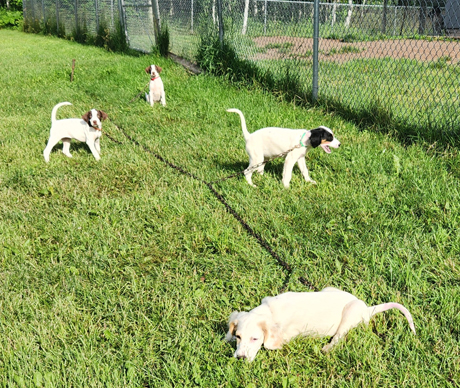
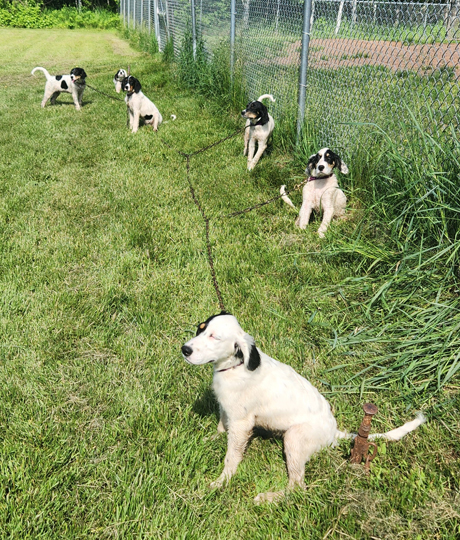
TIME ON A STAKEOUT CHAIN When our puppies are eight weeks old, we always put brightly colored collars on them. When they became comfortable with their collars, we clipped them to a stakeout chain. They all struggled at first—some more than others—but they all learned to give in, to be comfortable with restraint and ultimately to relax.
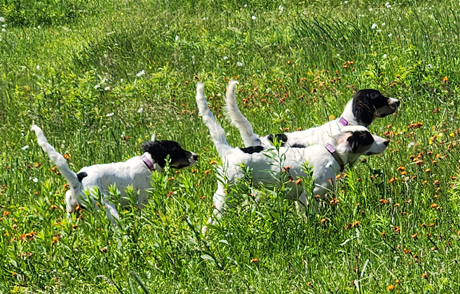
Front to back: setters Chestnut and Foxglove (May’s Pond Hank x Northwoods Stardust) and pointers Peony and Dahlia (CH Miller’s Upgraded Version x Northwoods Comet).
Front to back: Our six puppies out of CH Woodville’s Yukon Cornelius x Northwoods Redbreast: Daffodil, Roy, Beech, Violet, Jack and Miley.
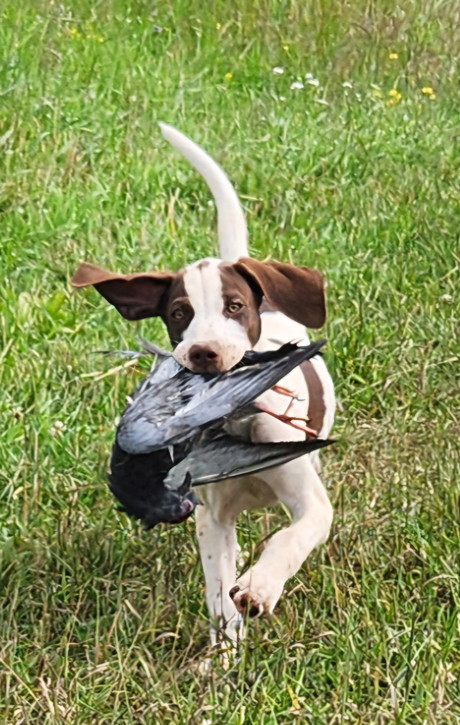
RETRIEVING Puppies are eager to please which makes retrieving an easy exercise at a young age. Jerry and I always start with tossing a tennis ball or retrieving dummy in the kennel office. But soon, Daffodil (CH Woodville’s Yukon Cornelius x Northwoods Redbreast), below, progressed to retrieving a freshly killed quail in the field.
Northwoods Vixen, on left, and her pregnant daughter, Northwoods Comet, watch for rabbits.
Northwoods Vixen (CH Westfall’s Black Ice x Northwoods Prancer) and her daughter by HOF CH Rock Acre Blackhawk, Northwoods Comet, have always been house dogs.
As eight-week-old puppies, they were brought into the house where they learned to get along with our other house dogs–older setters and May, our Labrador. They were house-broken and, after sleeping in crates at night, they graduated to sleeping on dog beds alongside the older dogs.
Vixen and Comet spent days in the kennel and they received the same training as all our bird dogs. They were hunted in the grouse woods of Minnesota and in the southeastern piney woods on bobwhite quail. They’ve also both starred in Jerry’s guiding strings—whether at Bowen Lodge on the shores of Lake Winnibigoshish or at various quail plantations. Too, they hunted sharptails and Huns on the prairies of North Dakota and Montana.
Around the house, Vixen and Comet are a perfect two-some, much like a cashmere twin set. They are two beautiful, classic peas in a pod.
2X RU-CH Northwoods Atlas (Northwoods Grits x Northwoods Nickel) is owned and handled by Greg Johnson of Superior, Wis.
Something extraordinary occurred when the Minnesota/Wisconsin Dog of the Year trophies for open shooting dogs and derbies were announced on Sunday, April 28, in Moose Junction, Wis.
A father/son duo won their respective awards.
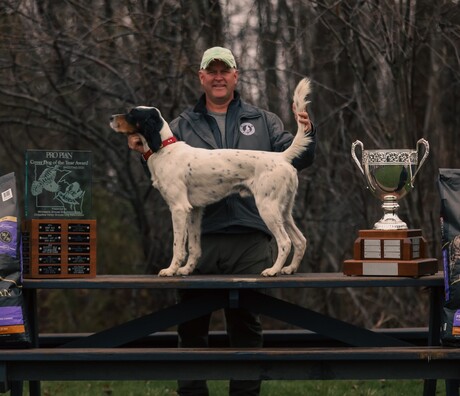
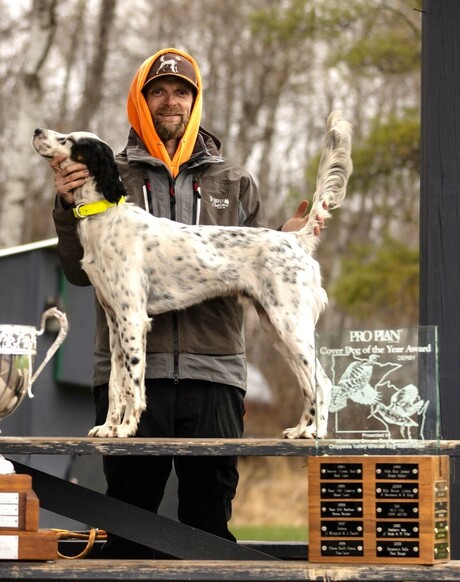
2X RU-CH Northwoods Atlas (Northwoods Grits x Northwoods Nickel) won what is officially called the Purina Pro Plan Cover Dog of the Year Award/Shooting Dog. Atlas (call name Jet) is owned and handled by Greg Johnson of Superior, Wis.
Big Big Energy (Northwoods Atlas x Clover Valley’s Millie) is owned and handled by Jordan Pharris of Brainerd, Minn.
Big Big Energy (Northwoods Atlas x Clover Valley’s Millie) won the Purina Pro Plan Dog of the Year Award/Derby. Big (call name Lotto) is owned and handled by Jordan Pharris of Brainerd, Minn. Lotto was bred by Jerry Furnish of Two Harbors, Minn. and whelped in April 2023, and so is truly a puppy.
Both awards, sponsored by the Minnesota Grouse Dog Assoc. and the Chippewa Valley Grouse Dog Assoc., honor a winning body of work spanning months. Beginning last fall and including this spring, points for trial placements in open and amateur stakes held in Minnesota and Wisconsin are recorded and tallied.
Jerry and I are extremely proud not only of Jet but of Greg’s handling of him. Jet is a son of Northwoods Grits—a product of Northwoods Blue Ox x Northwoods Chablis, one of our best nicks. Grits inherited the best from both parents and was renowned for his stamina, desire, bird finding and, yes, grit.
Jet’s dam, Northwoods Nickel, is a daughter of our most prolific producer of field trial winners, Northwoods Chardonnay. Chardonnay herself was no slouch. She was out of another of our top nicks—Blue Shaquille x Houston’s Belle’s Choice—and won the Dog of the Year Award/Derby in 2011. Nickel’s sire was CH Shadow Oak Bo, the only setter to win back-to-back National Championships. Nickel offers intelligence, coolness and a long, strong, graceful gait.
Besides the honor of winning, Greg and Jordan received traveling trophies that I think are among the classiest in the world of cover dog field trials. Stunning pieces of etched glass slide into chunky walnut bases where the winning dogs and handlers’ names are engraved.
Minnesota-Wisconsin Amateur Dog of the Year Awards
About 10 years ago, the two clubs began similar awards for amateurs: Minnesota-Wisconsin Amateur Shooting Cover Dog of the Year and Minnesota-Wisconsin Derby Cover Dog of the Year. The trophies for both are big, beautiful, shiny cups.
Jet was a double winner that day. He also won the shooting dog award so Greg had even more hardware to bring home.
Northwoods Cedar Edge (CH Snyder’s Pioneer Scout x Northwoods Cedar) is owned by Eric and Lindsey Saetre of Holyoke, Minn.
The derby trophy was won by Northwoods Cedar Edge (CH Snyder’s Pioneer Scout x Northwoods Cedar). Edge (call name Enni) is owned by Eric and Lindsey Saetre of Holyoke, Minn., and handled by Eric.
Enni has a distinguished pedigree. Her dam is Northwoods Cedar (RU-CH Erin’s Prometheus x Northwoods Carly Simon), a talented dog also owned and run in field trials by Eric and Lindsey. Even when Cedar was young, she caught our eye and we knew we wanted to breed her. Cedar is out of a breeding we repeated three times and one of our finest nicks.
When Jerry and I bred Cedar, we chose Scout, owned by Steve Snyder of Ellendale, Minn., as the sire. Scout is a champion grouse dog and Scout’s sire, 8X CH Ponderosa Mac, is the winningest dog ever in grouse trials.