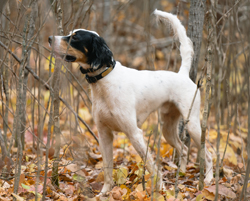
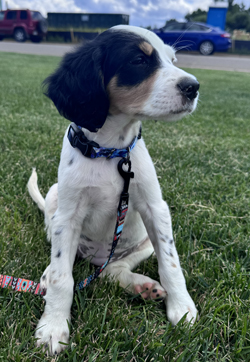
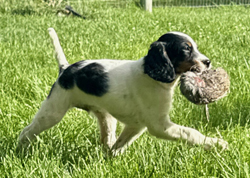
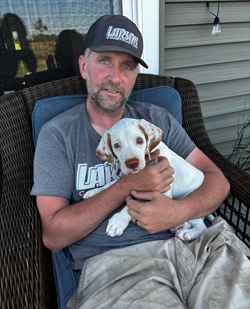
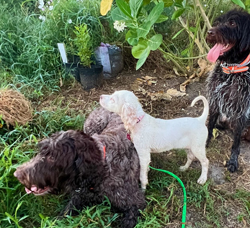
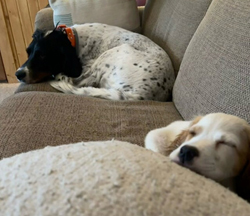
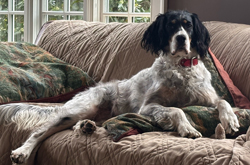
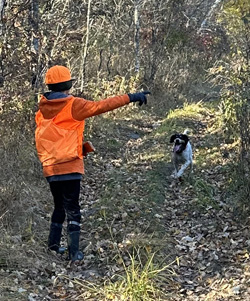
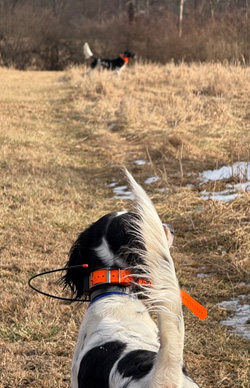
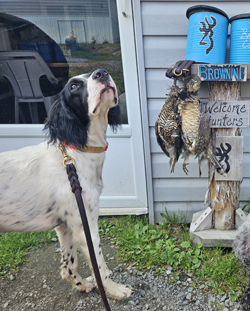
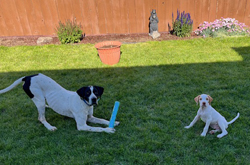
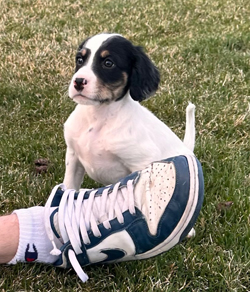
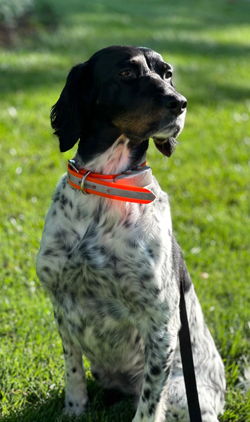
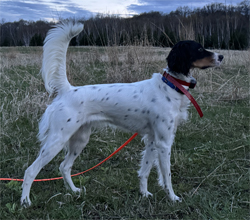
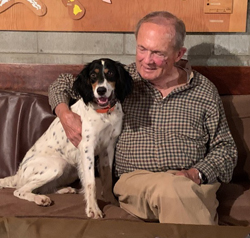
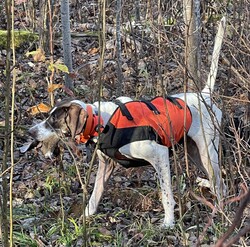
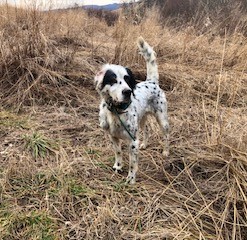
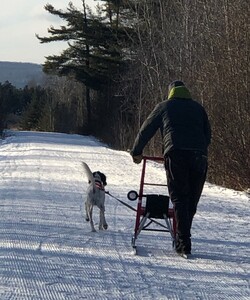
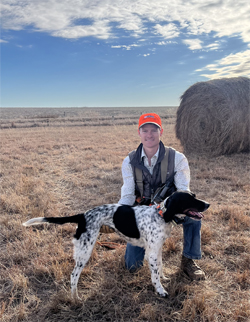
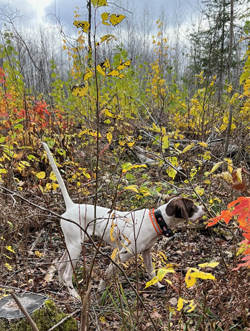
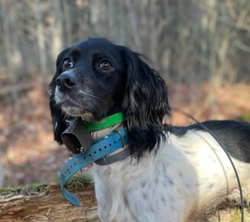
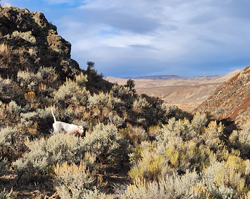
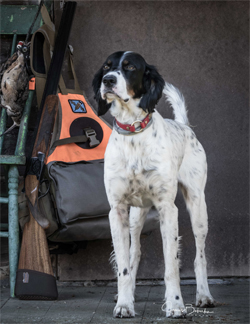
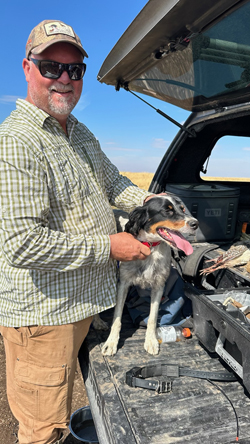
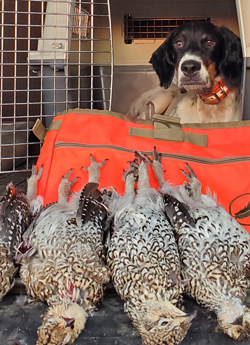
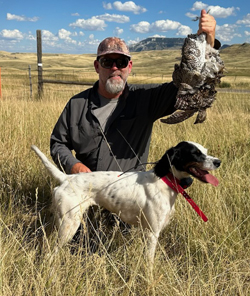
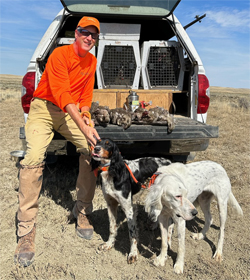
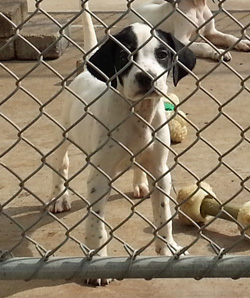
Common sense should tell us that the best and most efficient way to get a dog with the inherited ability to find and point ruffed grouse would be to get one from a line of proven grouse dogs. But common sense, often, is not so common. People mistakenly believe that any well-bred bird dog will make a grouse dog, even if none of the dogs in the pedigree have ever hunted, much less pointed, a grouse. While some could develop into fine grouse dogs, the odds don’t favor them.
What are the genetic qualities of a grouse dog?
To start:
• strong hunting instincts
• above average intelligence
• right amount of point
Also important, though:
• physical strength and stamina
• desire to hunt in heavy, punishing cover
• good hearing and eyesight
Finally, a little fine-tuning:
• the instinct to range in a manner that effectively covers ground and yet stays in contact with the hunter
• scenting ability that allows accurate location of a bird while the dog is moving through the woods at a fast pace
• capability to follow a running bird, possibly for hundreds of yards, and get it pointed
So, you bought a puppy prospect with the right genes; now the work begins.
It will take about three seasons of consistent exposure for that prospect to develop into a grouse dog. Consider a good year when one could average three grouse flushes per hour. For a hunter walking at 2 mph, that’s about 1.5 grouse per mile. If you hunt four hours per day for 10 days, you will have walked 80 miles to flush 120 grouse. (4 hours x 10 days = 40 hours. 40 hours x 2 mph = 80 miles. 80 miles x 1.5 = 120 grouse).
After three seasons you’ll have walked about 240 miles!
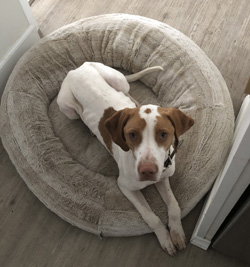
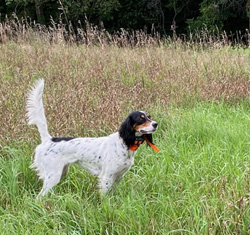
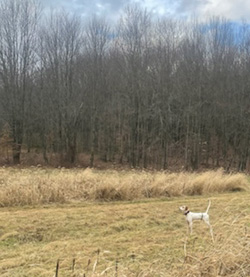
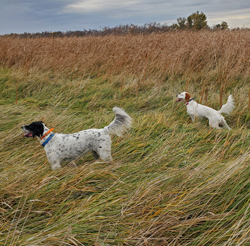
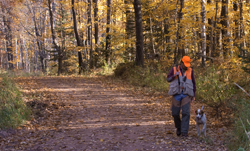
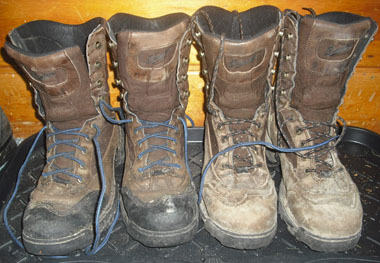
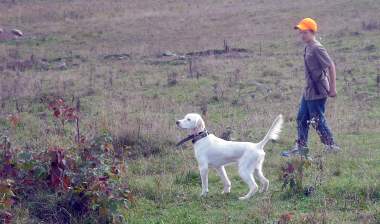
Bottom line? Buy a puppy from a line of proven grouse dogs and buy two pair of good boots. Find hunting spots with good grouse habitat. Turn your dog loose and start walking.
By the time both pairs of boots are worn out, you’ll have a grouse dog!
A dog teaches a boy fidelity, perseverance, and to turn around three times before lying down.
~ Robert Benchley
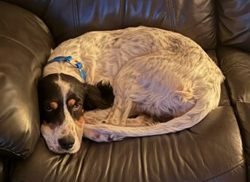
Bucky spent the first nine years of his life hunting the woods of east central Minnesota as an esteemed member of one of our client’s string of bird dogs. In 2004, he even made the cover of Shooting Sportsman magazine.
During late winter of 2010 Bucky suffered a brain trauma and became ill. He is tough, though, and pulled through but never regained the physical stamina to be hunted.
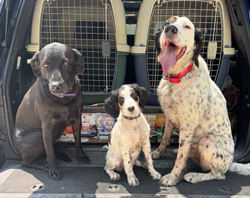
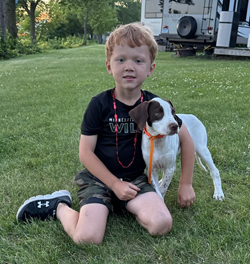
Enter Paul Diggan, age 12. Paul is the son of Mark and Martha Diggan of Sandstone. Mark is a good friend of Dan Stadin, the guy who works with us, and through Mark, Paul also is a friend of Dan’s. In fact, Paul often accompanies Dan to work and has spent hours with us either in the kennel doing chores or out in the field working dogs.
Somehow, someone concocted the idea that maybe Paul could adopt Bucky. How to convince Paul’s parents? What would Paul’s sister, Kelly, think? What about the other two dogs in the Diggan household? Would our client agree?
Several negotiations followed and many conversations and telephone calls later, all was arranged.
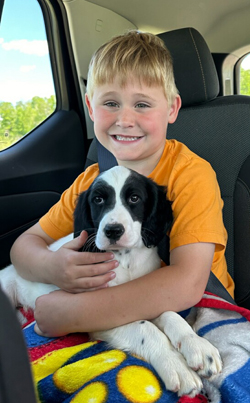
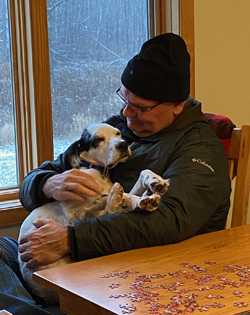
Paul and Bucky are now great pals. And Bucky upgraded his kennel bed to the comforts of either Kelly’s or Paul’s bed.
It began with the first pointer litter out of our dam, Dancer, in 1997. Jerry and I kept a male and named him Dasher. Makes sense, right?
Of all the pro sports, the only one we have followed with any regularity or interest is the NBA. My allegiance to the LA Lakers began in the late 70s when Magic Johnson came into the league from Michigan State University, my alma mater. Johnson encountered his nemesis from collegiate games, Larry Bird, who had been drafted by the Boston Celtics. For the next decade or so, Johnson and Bird and their respective teams played the best basketball games I’ve ever seen.
In the spring of 2004, the LA Lakers were on a tear with a new generation of players, Shaquille O’Neal and Kobe Bryant. Even though the Detroit Pistons eventually won the championship series, my loyalty to the Lakers remained strong. We kept two males out of Paul Hauge’s Houston x Blue Silk breeding; the big, strong one became Shaq and the good-looking, smaller male we named Kobe.
Other themed litters we’ve dreamed up:
• Beer and Wine: Porter, Lager, Chardonnay, Chablis
• Cheese: Brie, Camembert, Roquefort, Parmigiano
• Minnesota Legends: Blue Ox, Babe
• Minnesota Wildflowers: Tiger Lily, Black-eyed Susan
• Ancient Egypt/Rome: Cleopatra, Tut, Zeus
• Planets: Mars, Venus
• Rock Stars: Kiss, Heart, Aerosmith, Led Zepellin
Of course, ensuing generations of pointers carried on the reindeer theme. Out of Dasher, we have Prancer and now her daughter, Vixen.
But, back to Grits, Biscuit and Sweet Tea, the title of this post.
One morning last winter when Jerry and I were staying in eastern Tennessee, we treated ourselves to breakfast out. We passed Perkins and IHOPs and chose instead a roadside diner. On the smudged, plastic-coated menus were offerings generally not found in Minnesota. Our excellent meal included traditional southern dishes like grits, biscuits and gravy and sweet tea.
Voila! Our two-month-old litter at home had their theme.
P.S. We sold Sweet Tea earlier this summer to the very nice Balfanz family from Stillwater. Biscuit was sold to good clients Ryan and Monica Gould, who had a special collar and name tag made for her.
Dennis Anderson, outdoor columnist for the StarTribune of the Twin Cities, recently wrote a piece, “Dog Gone.”
Four tales of hunting companions that were cherished and lost reveal a lingering truth—the love that binds best friends never ends.
~ Dennis Anderson
The vignettes are recounted in first person. Normally, articles like this are difficult to read but these stories are uplifting. They are tributes to great dogs.
Paul Hauge and his outstanding female English setter, Houston’s Belle, were featured. Paul’s opening words are so true. Jerry and I laughed out loud when we read them.
I own a log of dogs. It’s sort of an addiction. Every year I tell my wife I’ll cut back. But I don’t.
~Paul Hauge
Anyone familiar with the bloodlines of our English setters knows about Belle. She is the source of all our English setter dams—whether as daughters or granddaughters.
There is something about handling a bird dog from the back of a horse across seemingly endless grasslands that is very appealing. Here are photos Ben McKean shot this summer. Enjoy!
Nice way to end the day.
Point!
Our prairie camp.
Jerry, Prancer and trusty horse, Captain.
Young Northwoods Parmigiano learns from veteran Merimac’s Adda Girl.
Three-year-old Ridge Creek Cody, a setter male co-bred by Paul Hauge and Northwoods Bird Dogs, won Runner-up in the All America Open Shooting Dog Championship. The trial was held near Carson, North Dakota, and was run on native pheasants and sharp-tailed grouse.
In our gun dog foundation training, we use pigeons in launchers to teach dogs about birds and how to act around them. We need control of the bird to create the necessary training situations. That control gives us better timing and helps instill the desired behavior.
But since the goal is not to have the best pigeon dogs around, we eventually need to transition to wild birds.
While a dog may be finished on pigeons in two or three months, it will take at least that long and much more effort to finish it on wild birds. There are three reasons.
We lose the ability to control the bird.
This creates a whole new set of conditions for us. Since we don’t know when or how the bird will flush, we have to focus intently on everything going on to react and to properly correct the dog.
The level of distraction is much higher.
The locations and terrain are different. The dog is more excited and less focused on us. (Wild birds are much more stimulating to the dog.) The sessions are longer which may cause the dog to be hot and/or tired.
The number of bird contacts changes.
The dog can only progress when it finds a bird. As trainers, knowing where the birds are is critical. Consistent bird contact creates consistent opportunities for learning.
Key points to remember.
• Progress in wild bird training depends on the foundation created during pigeon training. If your dog isn’t performing well in training situations, it’s not ready to move on.
• Expect your dog to do things wrong on wild birds. Give it some freedom to learn from mistakes. Don’t correct too hard or too fast. Look for progress not perfection.
• More birds are not always better. Dogs learn by repetition and consistent bird contact over a longer period will provide those repetitions.
• Some dogs can take a lot of pressure and the finishing will go quickly. Others must be handled more delicately. Read your dog.
• Timing is everything. The dog must understand why it was corrected. If your timing is good, much progress can be made in a few encounters.
• Dogs are place oriented. They learn to respond to certain stimulus in the training field, but it will take repetition to generalize that behavior on wild birds.
• Dogs constantly read our body language. We, too, act differently in situations involving wild birds.
Finishing your dog on wild birds will take time. But the results of that effort will reward you with many years of satisfaction and pride.
When Betsy and I sit down to discuss litters we’d like to produce, it’s a fun process but it also takes hard work. We look at individual sires and dams. We also look at possible combinations of traits, characteristics and tendencies of those dogs, both in the field and in the kennel.
We also evaluate litters already produced. While appraising one dog from a litter gives us some idea of what its parents can produce, an even better option is to evaluate an entire litter. Then we can truly get a feel for the preponderance and/or scarcity of the various traits we’re breeding for.
We’re fortunate to train many dogs we’ve bred and this summer has been fantastic. We’ve looked at offspring from seven litters—from first-year dogs and puppies to three-year-olds.
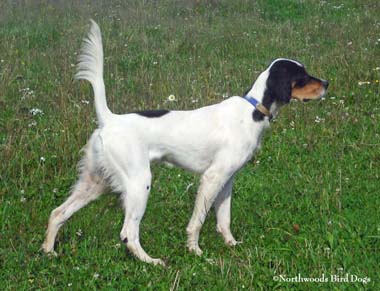
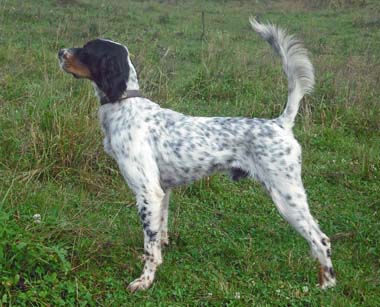
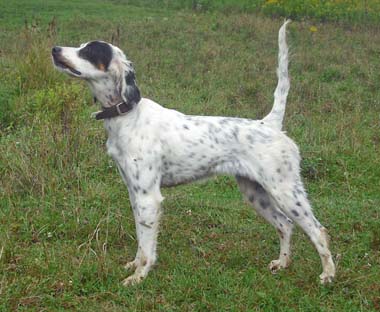
Six of seven puppies from our January 2011 litter by Northwoods Chablis x Northwoods Blue Ox litter are here for early training. Betsy and I kept two and four are client-owned. We’re getting a good look at what first-time dam Chablis is passing on. We’re very pleased with our initial impressions—all are naturally staunch on point, back and, to some degree, retrieve. They have a strong urge to hunt for birds and are beautiful on point with lofty posture and high, straight tails.
Beasley: Ox x Chablis (2011) male
Tes: Ox x Chablis (2011) female
Last year the breeding of Houston’s Belle’s Choice x Northwoods Blue Ox produced seven puppies and all have been in for training. Again, four are client-owned, Dan Stadin, the man who works with us, owns one and we own two. This litter is being steadied to wing and/or shot and is finishing out with great character and intensity. It should be an exciting fall for these one-year-old dogs and their owners.
Parmigiano Ox x Choice (2010) male
Camembert: Ox x Choice (2010) female
In addition to those two, this summer we’re training offspring from the following litters:
2011: Northwoods Prancer x CH Westfall’s Black Ice
2010: CH Houston’s Belle x Northwoods Blue Ox
2009: CH Houston’s Belle x CH Magic’s Rocky Belleboa
2009: Houston’s Belle’s Choice x Blue Shaquille
2008: Old Glory Bluebell x CH Magic’s Rocky Belleboa
J.B.: CH Magic’s Rocky Belleboa x Old Glory Bluebelle (2008) male
The history of using dogs for hunting game birds in the state of North Dakota is peculiar, to say the least. It would be funny, too, except that it actually happened. Less than thirty years earlier, Indian wars were being fought and forty years earlier the American Bison was still being market hunted. How could bird dogs be of that much importance?
In 1919, North Dakota passed a law that outlawed the use of dogs for hunting upland game birds. Dogs were allowed for retrieving waterfowl only. “No bird dogs allowed to run loose or with owners between April 1 and November 1.”
Shortly after those restrictions, the North Dakota Game and Fish Board of Control, in its 1919-1920 Biennial Report, bragged about the success of the law: “It is conceded by everybody that the grouse and prairie chickens were never more plentiful than they were the past two seasons…the bill cutting out the use of dogs was one of the most far-sighted pieces of legislation ever passed for the conservation of game and should never be repealed…”
Some members of the Board of Control believed fewer birds were lost or crippled by using dogs to retrieve them. In 1933, after much bantering about what types of dogs, the law was changed again to only allow spaniels or retrievers for retrieving. “Use of Pointers, Setters and Droppers is unlawful.”
Later in 1943, a new law was passed that is still in effect today: “All types of dogs were legal to hunt upland game in season.”
Finally, common sense prevailed.
Quotes from Feathers from the Prairie by Morris D. Johnson and Joseph Knue.
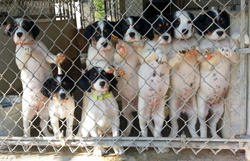
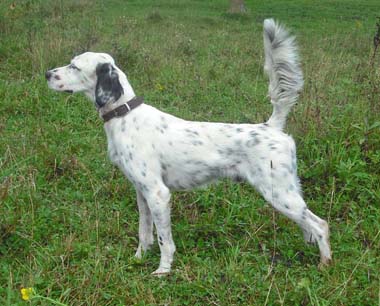
The all-female litter out of CH Westfall’s Black Ice x Northwoods Prancer is now about 12 weeks old.
We’ve heard excellent reports from Mark & Janie Fouts (Timber), Chip Young (Birdie), Tony & Cheryl Follen (Lucy), Dave Sheley, Mike Stout (Jackie Daniels) and Ben Mergens.
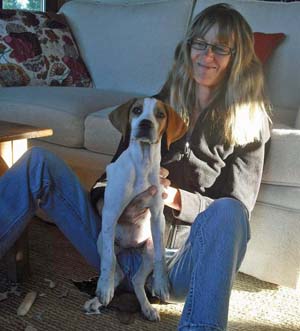
Jerry and I kept an orange-and-white that we named Vixen. Jeff, our neighbor and friend who helps with training, and his wife, Carol, have a black-and-white. They named her Izzie after the doctor on Grey’s Anatomy.
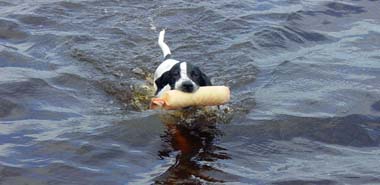
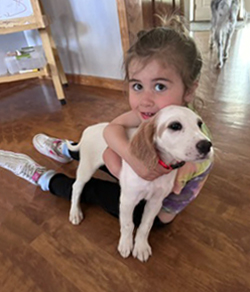
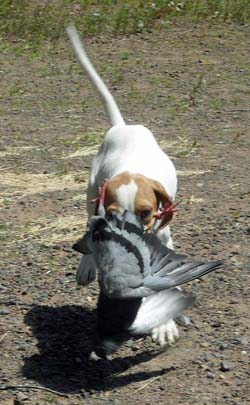
These two couldn’t be cuter or more precocious or more fun. Vixen lives in the house with us and I love sitting on the floor with her and her chew toys. One day Jerry threw a dead pigeon for her. She ran out, picked it up (it was as big as she was) and carried it all the way back to him.
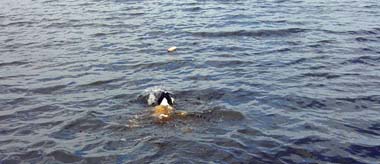
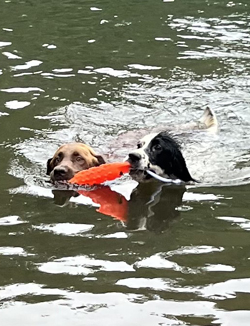
Jeff takes his group of pointers to a nearby lake to cool off on these hot summer afternoons and throws a dummy. Izzie took off after Jeff’s older pointer, Hershey, when he out for the retrieve. What to do? Jeff threw one just for Izzie…and she loved it.
Molly (RU-CH Northwoods Atlas x Houston’s Nelly Bly, 2023) backs Charlie (Northwoods Grits x Northwoods Carbon, 2017) ~ Ken and Caroline Taylor, Jim and Flo DePolo, respectively, Pennsylvania
Filly (May’s Pond Hank x Northwoods Stardust, 2024) ~ Tom and Lauren Strand Family, Minnesota
Rae (CH Ridge Creek Cody x Northwoods Chardonnay, 2013) ~ David Larson, Minnesota
Junie (HOF CH True Confidence x Northwoods Comet, 2021) ~ Joey Paxman and Amanda Allpress, Montana
Normanie (RU-CH Northwoods Nirvana x Northwoods Carbon, 2017) and her pal ~ Walter Manley, Florida
Archie (CH Miller’s Upgraded Version x Northwoods Comet, 2024) ~ Blake and Solveig Nelson, Minnesota
Molly (RU-CH Northwoods Atlas x Houston’s Nelly Bly, 2023) ~ Ken and Caroline Taylor, Pennsylvania
Caddie (CH Southern Confidence x Northwoods Comet, 2023) ~ Brian Smith, Pennsylvania
Frisco (Blue Riptide x Northwoods Carly Simon, 2014), on left, and Zion (CH Snyder’s Pioneer Scout x Northwoods Cedar, 2022) ~ Rick and Jodi Buchholz, North Dakota
Rip (CH Woodville’s Yukon Cornelius x Northwoods Redbreast, 2024) ~ Greg and Michelle Johnson, Wisconsin
Miles (RU-CH Northwoods Atlas x Northwoods Madrid, 2024) ~ Lars Totton, New Jersey
Rip (Northwoods Louis Vuitton x Houston’s Dancing Queen, 2022) ~ Mark Fitchett, Kansas
Vida (RU-CH Erin’s Prometheus x Northwoods Carly Simon, 2019) ~ Tom Condon, Montana
Suki (May’s Pond Hank x Northwoods Stardust, 2024) ~ Eric Beauregard, Massachusetts
Winnie (CH Miller’s Upgraded Version x Northwoods Comet, 2024) ~ Joe and Jess Nelson Family, Minnesota
Tally (May’s Pond Hank x Northwoods Stardust, 2024), on left, and Georgia (Northwoods Grits x Northwoods Carly Simon, 2015) ~ Joe and Deb Wech, Minnesota
Cosmos (RU-CH Erin’s Prometheus x Northwoods Carly Simon, 2019), on right, and his pal ~ The Collins Family, Georgia
Stanley (May's Pond Hank x Northwoods Stardust, 2024) ~ Johansson Family, Minnesota
Tyler (CH Miller’s Upgraded Version x Northwoods Comet, 2024) ~ Josh and Des Matel, Minnesota
Filly (May’s Pond Hank x Northwoods Stardust, 2024) ~ Tom and Lauren Strand Family, Minnesota
Sage (CH Miller’s Upgraded Version x Northwoods Comet, 2024), top, and Louis (CH Erin's Hidden Shamrock x Northwoods Nickel, 2018) ~ Joey Paxman and Amanda Allpress, Montana
Racer (CH Miller’s Upgraded Version x Northwoods Comet, 2024), right, and his very special pal JTH Cooper (HOF CH Rock Acre Blackhawk x Northwoods Vixen, 2015) ~ Doug and Nicole Miller, Oregon
Russell (CH Woodville’s Yukon Cornelius x Northwoods Redbreast, 2024) ~ Gregg Pike and Family, Montana
Abby (CH Woodville’s Yukon Cornelius x Northwoods Redbreast, 2024), on top of her new pal ~ Ben and Penelope Pierce, Montana
Annie (RU-CH Northwoods Nirvana x Northwoods Carbon, 2017) on her 7th birthday ~ Lynn and Kathy Olson, Iowa
Maisy (RU-CH Northwoods Atlas x Houston’s Nelly Bly, 2023) ~ Zenas and Susanne Hutcheson, Minnesota
Molly (RU-CH Northwoods Atlas x Houston’s Nelly Bly, 2023) ~ Ken and Caroline Taylor, Pennsylvania
Jordy (CH Elhew G Force x Northwoods Prancer, 2014). Look closely! ~ Mark and Janie Fouts, Wisconsin
Speck (RU-CH Erin’s Prometheus x Northwoods Carly Simon, 2018) ~ Mike Watson, Pennsylvania
RU-CH Northwoods Atlas (Northwoods Grits x Northwoods Nickel, 2017) ~ Greg and Michelle Johnson, Wisconsin
Zion (CH Snyder’s Pioneer Scout x Northwoods Cedar, 2022) ~ Rick and Jodi Buchholz, North Dakota
Harper (CH Snyder’s Pioneer Scout x Northwoods Cedar, 2022) ~ Tom Dosen-Windorski, Minnesota
Attie (Southern Confidence x Northwoods Comet, 2023) ~ Jeff and Carol Hintz, Arizona
Chester (RU-CH Northwoods Atlas x Northwoods Stardust, 2023)
~ The Milles Family, Minnesota
Millie (RU-CH Northwoods Nirvana x Northwoods Carbon, 2017) ~ Mercer Clark, Georgia
Belle (CH Southern Confidence x Northwoods Comet, 2023) ~ Kevin Sipple, Wisconsin
Piper (CH Northwoods Sir Gordon x Houston’s Nelly Bly, 2021) ~ Tom and Ashton McPherson, Pennsylvania


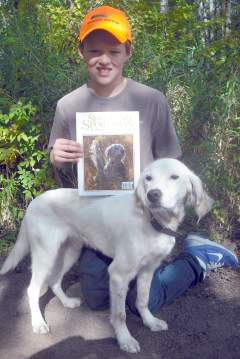 Enter Paul Diggan, age 12. Paul is the son of Mark and Martha Diggan of Sandstone. Mark is a good friend of Dan Stadin, the guy who works with us, and through Mark, Paul also is a friend of Dan’s. In fact, Paul often accompanies Dan to work and has spent hours with us either in the kennel doing chores or out in the field working dogs.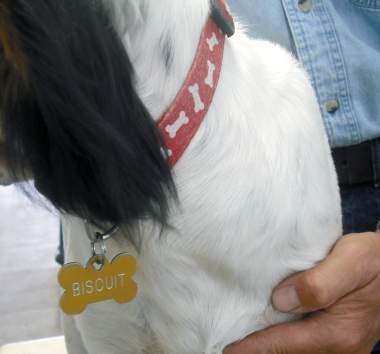
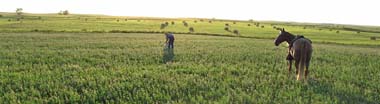
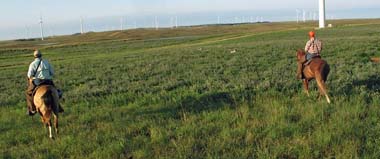
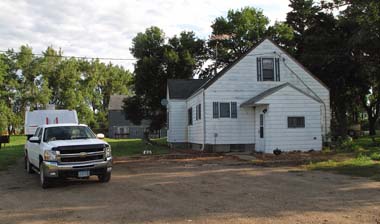
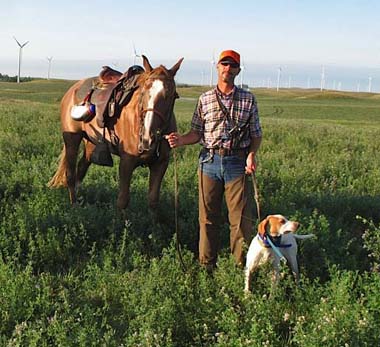
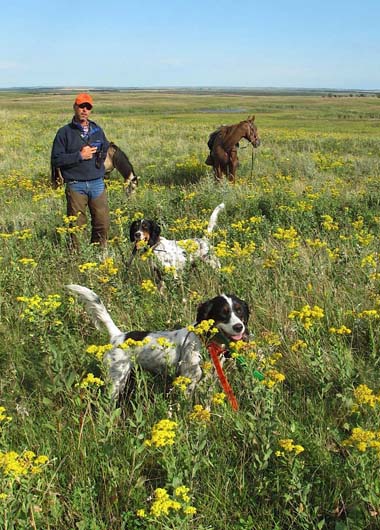
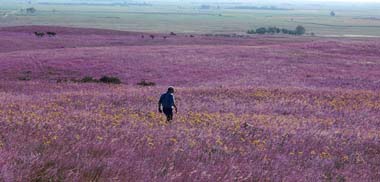
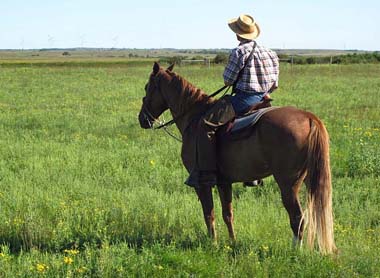
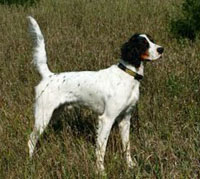 Three-year-old Ridge Creek Cody, a setter male co-bred by Paul Hauge and Northwoods Bird Dogs, won Runner-up in the All America Open Shooting Dog Championship. The trial was held near Carson, North Dakota, and was run on native pheasants and sharp-tailed grouse.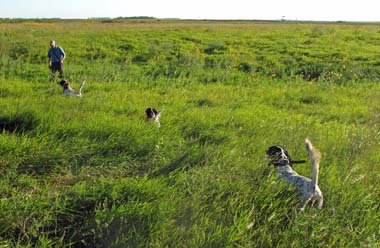
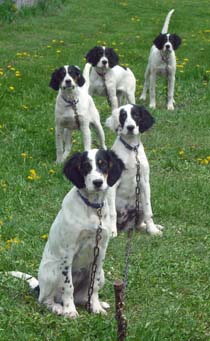 When Betsy and I sit down to discuss litters we’d like to produce, it’s a fun process but it also takes hard work. We look at individual sires and dams. We also look at possible combinations of traits, characteristics and tendencies of those dogs, both in the field and in the kennel.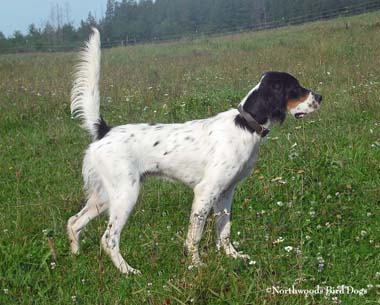
 The all-female litter out of CH Westfall’s Black Ice x Northwoods Prancer is now about 12 weeks old.
 These two couldn’t be cuter or more precocious or more fun. Vixen lives in the house with us and I love sitting on the floor with her and her chew toys. One day Jerry threw a dead pigeon for her. She ran out, picked it up (it was as big as she was) and carried it all the way back to him.