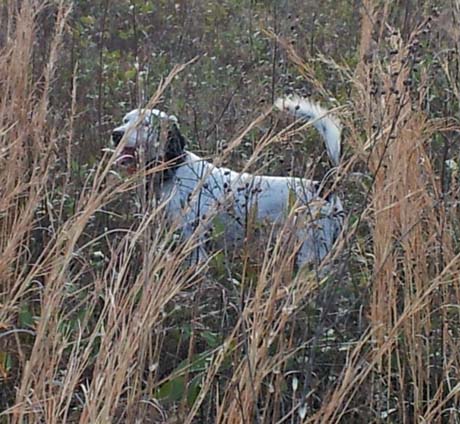
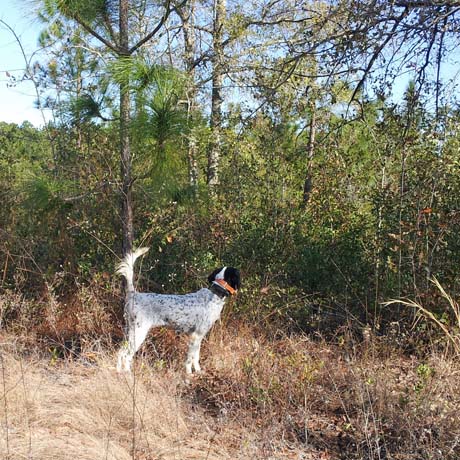
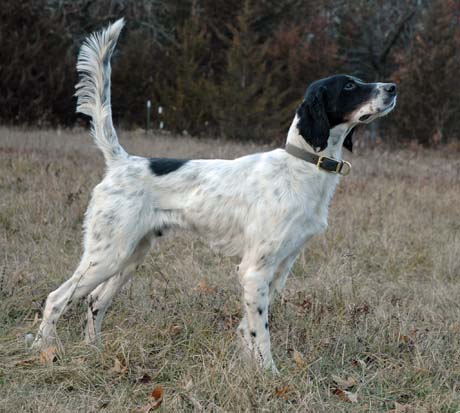
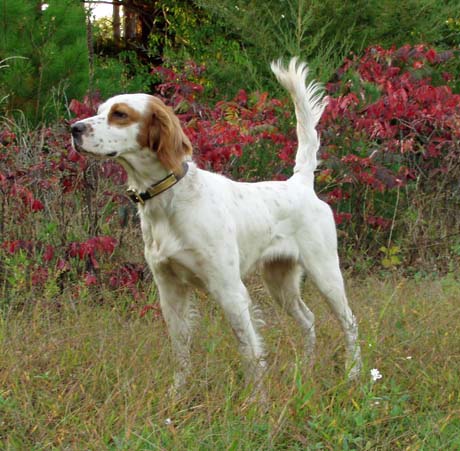
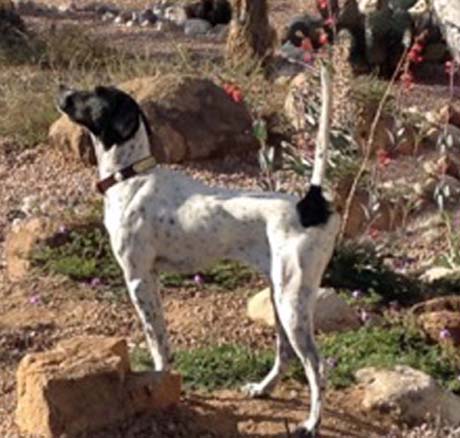
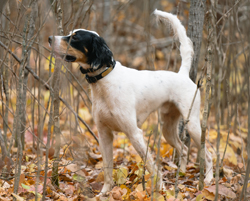
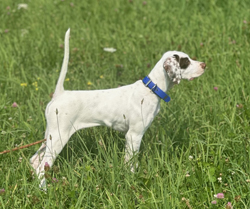
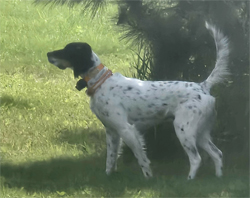
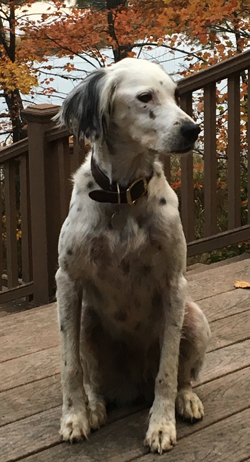
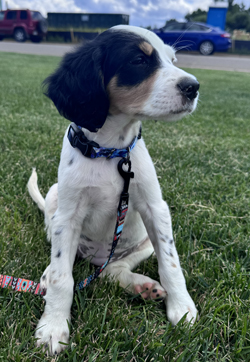
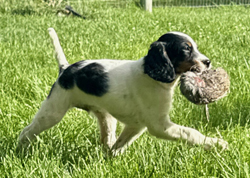
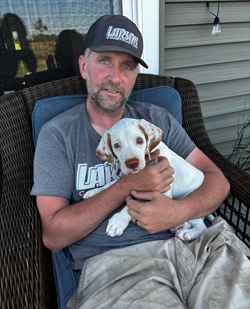
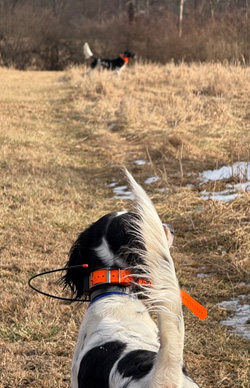
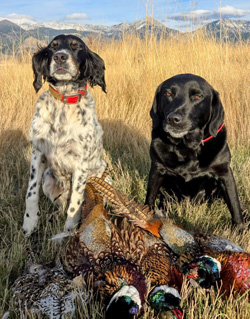
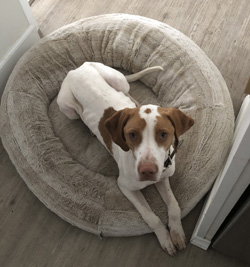
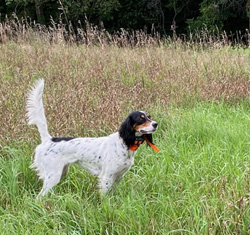
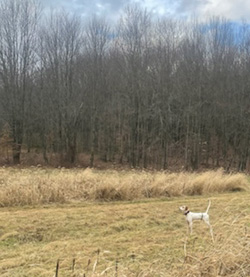
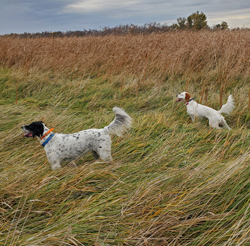
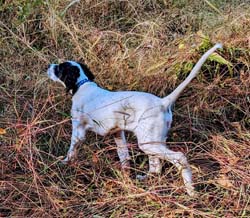
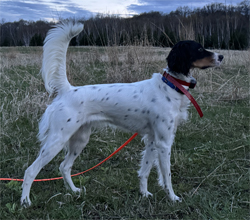
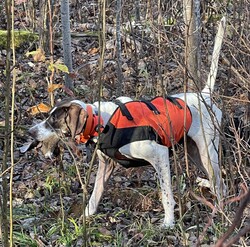
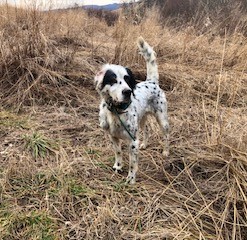
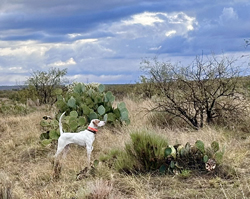
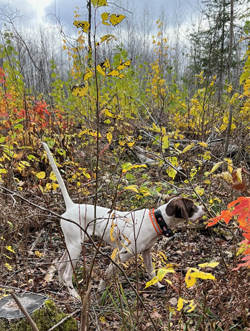
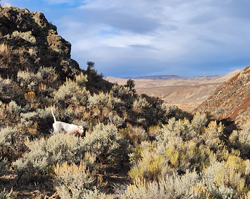
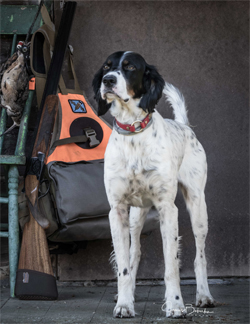
Chablis (Blue Shaquille x Houston’s Belle’s Choice) finds a covey in tall broomsedge bluestem (Andropogon virginicus).
Jerry and I have been in the Thomasville area of southwestern Georgia since January 5 and now are fully in the groove. We’ve even started eating grits, pimento cheese and mayhaw jelly.
Since there were few reported wild coveys on the 600-acre farm where the kennel and house are located, Jerry reserved 175 quail and planned to put out coveys. He explored the grounds to find 12 spots with good cover.
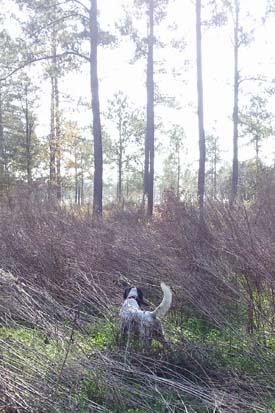
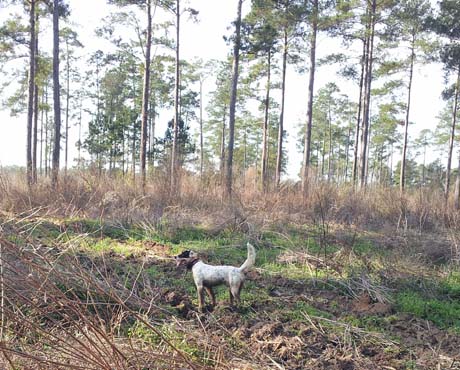
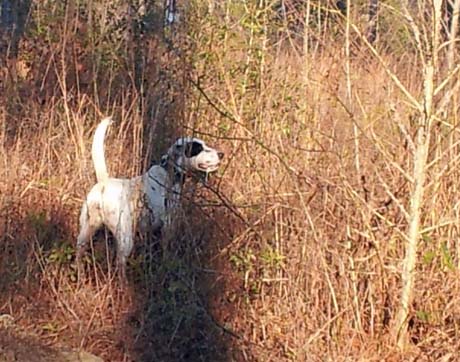
Tripp (Houston x Northwoods Blue Babe) has a beautiful find in the middle of a large strip.
In the afternoon of the day he picked up the quail, we placed 12 birds and spread a bucket of milo at each location. He put the balance of 31 birds in the Johnny house.
After giving the quail a bit of time to settle in, Jerry started working dogs on them. He has also driven the quick six miles to the Miami Plantation, a 2,000-acre plantation managed specifically for wild birds that is part of our farm.
The dogs have pointed quail in different locations and in various types of habitat—including mown and harrowed strips, edges near deciduous shrubs and small trees, in knocked down (un-identified) cane-y plants and near clumps of broomsedge bluestem (Andropogon virginicus).
Even though the habitat can be diverse, one genus of plants provides a unifying look and feel to the landscape. Stately pine trees, either longleaf (Pinus palustris) or loblolly (Pinus taeda), tower high overhead.
Franny (Northwoods Blue Ox x CH Houston’s Belle) points a quail covey at the edge of a harrowed strip.
In the shadow of a tall pine, Liz (CH Magic’s Rocky Belleboa x CH Houston’s Belle) nails a covey.
Choice (Gusty Blue x CH Houston’s Belle) has a nice find on a covey that was buried in dense cover at the edge of field.
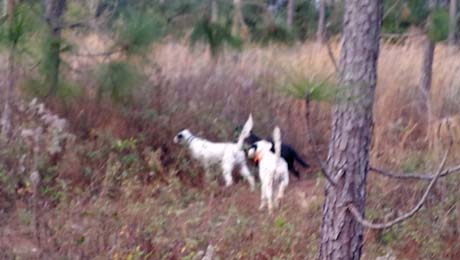
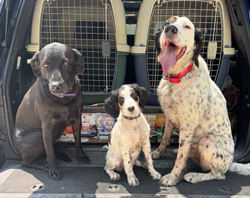
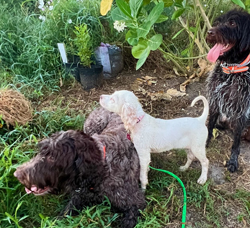
Setter puppy Manhattan (Northwoods Blue Ox x Northwoods Chardonnay) and Labrador May (rather unusual but not unprecedented for May) score a divided find while stylish setter puppy Rickey (Blue Shaquille x Snyder’s Liz) backs.
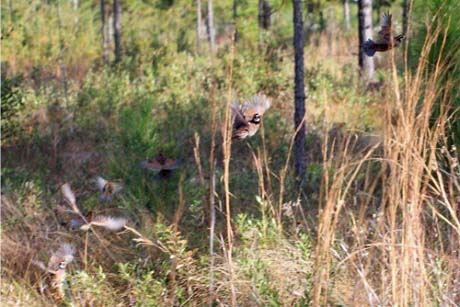
A covey of bobwhite quail flush under the pines of a southern Georgia plantation.
For almost as long as I’ve been training bird dogs, I’ve used bobwhite quail. I’ve planted single quail, flushed quail from various recall pens and put out free coveys. I’ve followed their tracks in the snow; watched as a separated covey re-grouped; and observed roosting and feeding areas. Whether in Minnesota, Texas, Oklahoma, Illinois, Tennessee or Georgia, I’ve watched hundreds of encounters between bobwhites and dogs.
In addition, I’ve been on countless hunting trips for quail throughout the Midwest. All this experience and observation has taught me a lot about their preferences and habits.
On our home training grounds, I buy enough bobwhites in July to fill four Johnny houses and use them until the snow stops me from training. These quail grow into extremely strong flyers that know their terrain as well as a wild bird. They even become comfortable enough to remain outside the recall pens and are healthy enough to survive on their own during winter conditions.
In August 2012, a covey disappeared from a recall pen and Dan and I couldn’t use that Johnny house during fall training. In mid December we heard that a covey of 11 had been flushed not far from the pen. This covey had been on its own for four months! When I checked it out—and by then it had snowed five inches—the covey flushed wild from a hillside with tall oak trees. The area was covered with quail tracks, snow had been scratched away and acorn pieces were scattered everywhere. Those birds had discovered a great food supply and had thrived.
Sometimes, though, they just disappear and I don’t know why.
Here are more observations about bobwhite quail.
• Late in October 2011, Dan and I put out a covey in a likely location—a south-facing slope with lots of good cover options—and then spread feed around the area several times each week. In spite of several snow falls and sub-zero temperatures, we saw this covey into early March 2012.
• Dogs often find ruffed grouse in the vicinity of the recall houses. This might be coincidental but it does seem quail and grouse are in close proximity. In fact, I’ve seen evidence that grouse feed on the scratch grain we spread for the put-out coveys.
• Like most adult game birds, the worst predators for bobwhites are hawks and owls. Often when it’s difficult to flush them from the Johnny house, a hawk is the reason. One will swoop in after some birds have been encouraged to leave. Cooper’s hawks are especially deadly. Countless times in Tennessee I saw a Cooper’s leaving a covey location when I approached to spread feed. They even chased quail when flushed from a covey in front of a dog’s point.
• Last year, I hauled two dozen quail from our Tennessee training grounds back to Minnesota, thinking I could use them for some spring training. Even though Dan and I flushed a few, they didn’t recall back to their Johnny house. My guess is that they had started to pair up and preferred to stay out with their chosen mates. One male in particular started showing up around our house in early May. Betsy and I saw him only occasionally but heard his distinctive whistle almost daily. Later in June, our neighbor Jeff spotted a female quail with several chicks just east of our kennel. This brood turned into a small covey that was flushed occasionally in the same vicinity until late fall.
Jerry and I are heartbroken to pass along the news that 5XCH/7X RU-CH Westfall’s Black Ice died in December. Even though Ice was healthy when I saw him in June, he had recurring cancerous growths that finally overtook him.
Ice was always impressive in the field and racked up championship win after championship win. But we liked Ice perhaps even more because of his temperament. His beautiful brown eyes were intelligent and displayed a calmness and good disposition. Ice was handsome, too. He was black-and-white with an evenly marked head. He was lightly ticked and had no body spots.
Ice was owned by Bill and Ryan Westfall of Liberty, Missouri. Jerry and I got to know Ice when we trained on their farm in Tennessee.
Ice is a multiple shooting dog champion with a pedigree to back it up. He is out of the very successful nick of Rock Acre Blackhawk x Elhew Katie Lee whose progeny included many field trial winners and even more outstanding wild bird dogs.
Even though Ice himself was bred sparingly during his lifetime, he had the pre-potency of his sire and produced an impressive list of field trial winners. His numbers are 34-24-213.
When we bred him to Northwoods Prancer in 2011, the entire litter of eight females was outstanding grouse dogs—natural, keen, easy to train, loved to retrieve and even liked the water. Plus, most importantly, all were well-adjusted with happy personalities.
Thankfully, we can carry on with some of Ice’s talented daughters, including our own Northwoods Vixen.
Maybe Izzie is as sharp as Snoopy and can read. One look into her beautiful, brown eyes does reveal her intelligence and good sensibility.
Izzie has been featured in three recent blog posts and perhaps has glanced over Jeff’s shoulder when he powers up his Ipad. She is definitely our poster child for “How to pick a puppy.”
November 28, 2012: How to pick a puppy “Since at eight weeks of age it’s impossible to definitively know what the puppy will become, any puppy should be ideal—no matter the picking order, no matter whether it’s the first pick or last.”
About two years ago, Jeff was in the market for a puppy and, in exchange for his work with us, we made a deal. He could have the last pick of our Ice x Prancer litter.
November 21, 2012: Winning wild bird field trial championships “Even though Izzie is just a derby, I feel compelled to include her because she has all the makings to be a champion.”
Izzie was whelped on April 17, 2011 (she is only 20 months old!) and was very successful last fall. In four derby stakes, she won two and twice placed second.
October 8, 2012: Jeff and Izzie: An inseparable pair “Izzie is a sweetheart in the house and a tiger in the field. She was quite precocious and last year Jeff successfully hunted her on grouse, woodcock and the quail of southern Arizona.”
Too, Izzie has the genes of a champion. Her sire is Westfall’s Black Ice, a five-time champion and seven-time runner-up champion. Out of Northwoods Prancer on the bottom side, her great grandparents were both multiple grouse champions, Brooks Elhew Ranger and Dance Smartly. Rather unusual for a dam, both parents of Dance Smartly were also multiple champions, Northern Dancer and Vanidestine’s Rail Lady (a six-time champion!).
But, truly, Jeff deserves all the credit. What any dog becomes depends on how it is raised, developed, handled and trained. Since she was a four-month-old puppy, Izzie has been hunted and worked at least three days a week.
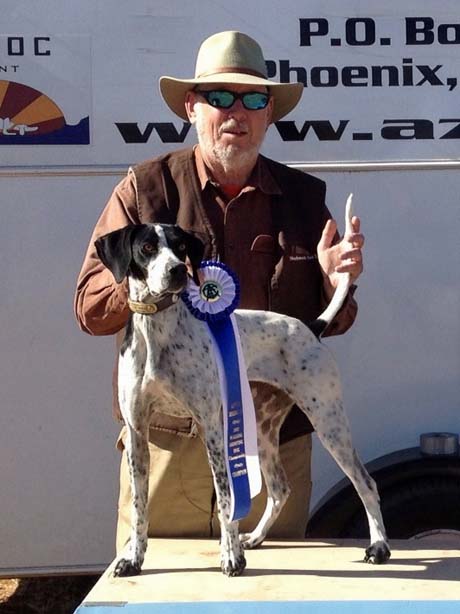
In early January, on the Empire Ranch of Sonoita, Arizona, Izzie was named champion at the Region 12 Amateur Walking Shooting Dog Championship. She ran a strong, forward race and went on point where no dog had gone. At the shot, she stood tall and firm. Amazingly just days before, Izzie had placed third in the horseback derby stake.
Congratulations, Jeff and Izzie! You deserve that big blue ribbon.
The purpose of a pointing dog is to hunt, find birds and point them until the shooter arrives. Unlike flushing dogs, they are supposed to hunt outside of shotgun range and find birds the hunter would not have found otherwise
…And range, although it is partly governed by training, is basically in the blood. Anything you do to alter it requires continued effort. ~ George Bird Evans, Troubles With Bird Dogs
The distance a dog hunts, or makes casts, from its handler is referred to as its range. Range is a genetic quality that can be selectively bred just as square heads, long legs and desire for birds. Consequently, a dog is born with a tendency to hunt at a certain range. If two wide-ranging dogs are bred, odds are the offspring will also be wide ranging. The same can be said for close- and medium-ranging dogs. This inherited range can be modified through training, but trying to make drastic changes can have a negative impact on a dog’s hunting ability.
Range is somewhat difficult to describe because dogs don’t consistently hunt at a specific distance from the handler. While a dog hunts, it is either going away or checking in with the handler. A dog that will willingly make contact, either visually or by sound, at frequent intervals during the hunt is said to be handling. This checking, to a large extent, determines the dog’s range.
In open country, the dog might see the handler from several hundred yards away but in tight cover that distance might be less than 20 yards. Making contact confirms the whereabouts of the dog and that it is hunting in the right direction. Our grouse dogs may make casts of 100 – 200 yards through the woods—depending on the density of the cover—but at the end of each cast, they hunt their way forward and make eye contact as they cross in front. As an alternative, they might stop and listen for our whereabouts before continuing to hunt.
Good hunting dogs are divided into three classes: wide, medium and close ranging. It is not practical to try to make a close-ranging dog out of either of the two other classes. You positively cannot make a wide ranging dog out of a close-in hunting dog. The wide and medium range dogs should be trained so that they will hunt close in under restraint. After the restraint is lifted, they will revert to their natural range. ~ Er Shelley, Bird Dog Training Today and Tomorrow, 1921
A common thought is that a wide-ranging dog finds more birds because it covers more territory. Actually, though, two dogs hunting at the same speed can only hunt the same amount of ground. The difference lies in what ground was hunted. This is where coverage of ground comes into play.
A wide-ranging dog may cover more linear distance, but it doesn’t cover that ground as thoroughly as a closer-ranging dog. Depending on the nature of the terrain being hunted, this could make a difference in which type of dog finds the most birds.
At Northwoods Bird Dogs, we favor a well-conformed, athletic dog with a strong desire to find birds; and one that has the ability to adapt its range using intelligence as opposed to one with circumscribed range because it is physically inferior or lacks desire. Our type of dog will naturally adjust its range and speed depending on the terrain being hunted and the pace of the handler. This dog will hunt wider in prairie, desert or field edges, but shorten up its range in thick or wooded areas. Along with increasing their range, they will also increase their speed when hunted in open areas.
Some dogs have the ability to adapt their range to different types of country and handle themselves properly no matter what type of terrain they are asked to work. But this quality is unusual and valuable, indeed, when a dog possesses it in a marked degree. ~ Henry P. Davis, Training Your Own Bird Dog, 1948
For a dog to have such an adjustable range, it must not only be intelligent but must have a strong desire to work with and please its handler. The latter quality falls under the broad category of “trainability” and is one of the most important traits in a dog. A trainable dog will allow its range, and other habits, to be more easily modified and without the side effects of one that is less trainable.
Top photo of Northwoods Vixen taken by Chris Mathan, The Sportsman’s Cabinet.
There is nothing more exhilarating to a bird dog or a bird hunter than the flush of birds.
It begins with the intense demeanor of the dog as it stands on point. Anticipation follows when the hunter moves in front of the dog. The explosion of wings is the thrilling culmination.
Ah, I never tire of watching or hearing birds flush.
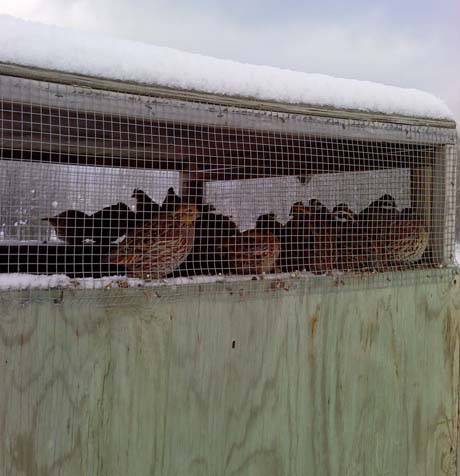
In addition to pigeons, we use bobwhite quail to train dogs. Four recall pens called Johnny houses are placed strategically around the pastures—near wood edges and clearings. In early July, I buy 12-week-old bobwhites and put about 35 in each Johnny house. They come to know their terrain and learn how to covey up just like wild birds. And by the end of the season, the birds are incredibly strong flyers.
Recently I visited all four Johnny houses to feed, water and check on the quail. I also opened wide the release door to let the birds out.
This video shows bobwhites flushing from each house. Enjoy!
Even though the ruffed grouse drumming counts last spring showed an average decline of 24 to 60% across Minnesota, I had a pleasant surprise this fall. Based on the number of grouse we flushed during our guided hunts, the broods had good survival rates. This was confirmed by the higher than expected ratio of young-to-old grouse we bagged.
Overall, we averaged 3.8 grouse flushes per hour during our hunts, which was slightly higher than last year. Most of the reports from our clients and fellow hunters also extolled markedly higher flush counts.
The bigger surprise, however, was the number of woodcock. We flushed almost three times as many woodcock as in 2011 and maybe the most we’ve seen in more than five years.
Clients of ours who hunted Michigan and Wisconsin also reported excellent numbers of woodcock.
Minnesota frequently is the nation’s top ruffed grouse producer. On average, 115,000 hunters harvest 545,000 ruffed grouse in Minnesota each year, also making it the state’s most popular game bird. During the peak years of 1971 and 1989, hunters harvested more than 1 million ruffed grouse. Michigan and Wisconsin—states that frequently field more hunters than Minnesota—round out the top three states in ruffed grouse harvest.
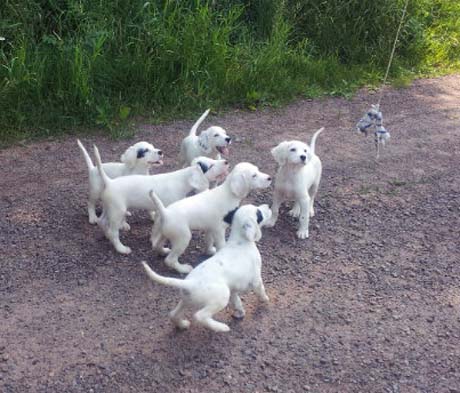
Blue Shaquille x Snyder’s Liz puppies point the wing at eight weeks of age.
I’ve closely watched and kept records on the progress of hundreds of pups. Those records clearly and conclusively show that it is absolutely impossible at 8, 10, 12 weeks of age to pick out the best pup or pups, no matter who you are or what you know. ~ John Wick, The Tree Dog Encyclopedia
Betsy and I are often asked our advice on how to pick the best puppy. After 17 years of breeding, raising and training puppies, we have an answer. While it’s simply not possible to know precisely what an eight-week-old puppy will become, we think that if you follow these three steps, you’ll be happy.
Choose the right breeder. Choose the right litter. Just pick the puppy.
#1. Choose the right breeder.
Within breeds, there can be tremendous differences between any two litters produced by any two breeders. And while a great dog can come from anywhere, consistently top-notch dogs come from breeders with vision. Betsy and I are now producing our sixth generation of English setters and fourth generation of pointers. This depth of knowledge enables us to make comprehensive breeding decisions which result in puppies with predictable traits.
We continuously evaluate our own dogs, especially on ruffed grouse and other wild birds. When we go outside our kennel, we’re never impressed by pedigrees and titles; rather it is imperative to see and appraise the dogs personally.
Our commitment is to breed setters and pointers with outstanding instinct, talent, conformation and temperament.
#2. Choose the right litter.
A breeder should listen carefully to your preferences and requirements. Some distinctions for us are setter/pointer, male/female, retrieving instinct and hunting style.
At our kennel, Betsy and I like to show puppy buyers the dam and sire, grandparents (if possible) and any other relatives, including puppies with similar breeding. After some discussions, the choice becomes clear.
#3. Just pick the puppy.
This is the easiest part. Since at eight weeks of age it’s impossible to definitively know what the puppy will become, any puppy should be ideal—no matter the picking order, no matter whether it’s the first pick or last. Choose based on color, markings, relative size or just pick the puppy that most appeals to you.
Finally, remember this key part. What the puppy eventually becomes will depend to a significant part on how it is raised, developed, handled and trained.
Dogs, like us, are more than their genome. No animal develops in a vacuum: genes interact with the environment to produce the dog you come to know. ~ Alexandra Horowitz, Inside of a Dog
To have a good wild bird dog takes hours and hours of training, days in the field and several seasons of hunting. To have a dog capable of winning a wild bird field trial championship takes that and so much more.
…field trials were not instituted for the purpose of bringing to the front a dog or class of dogs eminently suited for the wants of the average gunner, whose primary objective in using a dog afield is to swell the game bag, regardless of the manner that his dog performs. Rather it is for the purpose of bringing to the notice of the public a class of performers best suited to perpetuate the most desirable qualities possessed by the high-class field dog.
~William F, Brown, Field Trials 1947
The field trial competitor must stop on a flush, be steady to wing and shot, hunt in the right places and cover as much ground as possible, yet still stay in touch with the handler. The dog should always work in a forward fashion and with style, strength and flair. And to win big, the dog must not just perform well; it must perform to near perfection.
Preparation for fall trials begins in late June. The dogs start a physical conditioning routine three to four times per week to develop strength and stamina and to toughen their feet. In July, dogs are tuned up on their manners around birds with planted birds. For the next two months, the trainers/handlers spend many days traveling to areas where the dogs can be worked on wild birds. Physical conditioning continues and diets are strictly monitored to keep the dogs in peak condition. When the venues are horseback trials, another time-consuming level of commitment is necessary to condition and train several good horses.
After months of this intense preparation, the trainers/handlers again hit the road to attend the trials—some of which can be hundreds of miles away—and then spend more time at the trial. Each dog gets one chance, usually for an hour, to prove to the judges that they deserve to be named a champion.
Many things can go wrong and some are out of control of the handler. The luck of the draw is a major consideration. So too is incompatible weather, time of day, lack of birds or incompatible brace mates. It sometimes seems that the odds of everything coming together for a specific dog to win are nearly impossible.
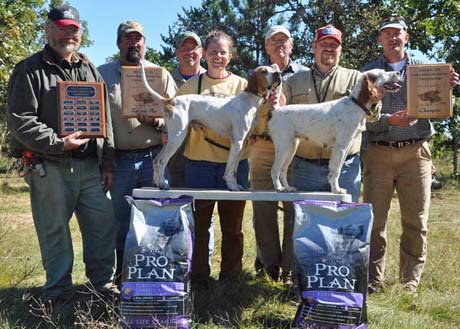
This fall, three dogs produced by our kennel won wild bird championships. Good genetics are essential, but these owners/handlers deserve all the credit.
Betsy and I are proud of these dogs and thank their owners for their hard work and commitment.
2xCH/RU-CH Ridge Creek Cody (CH Can’t Go Wrong x CH Houston’s Belle)
Cody is owned by Larry Brutger of Saint Cloud, Minnesota. Larry handles Cody in amateur horseback shooting dog trials and professional Shawn Kinklaar is the handler in open competition. Cody, handled by Larry, won the National Amateur Pheasant Shooting Dog Championship held in August near Circle, Montana. Larry also is successful in AKC field trial competition with Cody and his other setters.
CH Houston’s Blackjack (CH Can’t Go Wrong x CH Houston’s Belle)
Blackjack is co-owned by Frank LaNasa of Isanti, Minnesota, and Leroy Peterson of Slayton, Minnesota. Frank trains and handles Jack in open and amateur horseback shooting dog competition. In September, Blackjack was named champion at the National Amateur Prairie Chicken Shooting Dog Championship held at the Buena Vista field trials grounds near Wisconsin Rapids, Wisconsin. Frank is renowned for running championship pointers; this is his first championship win with a setter.
2xCH/RU-CH I’m Blue Gert (I’m Houston’s Image x Blue Silk)
Gert is owned by Dave and Rochelle Moore of Big Lake, Minnesota. Dave trains and handles Gert in wild bird grouse trials and hunts over her extensively. In October, Dave handled Gert to runner-up champion in the Minnesota Grouse Dog Championship held in the Rum River State Forest near Mora, Minnesota. He has also been successful in wild bird field trials with other setters and pointers.
JTH Izzie (CH Westfall’s Black Ice x Northwoods Prancer)
Even though Izzie is just a derby, I feel compelled to include her because she has all the makings to be a champion. Izzie is owned by Jeff Hintz of Ham Lake, Minnesota, and Tucson, Arizona. Jeff hunts, trains and competes in field trials in both locations. Izzie won first place in the Danforth Social Society and Fine Bird Dogs Open Derby held in late summer. She placed second in the Region 19 Amateur Derby, which was a horseback stake. In October, Izzie finished second in the Minnesota Grouse Dog Reuel Henry Pietz Derby Classic and won first place in the Moose River Grouse Dog Open Derby.
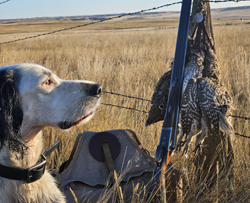
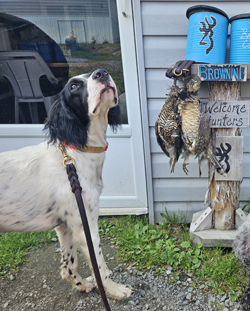
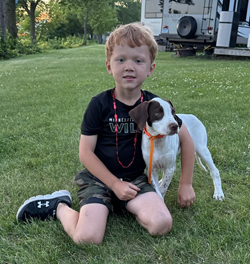
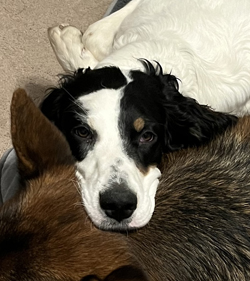
Molly (RU-CH Northwoods Atlas x Houston’s Nelly Bly, 2023) backs Charlie (Northwoods Grits x Northwoods Carbon, 2017) ~ Ken and Caroline Taylor, Jim and Flo DePolo, respectively, Pennsylvania
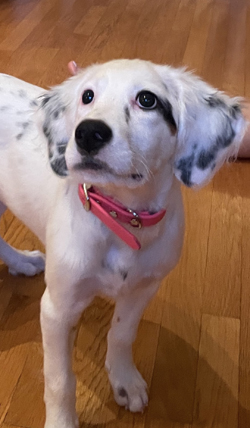
Filly (May’s Pond Hank x Northwoods Stardust, 2024) ~ Tom and Lauren Strand Family, Minnesota
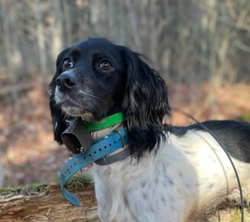
Rae (CH Ridge Creek Cody x Northwoods Chardonnay, 2013) ~ David Larson, Minnesota
Junie (HOF CH True Confidence x Northwoods Comet, 2021) ~ Joey Paxman and Amanda Allpress, Montana
Normanie (RU-CH Northwoods Nirvana x Northwoods Carbon, 2017) and her pal ~ Walter Manley, Florida
Archie (CH Miller’s Upgraded Version x Northwoods Comet, 2024) ~ Blake and Solveig Nelson, Minnesota
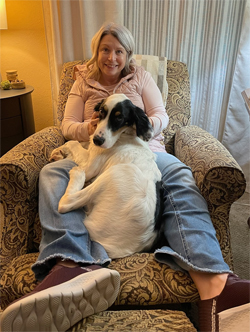
Molly (RU-CH Northwoods Atlas x Houston’s Nelly Bly, 2023) ~ Ken and Caroline Taylor, Pennsylvania
Caddie (CH Southern Confidence x Northwoods Comet, 2023) ~ Brian Smith, Pennsylvania
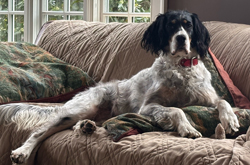
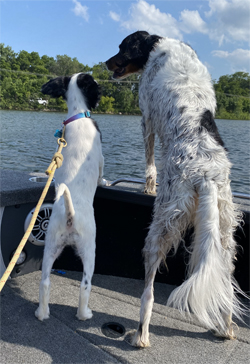
Frisco (Blue Riptide x Northwoods Carly Simon, 2014), on left, and Zion (CH Snyder’s Pioneer Scout x Northwoods Cedar, 2022) ~ Rick and Jodi Buchholz, North Dakota
Rip (CH Woodville’s Yukon Cornelius x Northwoods Redbreast, 2024) ~ Greg and Michelle Johnson, Wisconsin
Miles (RU-CH Northwoods Atlas x Northwoods Madrid, 2024) ~ Lars Totton, New Jersey
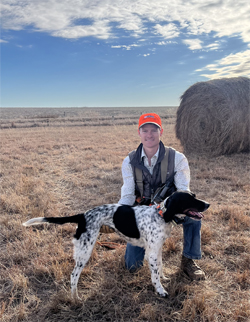
Rip (Northwoods Louis Vuitton x Houston’s Dancing Queen, 2022) ~ Mark Fitchett, Kansas
Vida (RU-CH Erin’s Prometheus x Northwoods Carly Simon, 2019) ~ Tom Condon, Montana
Suki (May’s Pond Hank x Northwoods Stardust, 2024) ~ Eric Beauregard, Massachusetts
Winnie (CH Miller’s Upgraded Version x Northwoods Comet, 2024) ~ Joe and Jess Nelson Family, Minnesota
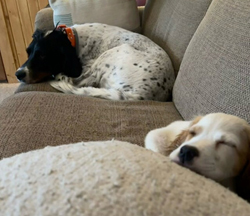
Tally (May’s Pond Hank x Northwoods Stardust, 2024), on left, and Georgia (Northwoods Grits x Northwoods Carly Simon, 2015) ~ Joe and Deb Wech, Minnesota
Cosmos (RU-CH Erin’s Prometheus x Northwoods Carly Simon, 2019), on right, and his pal ~ The Collins Family, Georgia
Stanley (May's Pond Hank x Northwoods Stardust, 2024) ~ Johansson Family, Minnesota
Tyler (CH Miller’s Upgraded Version x Northwoods Comet, 2024) ~ Josh and Des Matel, Minnesota
Filly (May’s Pond Hank x Northwoods Stardust, 2024) ~ Tom and Lauren Strand Family, Minnesota
Sage (CH Miller’s Upgraded Version x Northwoods Comet, 2024), top, and Louis (CH Erin's Hidden Shamrock x Northwoods Nickel, 2018) ~ Joey Paxman and Amanda Allpress, Montana
Racer (CH Miller’s Upgraded Version x Northwoods Comet, 2024), right, and his very special pal JTH Cooper (HOF CH Rock Acre Blackhawk x Northwoods Vixen, 2015) ~ Doug and Nicole Miller, Oregon
Russell (CH Woodville’s Yukon Cornelius x Northwoods Redbreast, 2024) ~ Gregg Pike and Family, Montana
Abby (CH Woodville’s Yukon Cornelius x Northwoods Redbreast, 2024), on top of her new pal ~ Ben and Penelope Pierce, Montana
Annie (RU-CH Northwoods Nirvana x Northwoods Carbon, 2017) on her 7th birthday ~ Lynn and Kathy Olson, Iowa
Maisy (RU-CH Northwoods Atlas x Houston’s Nelly Bly, 2023) ~ Zenas and Susanne Hutcheson, Minnesota
Molly (RU-CH Northwoods Atlas x Houston’s Nelly Bly, 2023) ~ Ken and Caroline Taylor, Pennsylvania
Jordy (CH Elhew G Force x Northwoods Prancer, 2014). Look closely! ~ Mark and Janie Fouts, Wisconsin
Speck (RU-CH Erin’s Prometheus x Northwoods Carly Simon, 2018) ~ Mike Watson, Pennsylvania
RU-CH Northwoods Atlas (Northwoods Grits x Northwoods Nickel, 2017) ~ Greg and Michelle Johnson, Wisconsin
Zion (CH Snyder’s Pioneer Scout x Northwoods Cedar, 2022) ~ Rick and Jodi Buchholz, North Dakota
Harper (CH Snyder’s Pioneer Scout x Northwoods Cedar, 2022) ~ Tom Dosen-Windorski, Minnesota
Attie (Southern Confidence x Northwoods Comet, 2023) ~ Jeff and Carol Hintz, Arizona
Chester (RU-CH Northwoods Atlas x Northwoods Stardust, 2023)
~ The Milles Family, Minnesota
Millie (RU-CH Northwoods Nirvana x Northwoods Carbon, 2017) ~ Mercer Clark, Georgia
Belle (CH Southern Confidence x Northwoods Comet, 2023) ~ Kevin Sipple, Wisconsin
Piper (CH Northwoods Sir Gordon x Houston’s Nelly Bly, 2021) ~ Tom and Ashton McPherson, Pennsylvania