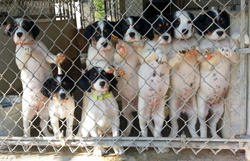
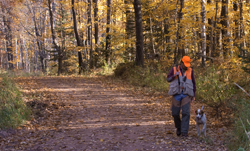
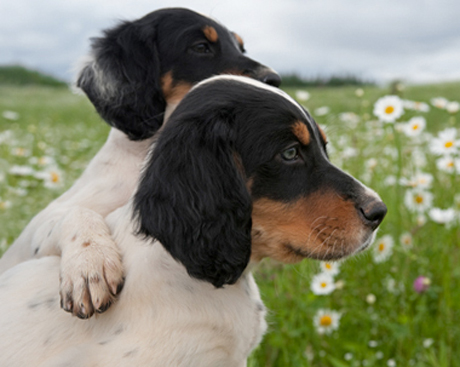
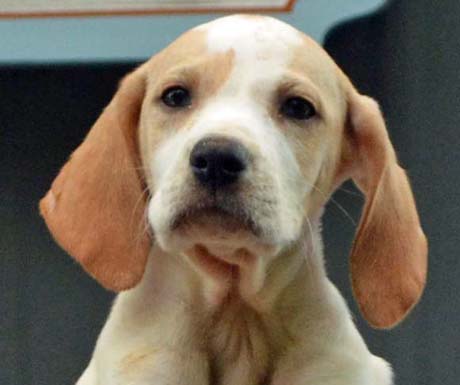
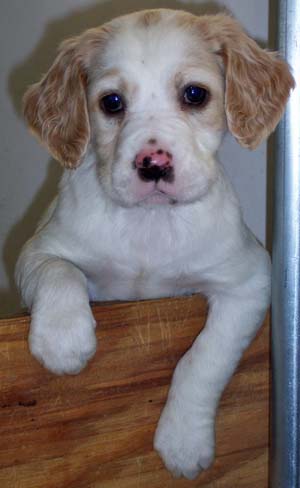
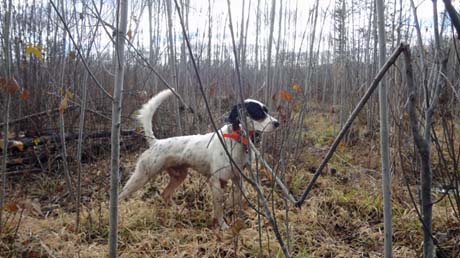
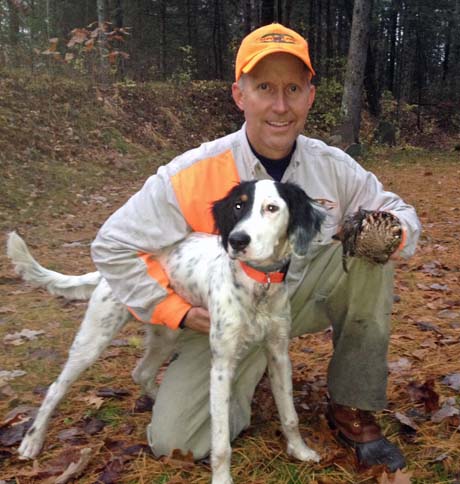
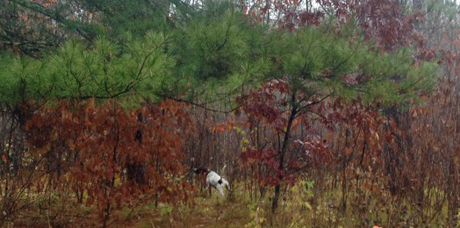
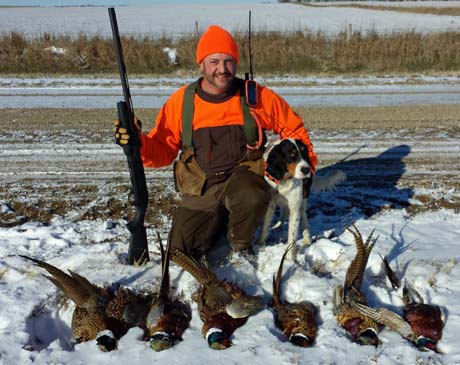
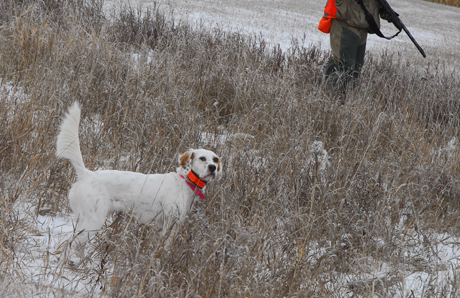
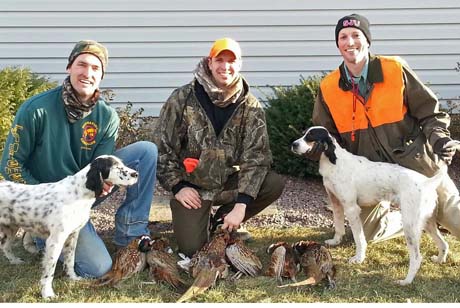
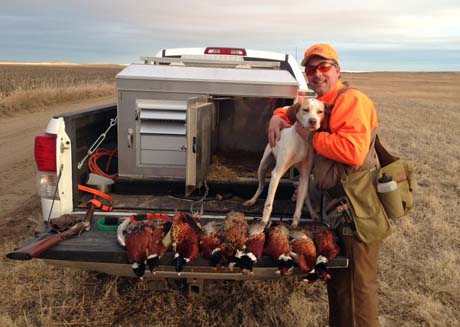
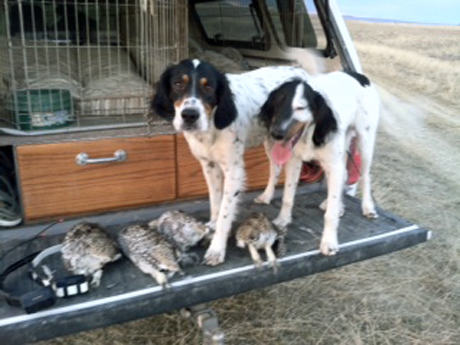
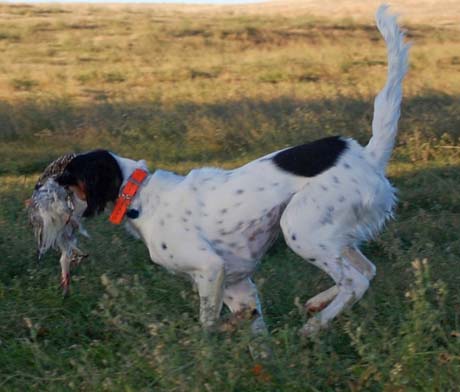
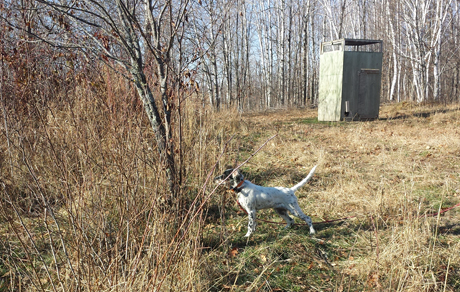
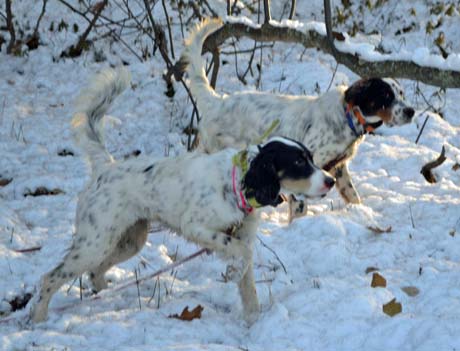
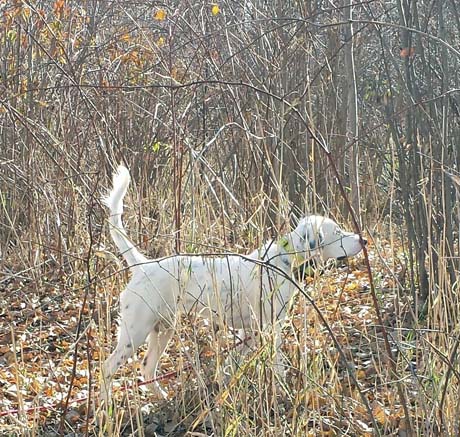
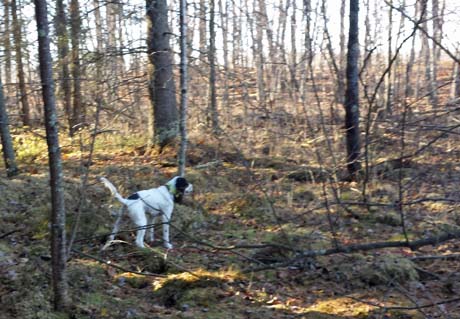
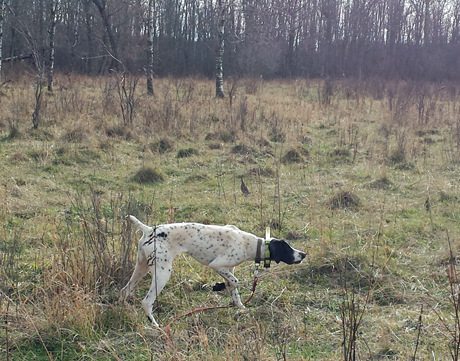
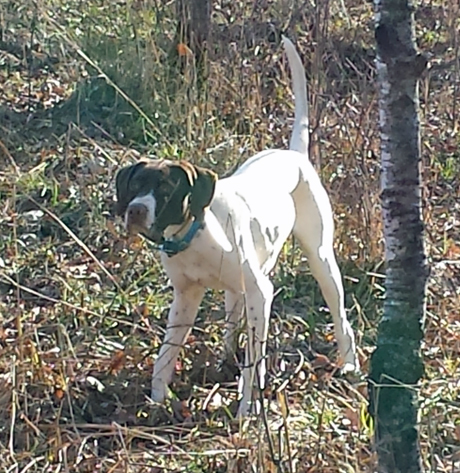
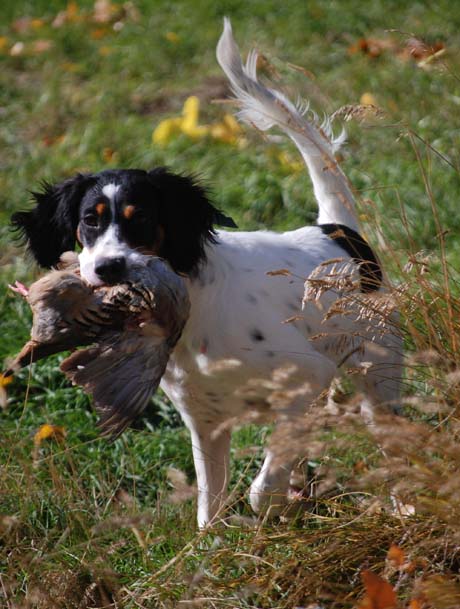
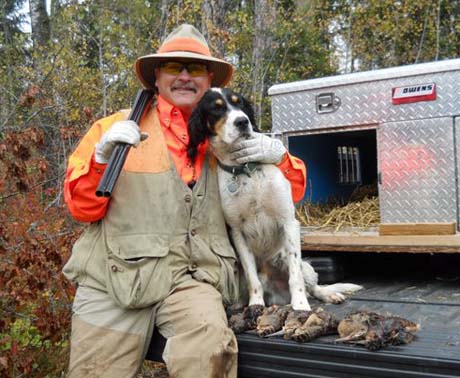
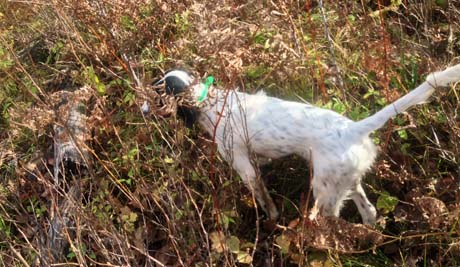
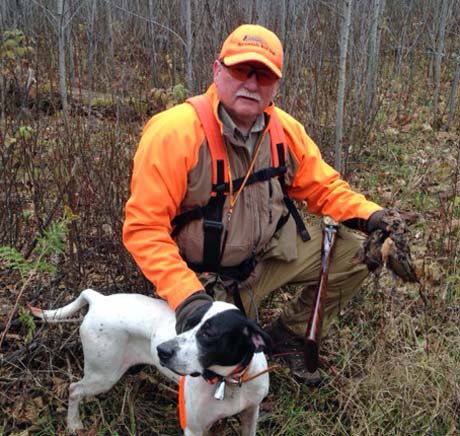
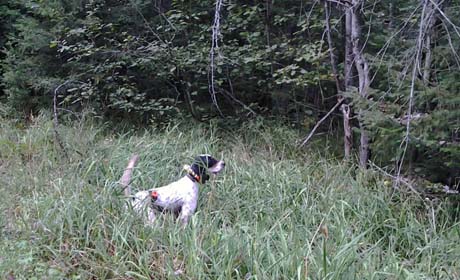
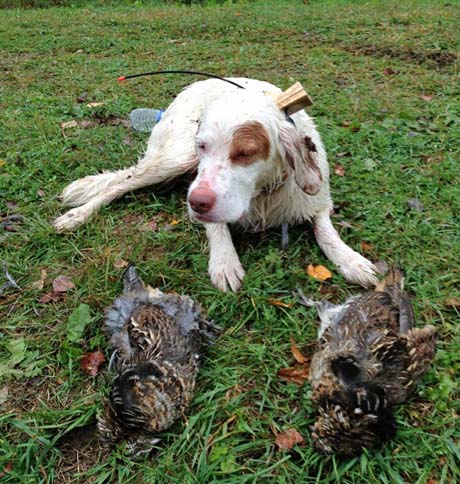
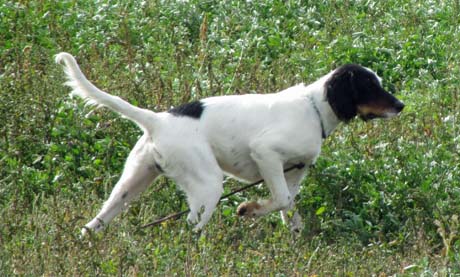
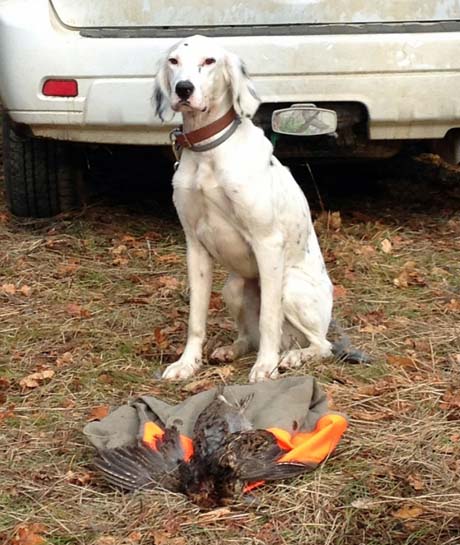
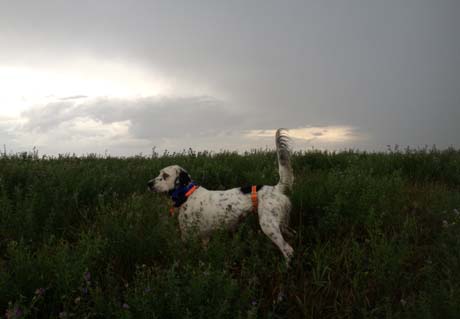
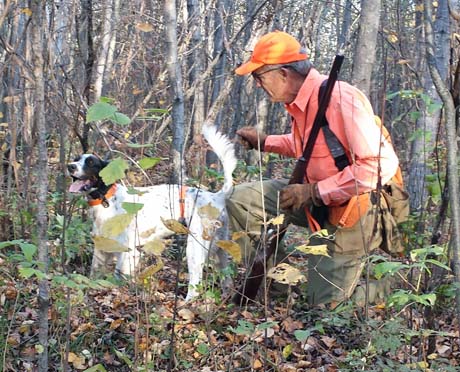
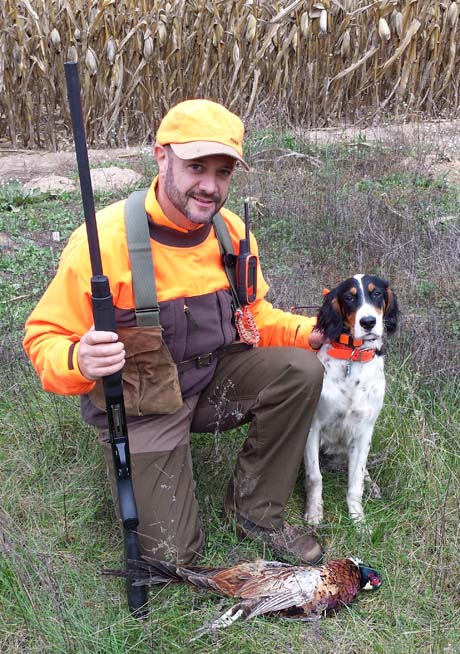
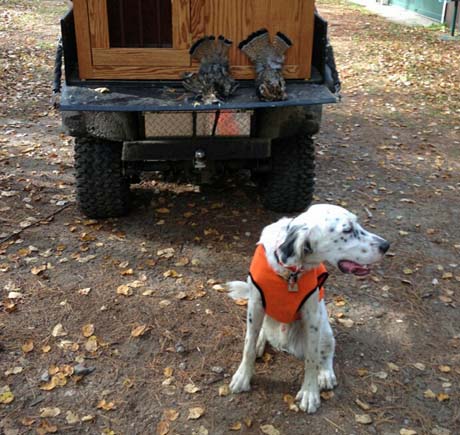
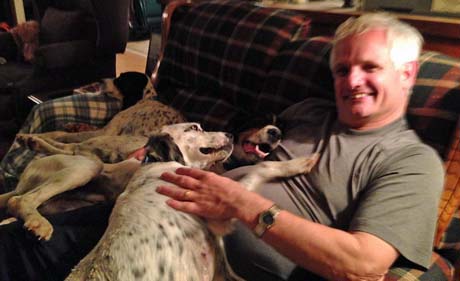
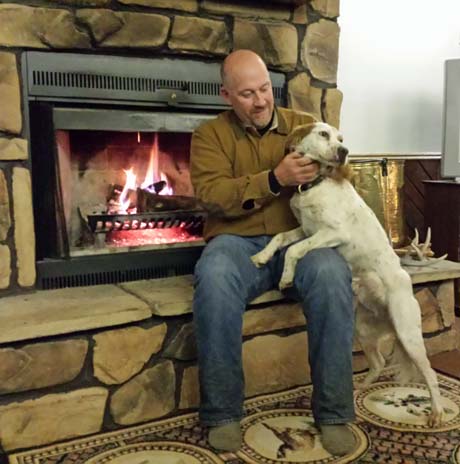
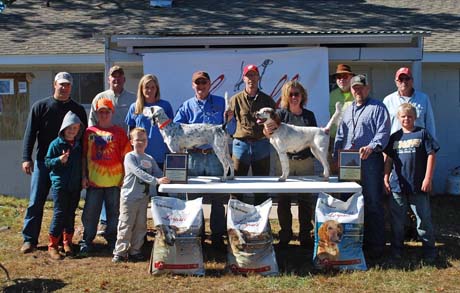
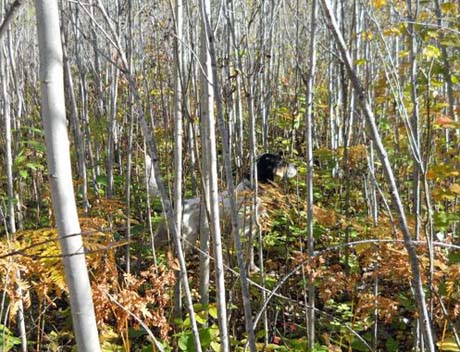
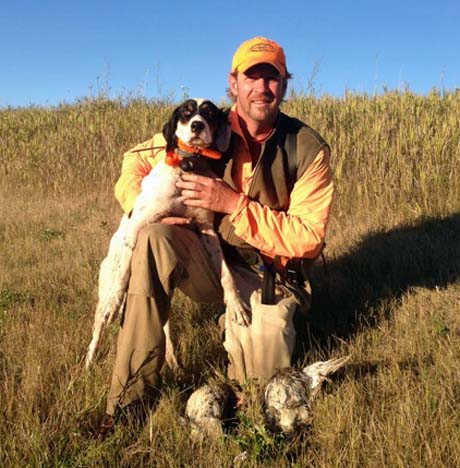
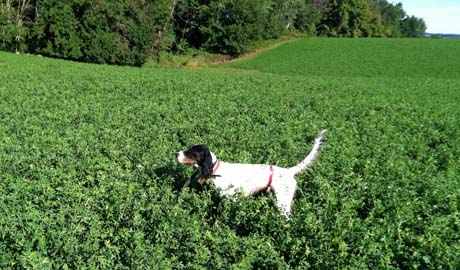
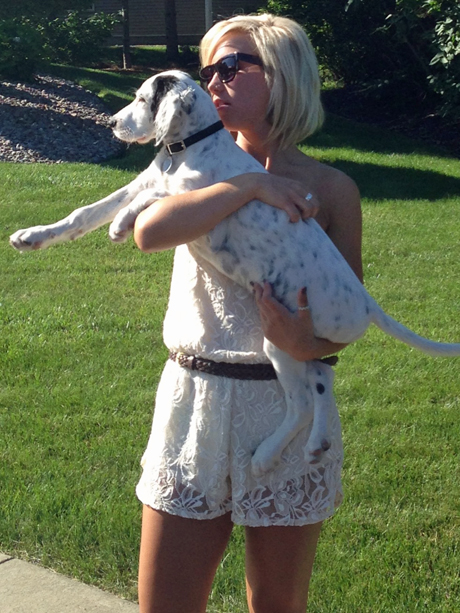
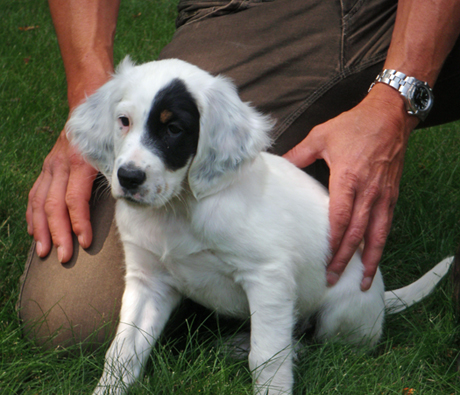
Northwoods Roquefort, on left, and Northwoods Parmigiano (Northwoods Blue Ox x Houston’s Belle’s Choice, 2010). Photo by Chris Mathan.
The overall goal of any dog breeder should be to produce healthy, happy, well-adjusted puppies.
The further objective for a breeder of bird dogs that will be in the field as hunters or field trial competitors should be to produce dogs that travel well, handle stress and pressure, take training well and perform with confidence and style.
At Northwoods Bird Dogs, a final, crucial goal is to breed pointers and setters that are as good in the home as in the field. Jerry and I strive for puppies that have it all—including intelligence and temperament.
But more than good genes are needed; early development of puppies is essential.
We’ve found that there are five factors vital to early development of puppies. Some of these practices help foster a good attitude that will make them a better dog in general. Others actually begin the very earliest stages of training—even before the puppy is aware it’s being trained.
And it all starts when the puppies are at their very tiniest.
Health of the dam.
This is so important! Jerry and I believe the dam is key. Not only is her stamina and demeanor integral for whelping, but puppies are completely dependent on her from birth to at least three weeks.
Special attention should start as soon as she’s bred. Nutrition is essential and only premium quality food should be fed. We gradually increase her daily ration with a watchful eye on her weight. Her caloric intake will peak when she is nursing and will need about twice her normal amount.
The dam should be in excellent physical condition prior to whelping. She should have daily exercise with obvious care as she gains weight.
More subtle, perhaps, but equally influential is the dam’s temperament. Even before birth, puppies are influenced by her and they continue to interact with her until completely weaned at about six weeks. For example, puppies will key off her attitude toward people.
Buddy (Elhew G Force x Northwoods Vixen, 2013).
Super Puppy.
Several years ago Jerry discovered a program that was developed by the U.S. military to improve performance of their canine units. They named it Bio Senser which later became known as Super Dog. We call it Super Puppy.
According to Dr. Carmen L. Battaglia, author and researcher, the military’s study showed that “early neurological stimulation exercises could have important and lasting effects” on the dog’s brain in terms of ability to cope, adjust and adapt to situations. The study discovered that Day 3 until Day 16 “is a period of rapid neurological growth and development.”
The benefits are numerous:
• improved heart rate
• stronger heart beats
• stronger adrenal glands
• more calm and less disturbed when stressed
• greater resistance to disease
• mature faster
• better problem solving
• more active
• more exploratory
Super Puppy is a series of five exercises. For every litter, Jerry or Dan pick up each puppy individually and perform the exercises.
Bella (Peace Dale Duke x Blue Silk, 2007).
Environment.
We whelp and raise litters in runs adjacent to our own and other dogs. From the moment our puppies are born, they are subjected to various noises of differing intensities—whether melodious voices on National Public Radio or near-deafening cacophony of 20 hungry dogs at feeding time.
Ours is a working kennel with lots of daily training activity and barking. Daily chores also result in commotion and noise.
A radio is always playing softly in the kennel. We vary the stations from NPR and rock stations to country music and, during baseball season, the Minnesota Twins station.
Socialization.
This is surely one of the easiest and yet most fulfilling parts of our job. Jerry, Dan and I spend time each day with our litters. Whether it’s Super Puppy exercises or just cuddling, we pick them up, touch them and hold them. We also inspect them, look in their mouths and clip their tiny toenails.
When they’re about five weeks old, I introduce soft chew toys and sit in their run with them. They climb all over me and play with each other and the toys.
Walks in the field.
When puppies are about eight weeks old, we begin taking them for walks with an older dog. May, our Labrador retriever, is the perfect, gentle leader. The walks are short at first but gradually lengthen as the puppies mature. May isn’t a big-running dog but always stays in front—and so do the puppies. May responds to voice and whistle commands—and so do the puppies. May loves to stop at ponds to drink and swim—and the puppies learn those valuable lessons.
These walks aren’t in a manicured city park but rather are in real bird habitat of fields and woods. Puppies learn different smells and become skilled at scrambling over fallen logs and through shallow swamps and tall, grassy pastures.
Of perhaps even more value, Jerry and I let the puppies learn on their own—without help from us—on these walks. They learn the consequences of their choices and actions.
If we come upon a fence, we don’t help them but instead let them figure how to get through on their own. Sometimes one will get on the opposite side of a little creek and must gather courage to cross it. If one does get behind, we keep walking forward.
This post is adapted from a piece I wrote for Chris Mathan on the Strideaway website (http://strideaway.com/early-development-of-bird-dogs/).
“Roy (Northwoods Blue Ox x Northwoods Chablis, 2012) is doing extremely well…He has been hunting every weekend of the season. Although the grouse are down compared to last year, we are still seeing our share…I have noticed the experienced dogs (Piper, Rosie, Sage and Kally) are finding significantly more birds than the younger dogs. As the grouse population declines, the good/experienced grouse dogs really separate themselves from the others.” ~ Chris
By November, the grouse woods have changed. Leaves have fallen from deciduous aspens and maples. And besides the occasional green of conifers, colors have faded to soft shades of tan, brown and gray.
“Willow (Ridge Creek Cody x Northwoods Chardonnay, 2013) continues to shine and excel every time we get out. She is still the sweetest around the house, but turn her loose in the woods and she transforms into a very focused, bird finding and hunting machine….Has been just a wonderful fall so far despite limited grouse…I think 18 days in the field so far.” ~ Gregg
Izzie (Westfall’s Black Ice x Northwoods Prancer, 2011).
Many clients took to the fields in November. Some hunted pheasant in Minnesota and the Dakotas; others had their setters on Montana sharp-tailed grouse.
“Just got back from a quick 2-day hunt in SD. Stoeger (Ridge Creek Cody x Northwoods Chardonnay, 2013) did great, even with the chilly weather. Rock solid points and tireless enthusiasm.” ~ Drew
Kiki (English setter female).
Simon, on left, and Biscuit (Northwoods Blue Ox x Northwoods Chablis, 2011).
Buddy (Elhew G Force x Northwoods Vixen, 2013).
Nemo (Northwoods Blue Ox x Northwoods Chablis, 2011), on left, and Midas (Houston’s Blackjack x Northwoods Chablis, 2013).
Zada (Ridge Creek Cody x Northwoods Chardonnay, 2013).
Jerry and I had a small group of puppies in for our November Quail training program. With the exception of Josie, a German short-haired pointer, all were puppies we bred this year. Jerry was able to work them every day—even after a three-inch snowfall.
Shelby (Houston’s Blackjack x Northwoods Highclass Kate, 2013).
Dixie (Houston’s Blackjack x Northwoods Highclass Kate, 2013).
Mac (Blue Shaquille x Houston’s Belle’s Choice, 2013), on left, and Beemer (Houston’s Blackjack x Northwoods Chablis, 2013).
Mercy (Houston’s Blackjack x Northwoods Chablis, 2013).
Scout (Houston’s Blackjack x Northwoods Highclass Kate, 2013).
The piney woods of southwestern Georgia are gorgeous…especially in early morning.
A big contingent of Northwoods Bird Dogs will hit the road soon for the long drive to the southwest corner of Georgia. Jerry and I will bring a select number of client-owned dogs and, with the exception of two, all of our own dogs.
We’re excited to get back to our southern training grounds just outside Thomasville, Georgia. The location is ideal in so many regards. Not only is it smack dab in the middle of bobwhite quail plantation country but there are many field trials held in Georgia and nearby Florida and Alabama. Thomasville is a charming small town. The weather is ideal. The piney woods are beautiful. And the Gulf Coast is a short 80-mile drive.
Back in Minnesota, the kennel will be in the very capable hands of Dan Stadin, the guy who works with us throughout the year. He’ll be busy with Northwoods Chardonnay, who is scheduled to whelp her litter by Blue Chief (frozen semen) in late December. Since Northwoods Chablis is due to be bred to Northwoods Blue Ox early winter 2013, he needs to be in Minnesota.
Jerry and I will make a quick trip back to Minnesota in mid January to pick up a fresh group of client-owned dogs.
Zada (Ridge Creek Cody x Northwoods Chardonnay, 2013) with chukar in Montana.
No matter whether the grouse numbers were up or down; no matter whether the early days were more summer-ish than autumnal; no matter what state one hunted in or for what bird, it seems that our friends and clients and their dogs spent more time in the woods and fields than at the workplace during October.
Tony, owner of Lucy (Westfall’s Black Ice x Northwoods Prancer, 2011) with grouse in Minnesota.
Jerry and I have received dozens of photos and enthusiastic phone calls, texts and emails. Dogs of all ages—many just puppies, some one- to two-year olds and others with years of experience—have been on the ground and hailing from as far east as Pennsylvania, across the upper Midwest, through the Dakotas and into Montana and Idaho.
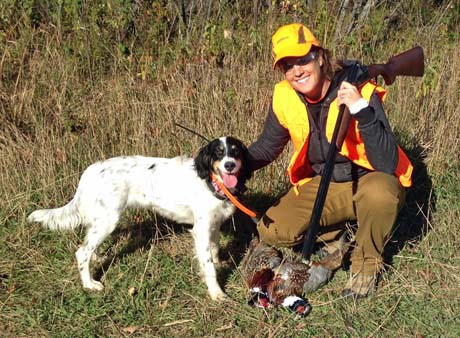
Mac (Blue Shaquille x Houston’s Belle’s Choice, 2013) and a friend with pheasants in Minnesota.
Nothing…nothing…give us more satisfaction than knowing that dogs we’ve bred and/or trained are now fulfilling their potential with their owners in the woods and fields. Thanks to all who shared.
“And BTW Jerry, I have taken your advice. I keep my mouth shut while in the woods with her. As you well know, that’s the best thing I could have ever done.”
“Just got back from a few days in the grouse woods with Tia (Sweet Tea). The boys are in 8th and 10th grades this year. I still believe it was a good move to buy her from you when we did, even if the grouse count is headed down. The boys are in their formative years and they’ll remember a good dog such as Tia in good years and bad. We couldn’t be happier. She’s such a sweetheart. We all love her!”
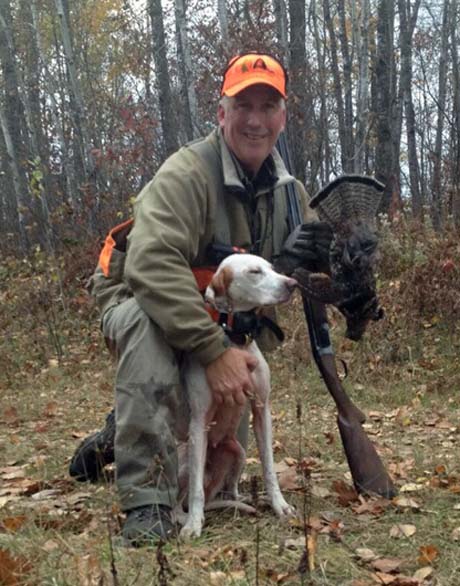
Scout (Elhew G Force x Northwoods Vixen, 2013) with grouse in Michigan.
“The most fun I’ve had has been watching her drive, focus and intensity grow with every grouse and woodcock touch.”
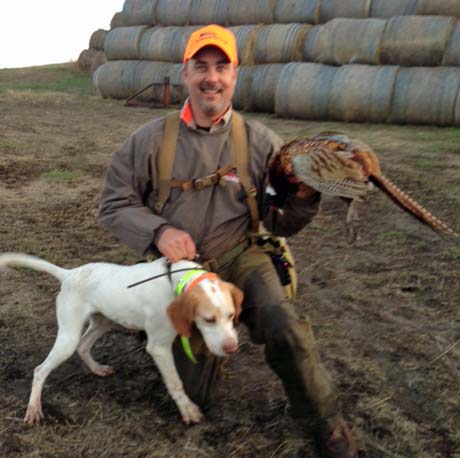
Joe, owner of Buddy (Elhew G Force x Northwoods Vixen, 2013) with pheasants in South Dakota.
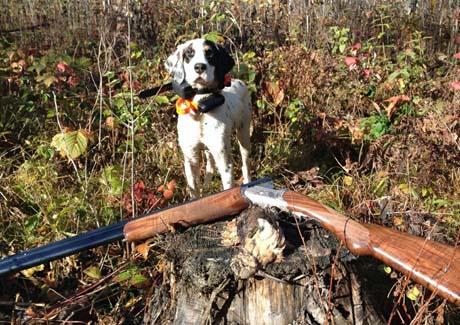
“Never took a shot all day last. Last 45 minutes, took Buddy out just trying to see if I can get him to move with me and respond to the collar Shot 4 birds over him. He looked at me with “Hey, I was born for this.” I was shooting a 72-year-old LC Smith 20-ga. I rescued.”
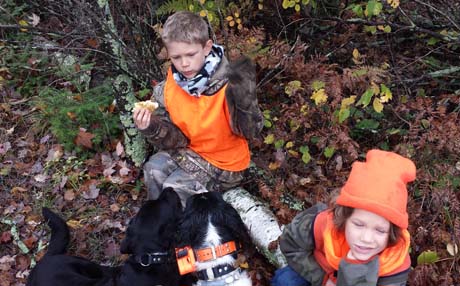
Kids, a Labrador and Tana (Northwoods Blue Ox x Northwoods Chablis, 2012) on a picnic lunch break in Minnesota.
“My kids accompanied me and we had a “picnic” in the middle of the hunt. The picture…epitomizes my feelings of why October is the most perfect month of the year for anything outdoors.”
Piper (Ridge Creek Cody x Northwoods Chardonnay, 2013) with a woodcock in Minnesota.
“Piper pointed at least 12 woodcock and 2 grouse over 90 minutes. I limited on woodcock. This dog loves to hunt already and absolutely will not quit. Only 34 pounds but nothing slows her down.”
Bart, owner of Snicker (Northwoods Blue Ox x Northwoods Chablis, 2012) with woodcock in Minnesota.
“Snicker was wonderful today…it was a thrilling point and this time I didn’t miss!”
Scout (Blue Shaquille x Houston’s Belle’s Choice, 2013) on woodcock in Minnesota.
“First solo actually able to be killed for him! See if you can spot the woodcock in front of his nose! He’s been pointing, backing and hunting hard! Awesome dogs you’re producing!”
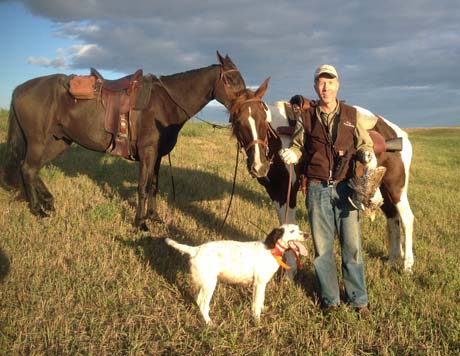
Ian, owner of horses and Cold Creek Pearl (Blue Shaquille x Houston’s Belle, 2007) with sharp-tailed grouse in North Dakota.
Wayne, owner of Northwoods Magic (Dashaway x Goodgoing Moxie, 2006) with a double on woodcock with his Purdey in Minnesota.
Northwoods Fuzzy Navel (Northwoods Blue Ox x Northwoods Chardonnay, 2012) on grouse in Michigan.
Rainy (Magic’s Rocky Belleboa x Banshee, 2009) with grouse in Minnesota.
Midas (Houston’s Blackjack x Northwoods Chablis, 2013) on point in Montana.
Northwoods White Russian (Blue Shaquille x Snyder’s Liz, 2012) with grouse in Minnesota.
Chet (Can’t Go Wrong x Cold Creek Pearl, 2011) on a covey of Huns in North Dakota.
Ken, owner of Northwoods Aerosmith (Blue Shaquille x Houston’s Belle’s Choice, 2011) on a grouse hunt in Minnesota.
Drew, owner of Stoeger (Ridge Creek Cody x Northwoods Chardonnay, 2013) with a pheasant in Minnesota.
Stormy with grouse in Minnesota.
Bob, owner of three generations of grouse dogs: Choice (Gusty Blue x Houston’s Belle, 2005), Grits (Northwoods Blue Ox x Northwoods Chablis, 2011) and Chablis (Blue Shaquille x Houston’s Belle’s Choice, 2009). Is there a better way to end a day of hunting?
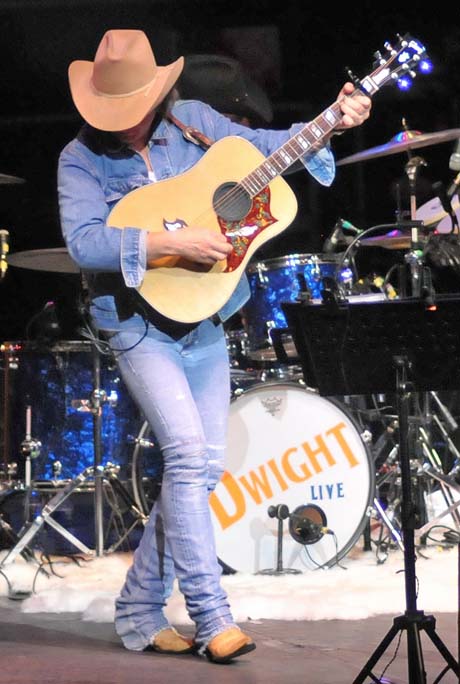
Maybe I’ll be fast as you Maybe I’ll break hearts too ~ Dwight Yoakam, Fast As You
Even though Dwight Yoakam probably had something else on his mind when he wrote those lyrics, they seem apropos to bird dogs at a horseback field trial championship.
So it’s fitting that this song by Yoakam, who’s usually outfitted in a big hat, very tight jeans and high-heeled cowboy boots, is the background music to Dennis Lutynkski‘s video of the Region 19 Amateur Shooting Dog Championship. Chris Mathan posted a short piece on her Strideaway website that includes a link to the youtube video.
It is a very well-edited, fun, foot-stomping video and Jerry and I were thrilled to see footage of two dogs we bred.
Northwoods Nirvana (Pete) is featured throughout the opening sequences. He is a big, fast, powerful tri-color setter that flies over the ground. Truly, at one point, he is airborne as he gracefully leaps over a scrubby oak. Co-owned by Frank and Jean LaNasa, Pete is handled by Frank and scouted by Jean. Pete is a 2011 dog out of CH Houston’s Blackjack (owned by Frank and Leroy Peterson) x Northwoods Chardonnay.
Towards the end of the video, CH JTH Izzie, a black and white pointer female works like a missile through the cover. She is owned and handled by Jeff Hintz and is out of CH Westfall’s Black Ice x Northwoods Prancer. Amazingly, like Pete, she is only a two-year-old dog.
Even though Pete and Izzie didn’t place, congratulations to Frank and Jean because Blackjack (CH Can’t Go Wrong x CH Houston’s Belle) was named runner-up champion.
Maybe I’ll break hearts And be as fast as you, ahh ~ Dwight Yoacam
Gert is a cool dog. She has a snow-white body, just lightly ticked, and her 40-lb., strongly muscled conformation seems perfect for a grouse dog. The deep orange on her handsome, blocky head nicely sets off a dark nose and eyes.
Gert is owned by Rochel and Dave Moore, who live on a nice spread outside Big Lake, Minnesota. Ever since their marriage in 2002, they have owned bird dogs—setters and pointers both. They train, condition and work their dogs together and share chares, too. Even though Rochel and Dave are hunters, they especially train for field trial competition. They enjoy putting their dogs up against the best in the country. “I like to watch my dog but especially I like to watch my dog win,” Rochel said.
The last pick.
Gert was whelped in 2006 out of Paul Hauge’s talented I’m Houston’s Image (Houston x I’m Jet Setter) and our own Blue Silk (CH First Rate x CH Blue Streak). Even though Dave and Rochel were on the list early, they didn’t care which puppy they got. “I’ll take the last one,” Dave said.
Gert’s name.
I’m Blue Gert is a cool name. Each word has special meaning. I’m is in honor of her sire’s impressive pedigree which goes back to Paul’s favorite setter, Houston. Gert’s dam’s side is formidable, too, for both of Blue Silk’s parents were multiple champions. Gert is short for Gertrude, the daughter of friends of Moore’s. Dave said, “Gertrude was rock-star good-looking and if we’d had a daughter, I’d want her to look like that.”
Dirty Gert.
Most dogs have several nick-names—some are endearing, others playful. Gert earned her name of Dirty Gert many years ago. “By about 40 minutes into training sessions, Gert usually ends up dirty,” Dave said, whether by rolling in something dark and stinky or by pushing hard through heavy cover.
Gert as a house dog.
Even though Gert lives in Moore’s kennel with pals Slew and Elle and her son Zack, whenever she gets in the house, she makes a beeline for the master bedroom. According to Dave, “She lies down on our bed and won’t get up.”
Gert in the field.
Rochel deserves credit for Gert’s debut as a field trial competitor. She handled Gert to a placement in a puppy stake at a 2007 spring trial held by the Minnesota Grouse Dog Association. That was the only time Rochel handled a dog in a trial, preferring instead to scout, but it was exactly the start Gert needed.
While Gert has been worked to bring out her best, sometimes it’s the things that can’t be trained that become paramount; other characteristics can catch the hearts and minds of judges. What sets Gert apart? “Gert has zero quit. She’s always searching for a bird. There’s just no quit,” Dave said.
After the 2013 North Country Walking Shooting Dog Championship, Rochel Moore poses RU-CH I’m Blue Gert (on right) and Dave Moore holds the plaque. Scott Chaffee poses the champion on the left.
Gert’s championship placements.
2013 RU-CH North Country Walking Shooting Dog Championship
2013 Minnesota/Wisconsin Pro Plan Cover Dog of the Year
2012 CH Region 19 Amateur Walking Shooting Dog Championship
2012 RU-CH Minnesota Grouse Championship
2009 CH Region 19 Amateur Walking Shooting Dog Championship
Gert is a producer, too.
The 2013 runner-up champion of the National Amateur Grouse Championship is Woods R Callen Sam, a male owned by Bill Frahm. Sam is out of Gert’s only litter by Tom Jones, Scott Anderson’s dog out of his CH A Rolling Stone.
Congratulations to Rochel and Dave on your success with such a cool dog, I’m Blue Gert!
Usually a photo from Jeff includes CH Izzie (CH Westfall’s Black Ice x Northwoods Prancer, 2011) and a trophy or two. But this autumn scene is pretty nice, too.
“Great pup at home and in the field. Thanks again.” Tom, owner of Zada (CH Ridge Creek Cody x Northwoods Chardonnay, 2013)
“Cammie is keeping in shape chasing sticks in Lake Michigan. Only three days until the grouse season opener here.” Dick, owner of Cammie (Blue Chief x Blue Blossom, 2008)
“Snicker on point . . . I missed this woodcock . . . still pretty green in there.” Bart, owner of Snickers (Northwoods Blue Ox x Northwoods Chablis, 2012)
“I returned Monday evening from North Dakota where I was hunting with Barry and Jill. As you know, besides a bit of rain the weather was perfect. Barry and I filled up Saturday and Sunday by 9:30.” Chris, owner of Roy (Northwoods Blue Ox x Northwoods Chablis, 2012)
“Seems kind of disrespectful to Labs if you ask me.” Brad, owner of Riley (the Labrador) and Tana (Northwoods Blue Ox x Northwoods Chablis, 2012)
“Just had Gus out this morning. Only needed one minor correction and he was great on the remaining birds.” David, owner of Gus (Blue Shaquille x Houston’s Belle’s Choice, 2011)
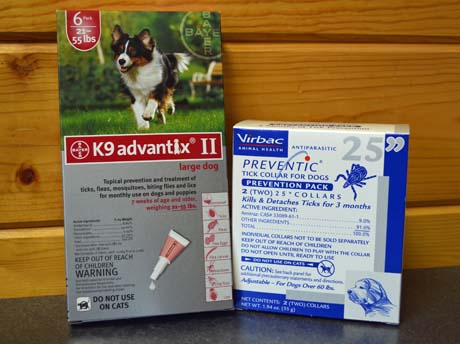
K9 Advantix II and Preventic tick collars are two products used to combat tick-borne diseases.
Tick-borne diseases are a hot issue across the country. Recently, local, city and state-wide newspapers have published articles about the subject. Even The New York Times deemed the issue worthy and wrote an editorial about Lyme disease in people on Sunday, September 22.
But I particularly noticed a feature story in the current issue of Purina ProClub’s Update . More than any other source, this piece was clear and concise. In addition, an excellent chart (Common Tick-Borne Diseases in Dogs) was included that detailed disease name, tick carrier, pathogen and signs for each of the seven common, tick-borne diseases in dogs.
From that article, listed below are some interesting facts about ticks and tick-borne diseases that all dog-owners need to understand.
Tick facts.
• Tick populations are at an all-time high this year.
• Ticks don’t usually transmit disease until 24 to 48 hours after attachment.
• Ticks often transmit multiple diseases simultaneously.
Diagnosis is tricky and complicated.
• 50% or more of dogs living in Lyme disease endemic regions have positive titers (blood tests) but don’t show symptoms and so aren’t sick.
• Other tick-borne diseases can cause positive titers also but, again, the dog doesn’t show symptoms and so isn’t sick.
• The most common indicators of tick-borne disease are nonspecific, such as lethargy, decreased appetite and gastrointestinal signs.
• There is no perfect test* for tick-borne diseases. A veterinarian should use a combination of historical information, physical examination findings, laboratory tests and how well a dog responds to treatment.
Jerry and I are extremely pro-active about ticks throughout the year but especially during spring and fall when they seem to be most prevalent. We’ve cobbled together our own protocol.
1. We regularly monitor dogs for ticks, which isn’t difficult because they are easily noticed by petting and stroking.
2. After time in the woods or fields, we check for ticks. We use a narrow-toothed comb that works well.
3. We vaccinate puppies with LymeVax by Pfizer (requires two shots the first year) and then administer an annual booster.
4. During spring and fall, we apply the topical Canine Advantix II every three weeks. This repels and kills black-legged ticks (deer tick), brown dog ticks, American dog ticks and lone star ticks. Active ingredients are imidacloprid, permethrin and pyriproxyfen. It is waterproof but the dog must be dry for 24 hours both before and after application.
5. During spring and fall, we put on a Preventic Tick Collar by Virbac. This aids in the prevention of Lyme disease, Rocky Mountain spotted fever and babesiosis. Active ingredient is Amitraz. We have one serious precaution—don’t allow a dog to ingest the collar. It only took one time for Jerry and me to learn our lesson. We had two young dogs kenneled together and one chewed the tick collar off the other. All we found was the metal buckle. She became very ill but after induced vomiting and several worrisome days, she survived.
Seresto is a new tick collar from Bayer, introduced in January 2013. This collar slowly releases a chemical that stays on the coat of the dog for the eight-month protection period. Upon the recommendation of our vet, we didn’t try it. He was uncomfortable with the possibility of the chemical’s exposure to people through petting and handling. We’ll revisit this option as more information becomes available.
Even with all the monitoring Jerry and I do and the precautions we take, several of our dogs have become ill with a tick-borne disease. If we notice tell-tale symptoms, we consult with our vet and usually administer the antibiotic doxycycline for 28 days. For puppies, we use amoxicillin. Generally, the symptoms disappear within one or two days and the dog is on the mend.
* Dr. Linda Kidd, Western University of Health Sciences College of Veterinary Medicine in Pomona, California, is leading a one-year research project. Among other issues, her study will determine if comprehensive testing, i.e., using both tests (serology and PCR) instead of the current protocol wherein vets usually test one sample using one test. Another possibility is to test more than one sample.
The two tests are:
Serology detects the presence of antibody, which is one product of the body’s immune response against a pathogen.
PCR (Polymerase Chain Reaction) screening detects the nucleic acid, the DNA, of the organism itself.
At four years of age, pointer female Northwoods Prancer is an experienced and fully-trained grouse dog.
For today’s Minneapolis Star Tribune Outdoors section, Jerry and I co-authored a piece, “Young dog’s first grouse season tells tale.” Yesterday was the season opener for ruffed grouse in Minnesota and the northern part of Wisconsin.
The key components of the article were fairly easy for us to put together.
Of all the training levels we offer, Jerry especially likes to work with young dogs, which includes bringing them through their first hunting season. A significant portion of my responsibilities includes rearing and developing puppies. Not only do we both love spending lots of time with young dogs but it’s the best way to evaluate our breeding program.
“The process of developing a puppy into an experienced grouse dog begins with the all-important first season,” we wrote. We then detailed four important considerations “to make the most of this time.”
• Owner preparedness
• Exposure to grouse—lots of grouse
• How to handle in the woods
• Owner attitude and expectations
Our sincere thanks to Dennis Anderson, Outdoors Columnist and Editor, for offering us the opportunity.
Caroline gives Tyler (Blue Shaquille x Houston’s Belle’s Choice, 2011) a big hug. According to Ken, “As you can see, we are getting along just fine. Tyler is a lover.”
There’s something special about kids and puppies. Minnie (Houston’s Blackjack x Northwoods Chablis, 2013) recently flew off to her new home in Pennsylvania and settled right in for a nap on the lap of James’ daughter.
Mike’s son Jay with their puppy Orb (Blue Shaquille x Houston’s Belle’s Choice, 2013). “We love the pup! He is so calm and socialized.”
Even if the child is a teenager and the puppy is five months old, the bond remains strong. Kate gives Willow (Ridge Creek Cody x Northwoods Chardonnay, 2013) a hug before she leaves town.
Who says pointers aren’t wonderful house dogs? Our own Vixen (Westfall’s Black Ice x Northwoods Prancer, 2011) comes from a long line of pointers—Dancer, Dasher and Prancer—that have lived in the house with Jerry and me.
Always-cool Roy (Northwoods Blue Ox x Northwoods Chablis, 2012) relaxes in his favorite spot. Chris wrote, “If we don’t make it to the river or lake, this is where he wants to be—in the shade of the deck in the water.”
Life is puppies! Barry is already working his new puppy Jack (Houston’s Blackjack x Northwoods Highclass Kate, 2013) in the field each day. “We keep heading into longer grass. A little whistle and a call of Jack and he comes right to you.”