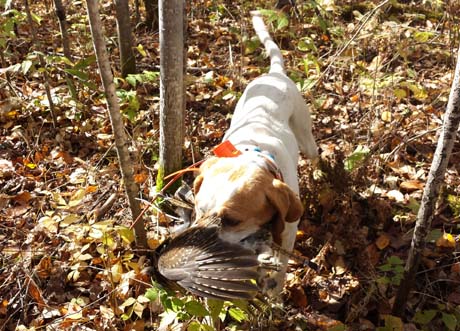
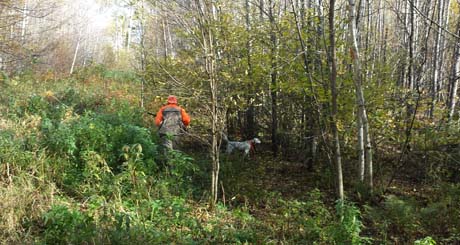
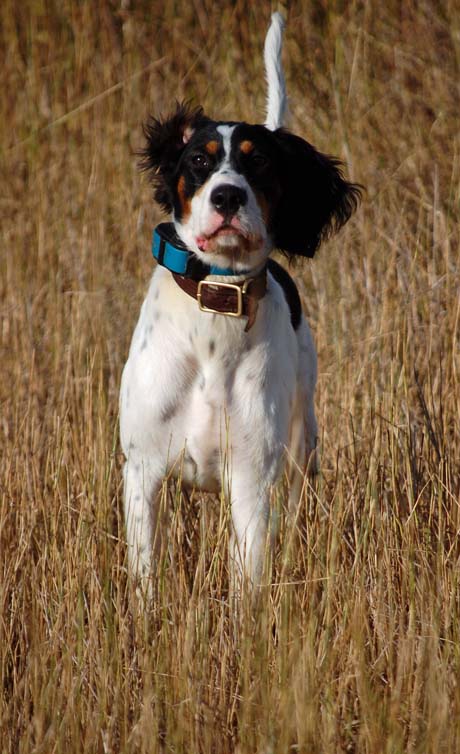
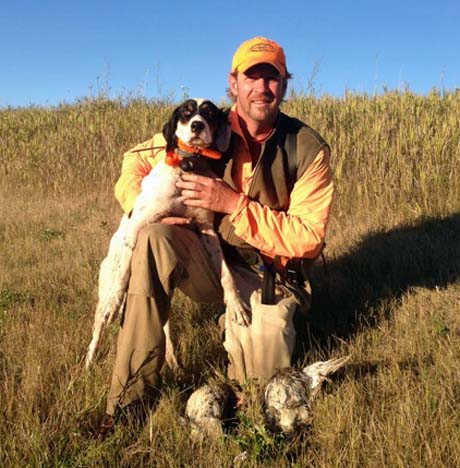
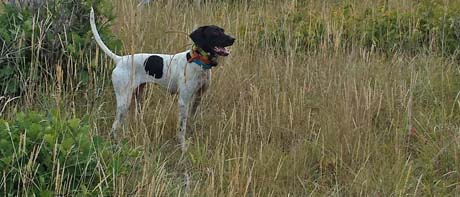
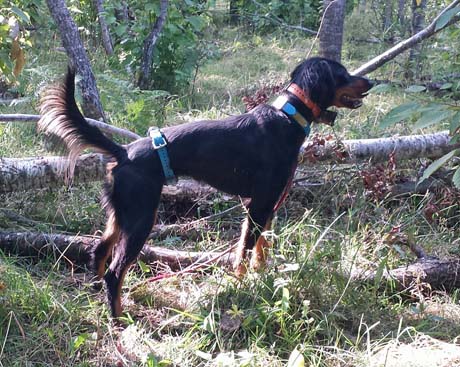
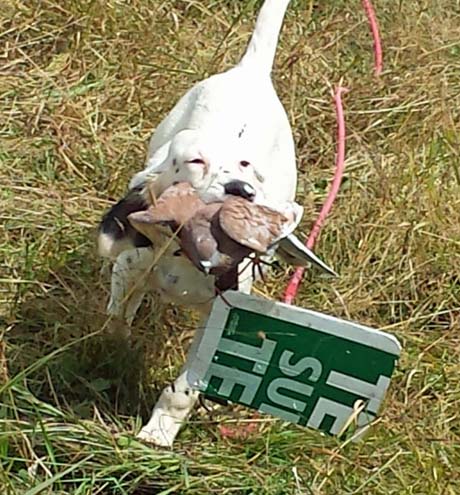
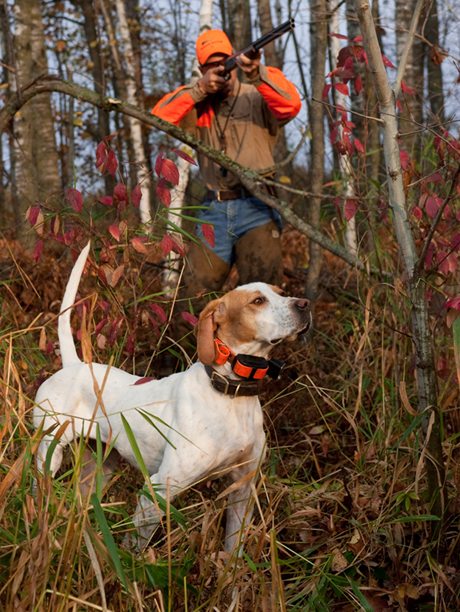
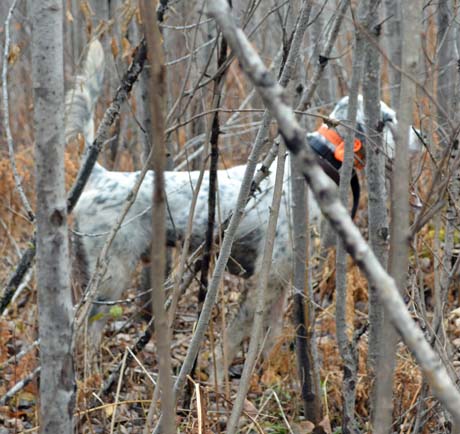
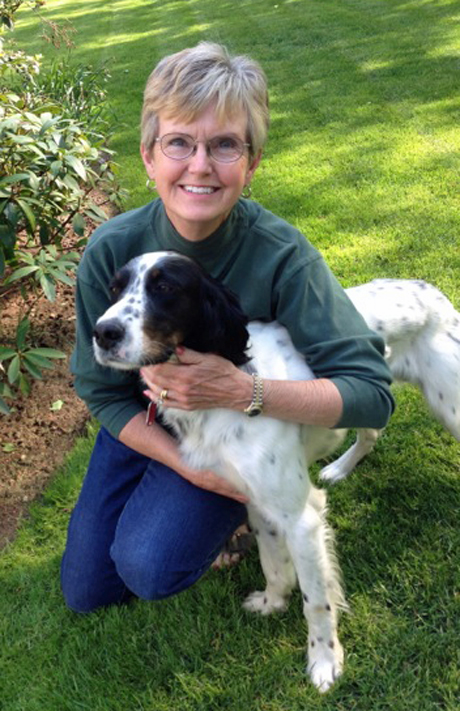
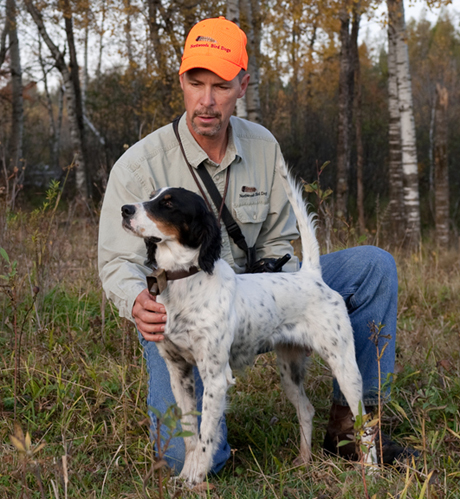
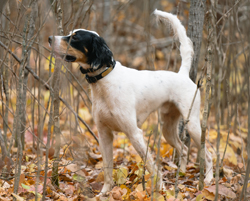
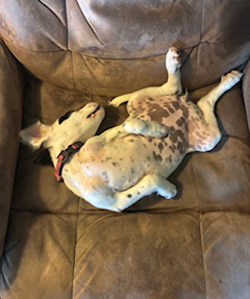
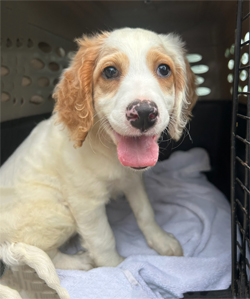
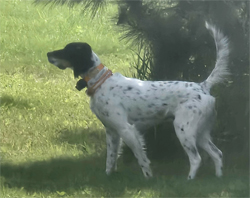
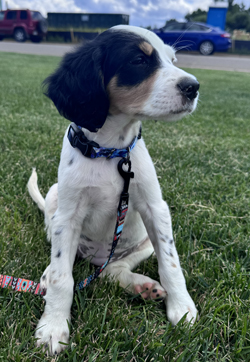
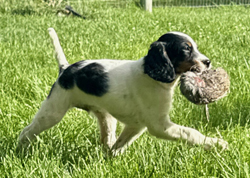
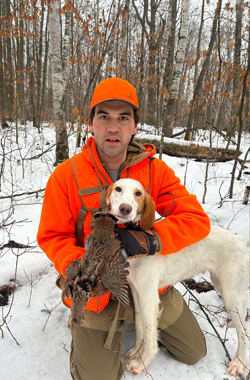
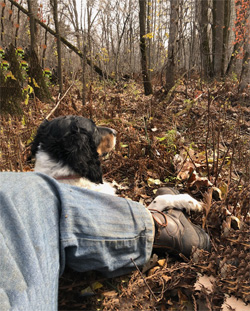
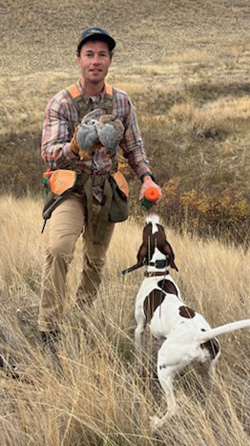
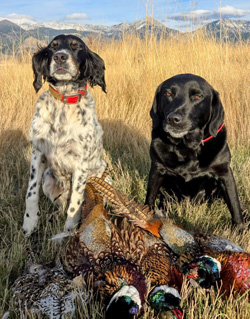
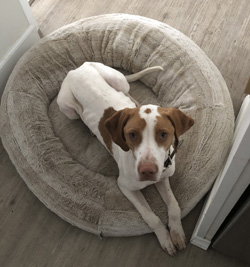
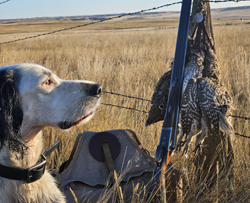
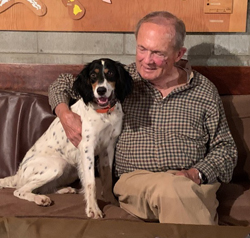
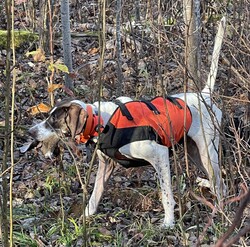
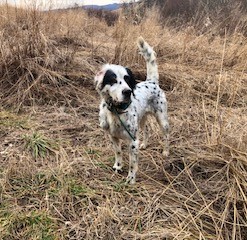
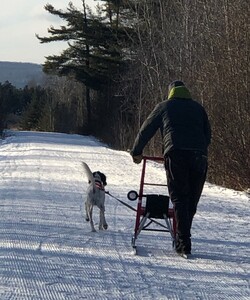
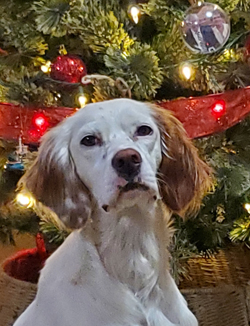
Northwoods Prancer retrieves a grouse so gently that its pretty wing feathers remain untouched.
The early part of the grouse and woodcock season with its bluebird days and beautiful woods could have been an ad for Minnesota tourism but sure made hunting difficult. The temperatures were warm, the conditions were bone-dry and since no hard freeze had occurred, the cover was green and thick. Mid October brought a welcome weather change and, within days, most of the leaves had fallen in central and northern Minnesota.
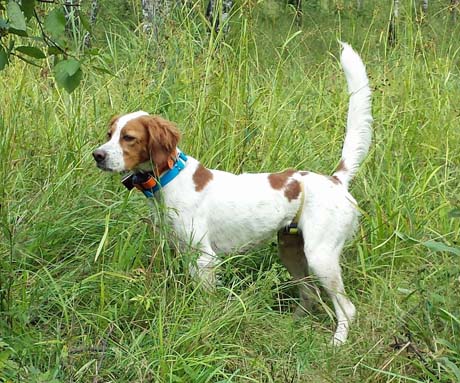
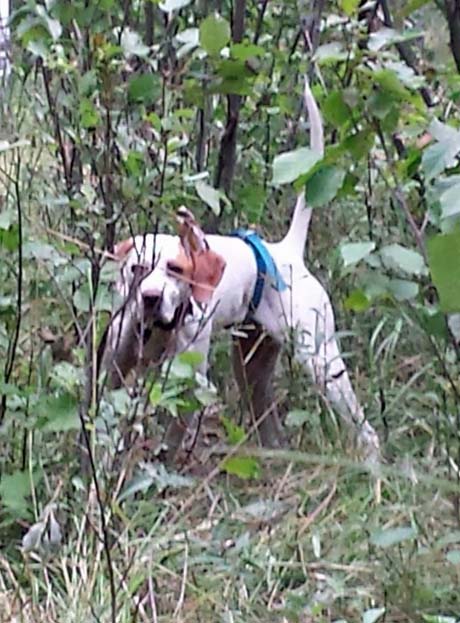
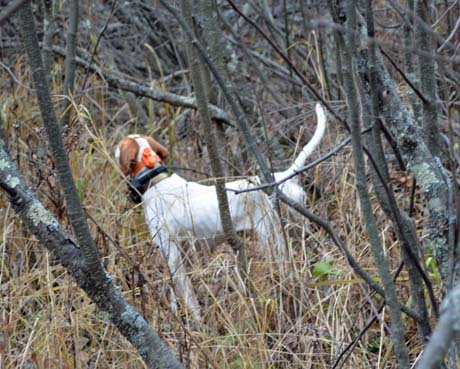
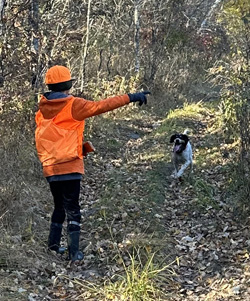
It takes a tough, determined dog to hunt in the north woods in early season. Susie’s hard work pays off after a push through tall ferns and grasses.
Throughout the season I’ve found a good number of local woodcock and have just begun seeing flight birds. Ruffed grouse are a different story, though. I’ve only flushed two broods. Otherwise, dogs’ points indicate young birds—when grouse are walking on the ground in front of the dog—or mature, savvy birds. I’ve had dogs follow those running grouse up to 300 yards before they flush.
This isn’t surprising to me. The year 2010 was the last peak of the grouse cycle so we’re now in the third year of decline. In my experience, the next two years will be tough, too.
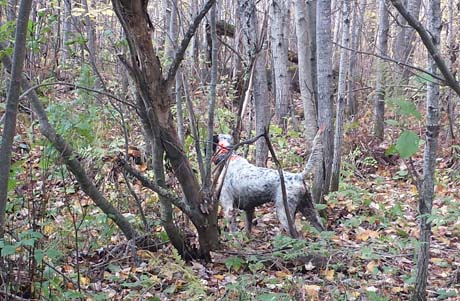
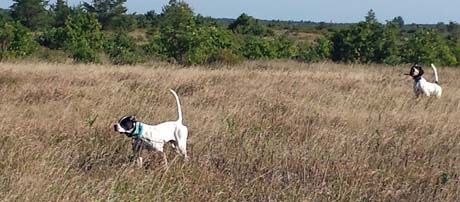
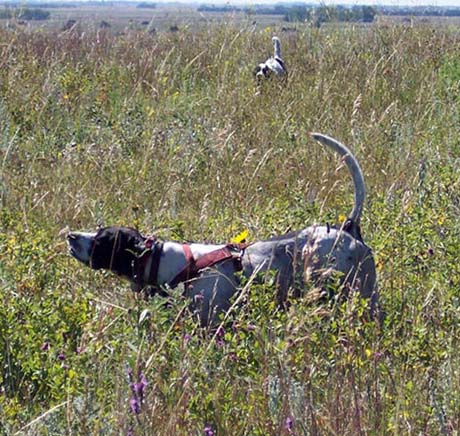
In years with low grouse numbers, an experienced dog truly shines. Blue Shaquille followed a running grouse for 300 yards before finally pinning it.
In years with plentiful birds, even a mediocre dog can look fairly good but in low grouse years, an experienced, talented dog makes a big difference. When birds are few and lots of cover separates them, the extraordinary grouse dog “takes you to the birds.” It will be exciting to see which dogs rise to the occasion.
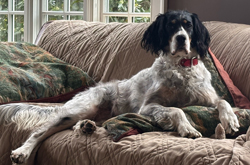
Gert is a cool dog. She has a snow-white body, just lightly ticked, and her 40-lb., strongly muscled conformation seems perfect for a grouse dog. The deep orange on her handsome, blocky head nicely sets off a dark nose and eyes.
Gert is owned by Rochel and Dave Moore, who live on a nice spread outside Big Lake, Minnesota. Ever since their marriage in 2002, they have owned bird dogs—setters and pointers both. They train, condition and work their dogs together and share chares, too. Even though Rochel and Dave are hunters, they especially train for field trial competition. They enjoy putting their dogs up against the best in the country. “I like to watch my dog but especially I like to watch my dog win,” Rochel said.
The last pick.
Gert was whelped in 2006 out of Paul Hauge’s talented I’m Houston’s Image (Houston x I’m Jet Setter) and our own Blue Silk (CH First Rate x CH Blue Streak). Even though Dave and Rochel were on the list early, they didn’t care which puppy they got. “I’ll take the last one,” Dave said.
Gert’s name.
I’m Blue Gert is a cool name. Each word has special meaning. I’m is in honor of her sire’s impressive pedigree which goes back to Paul’s favorite setter, Houston. Gert’s dam’s side is formidable, too, for both of Blue Silk’s parents were multiple champions. Gert is short for Gertrude, the daughter of friends of Moore’s. Dave said, “Gertrude was rock-star good-looking and if we’d had a daughter, I’d want her to look like that.”
Dirty Gert.
Most dogs have several nick-names—some are endearing, others playful. Gert earned her name of Dirty Gert many years ago. “By about 40 minutes into training sessions, Gert usually ends up dirty,” Dave said, whether by rolling in something dark and stinky or by pushing hard through heavy cover.
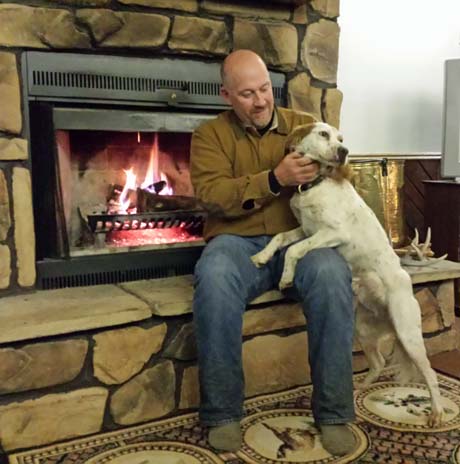
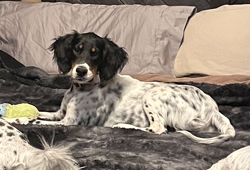
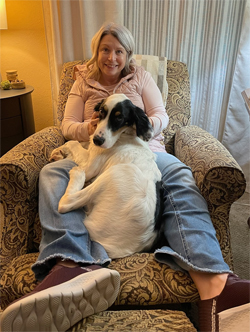
Gert as a house dog.
Even though Gert lives in Moore’s kennel with pals Slew and Elle and her son Zack, whenever she gets in the house, she makes a beeline for the master bedroom. According to Dave, “She lies down on our bed and won’t get up.”
Gert in the field.
Rochel deserves credit for Gert’s debut as a field trial competitor. She handled Gert to a placement in a puppy stake at a 2007 spring trial held by the Minnesota Grouse Dog Association. That was the only time Rochel handled a dog in a trial, preferring instead to scout, but it was exactly the start Gert needed.
While Gert has been worked to bring out her best, sometimes it’s the things that can’t be trained that become paramount; other characteristics can catch the hearts and minds of judges. What sets Gert apart? “Gert has zero quit. She’s always searching for a bird. There’s just no quit,” Dave said.
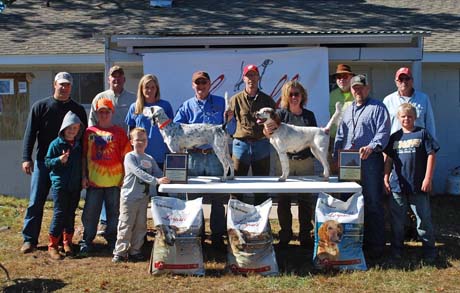
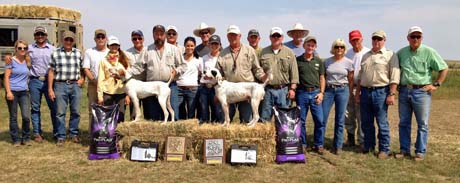
After the 2013 North Country Walking Shooting Dog Championship, Rochel Moore poses RU-CH I’m Blue Gert (on right) and Dave Moore holds the plaque. Scott Chaffee poses the champion on the left.
Gert’s championship placements.
2013 RU-CH North Country Walking Shooting Dog Championship
2013 Minnesota/Wisconsin Pro Plan Cover Dog of the Year
2012 CH Region 19 Amateur Walking Shooting Dog Championship
2012 RU-CH Minnesota Grouse Championship
2009 CH Region 19 Amateur Walking Shooting Dog Championship
Gert is a producer, too.
The 2013 runner-up champion of the National Amateur Grouse Championship is Woods R Callen Sam, a male owned by Bill Frahm. Sam is out of Gert’s only litter by Tom Jones, Scott Anderson’s dog out of his CH A Rolling Stone.
Congratulations to Rochel and Dave on your success with such a cool dog, I’m Blue Gert!
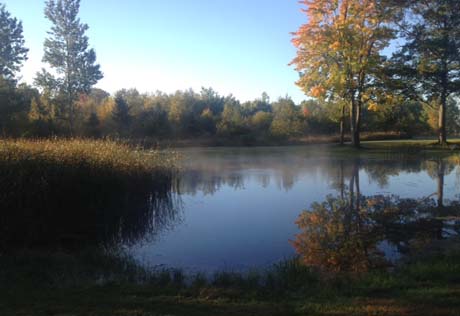
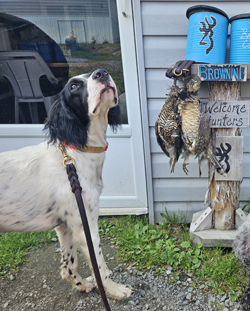
Usually a photo from Jeff includes CH Izzie (CH Westfall’s Black Ice x Northwoods Prancer, 2011) and a trophy or two. But this autumn scene is pretty nice, too.
“Great pup at home and in the field. Thanks again.” Tom, owner of Zada (CH Ridge Creek Cody x Northwoods Chardonnay, 2013)
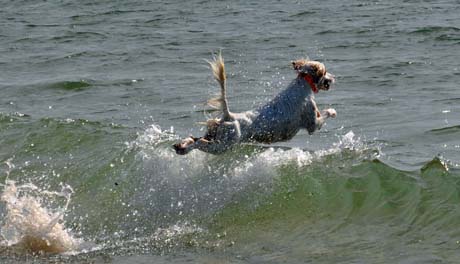
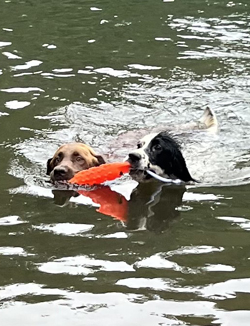
“Cammie is keeping in shape chasing sticks in Lake Michigan. Only three days until the grouse season opener here.” Dick, owner of Cammie (Blue Chief x Blue Blossom, 2008)
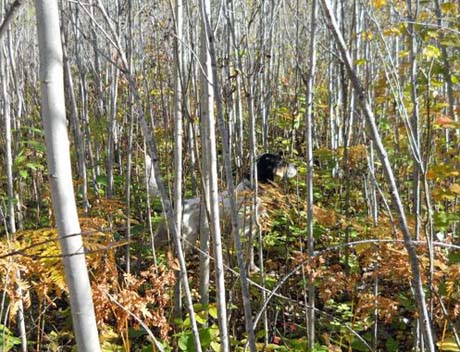
“Snicker on point . . . I missed this woodcock . . . still pretty green in there.” Bart, owner of Snickers (Northwoods Blue Ox x Northwoods Chablis, 2012)
“I returned Monday evening from North Dakota where I was hunting with Barry and Jill. As you know, besides a bit of rain the weather was perfect. Barry and I filled up Saturday and Sunday by 9:30.” Chris, owner of Roy (Northwoods Blue Ox x Northwoods Chablis, 2012)
“Seems kind of disrespectful to Labs if you ask me.” Brad, owner of Riley (the Labrador) and Tana (Northwoods Blue Ox x Northwoods Chablis, 2012)
“Just had Gus out this morning. Only needed one minor correction and he was great on the remaining birds.” David, owner of Gus (Blue Shaquille x Houston’s Belle’s Choice, 2011)
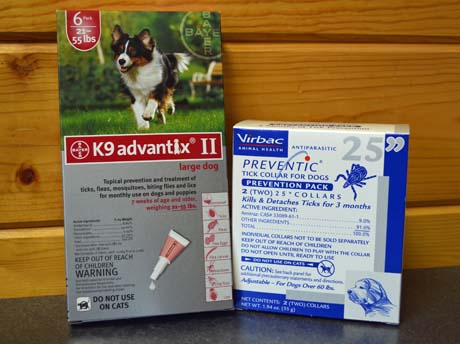
K9 Advantix II and Preventic tick collars are two products used to combat tick-borne diseases.
Tick-borne diseases are a hot issue across the country. Recently, local, city and state-wide newspapers have published articles about the subject. Even The New York Times deemed the issue worthy and wrote an editorial about Lyme disease in people on Sunday, September 22.
But I particularly noticed a feature story in the current issue of Purina ProClub’s Update . More than any other source, this piece was clear and concise. In addition, an excellent chart (Common Tick-Borne Diseases in Dogs) was included that detailed disease name, tick carrier, pathogen and signs for each of the seven common, tick-borne diseases in dogs.
From that article, listed below are some interesting facts about ticks and tick-borne diseases that all dog-owners need to understand.
Tick facts.
• Tick populations are at an all-time high this year.
• Ticks don’t usually transmit disease until 24 to 48 hours after attachment.
• Ticks often transmit multiple diseases simultaneously.
Diagnosis is tricky and complicated.
• 50% or more of dogs living in Lyme disease endemic regions have positive titers (blood tests) but don’t show symptoms and so aren’t sick.
• Other tick-borne diseases can cause positive titers also but, again, the dog doesn’t show symptoms and so isn’t sick.
• The most common indicators of tick-borne disease are nonspecific, such as lethargy, decreased appetite and gastrointestinal signs.
• There is no perfect test* for tick-borne diseases. A veterinarian should use a combination of historical information, physical examination findings, laboratory tests and how well a dog responds to treatment.
Jerry and I are extremely pro-active about ticks throughout the year but especially during spring and fall when they seem to be most prevalent. We’ve cobbled together our own protocol.
1. We regularly monitor dogs for ticks, which isn’t difficult because they are easily noticed by petting and stroking.
2. After time in the woods or fields, we check for ticks. We use a narrow-toothed comb that works well.
3. We vaccinate puppies with LymeVax by Pfizer (requires two shots the first year) and then administer an annual booster.
4. During spring and fall, we apply the topical Canine Advantix II every three weeks. This repels and kills black-legged ticks (deer tick), brown dog ticks, American dog ticks and lone star ticks. Active ingredients are imidacloprid, permethrin and pyriproxyfen. It is waterproof but the dog must be dry for 24 hours both before and after application.
5. During spring and fall, we put on a Preventic Tick Collar by Virbac. This aids in the prevention of Lyme disease, Rocky Mountain spotted fever and babesiosis. Active ingredient is Amitraz. We have one serious precaution—don’t allow a dog to ingest the collar. It only took one time for Jerry and me to learn our lesson. We had two young dogs kenneled together and one chewed the tick collar off the other. All we found was the metal buckle. She became very ill but after induced vomiting and several worrisome days, she survived.
Seresto is a new tick collar from Bayer, introduced in January 2013. This collar slowly releases a chemical that stays on the coat of the dog for the eight-month protection period. Upon the recommendation of our vet, we didn’t try it. He was uncomfortable with the possibility of the chemical’s exposure to people through petting and handling. We’ll revisit this option as more information becomes available.
Even with all the monitoring Jerry and I do and the precautions we take, several of our dogs have become ill with a tick-borne disease. If we notice tell-tale symptoms, we consult with our vet and usually administer the antibiotic doxycycline for 28 days. For puppies, we use amoxicillin. Generally, the symptoms disappear within one or two days and the dog is on the mend.
* Dr. Linda Kidd, Western University of Health Sciences College of Veterinary Medicine in Pomona, California, is leading a one-year research project. Among other issues, her study will determine if comprehensive testing, i.e., using both tests (serology and PCR) instead of the current protocol wherein vets usually test one sample using one test. Another possibility is to test more than one sample.
The two tests are:
Serology detects the presence of antibody, which is one product of the body’s immune response against a pathogen.
PCR (Polymerase Chain Reaction) screening detects the nucleic acid, the DNA, of the organism itself.
2013 National Amateur Pheasant Shooting Dog Championship winners: Champion Nemaha Yankee (on left) and Runner-up Champion Houston’s Blue Diamond.
From a quality entry of 62 dogs, Houston’s Blue Diamond was named Runner-Up Champion in the National Amateur Pheasant Shooting Dog Championship. Diamond was handled by his owner, Ross Leonard, of Cloudland, Georgia. The trial was held in August near Circle, Montana, and run on native pheasant, Hungarian partridge and sharp-tailed grouse. The judges were Jim Michaletz of Goodman, Missouri, and Harold Ray of Waynesboro, Georgia.
Diamond was bred in 2006 by Paul Hauge who used his favorite sire Houston (via frozen semen) to Forest Ridge Jewel. This is the second year in a row that a setter from Paul’s “Houston” line has placed in that championship–the 2012 winner was Ridge Creek Cody (CH Can’t Go Wrong x CH Houston’s Belle).
In excellent sharp-tailed grouse cover, pointer Hannah Montana points a covey and Northwoods Fuzzy Navel backs.
August is a busy month! Dan, Jeff and I meet at the kennel early and then head off for our particular duties.
We’re finishing up this year’s Gun Dog training using wild-acting bobwhite quail that are flushed into grouse cover. In our Puppy Foundation program, we start young dogs on pigeons and bobwhite quail. We train older dogs on local sharp-tailed grouse and take a select group to the prairie each weekend for work on sharp-tails, pheasants and Huns. We also begin serious conditioning and tune-up training for the coming hunting season.
Setter female Charly points a covey of bobwhite quail that have take cover.
Pointer female Coal points a covey of sharp-tailed grouse.
Composed and intense, Gordon setter Choo points a covey of quail in the woods.
Four-month-old Northwoods Rolls Royce (Blue Shaquille x Houston’s Belle’s Choice) loves to retrieve and proudly carries a carded pigeon.
Is it a grouse? Woodcock? Neither! Lucy (CH Westfall’s Black Ice x Northwoods Prancer) points a quail in the alders.
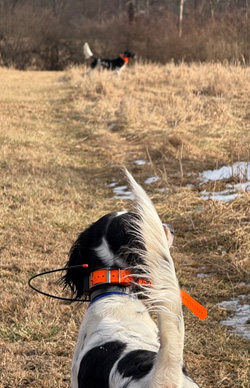
At four years of age, pointer female Northwoods Prancer is an experienced and fully-trained grouse dog.
For today’s Minneapolis Star Tribune Outdoors section, Jerry and I co-authored a piece, “Young dog’s first grouse season tells tale.” Yesterday was the season opener for ruffed grouse in Minnesota and the northern part of Wisconsin.
The key components of the article were fairly easy for us to put together.
Of all the training levels we offer, Jerry especially likes to work with young dogs, which includes bringing them through their first hunting season. A significant portion of my responsibilities includes rearing and developing puppies. Not only do we both love spending lots of time with young dogs but it’s the best way to evaluate our breeding program.
“The process of developing a puppy into an experienced grouse dog begins with the all-important first season,” we wrote. We then detailed four important considerations “to make the most of this time.”
• Owner preparedness
• Exposure to grouse—lots of grouse
• How to handle in the woods
• Owner attitude and expectations
Our sincere thanks to Dennis Anderson, Outdoors Columnist and Editor, for offering us the opportunity.
These two dogs–a pointer and a setter–have 14 championships and runner-up championships between them in horseback and cover dog venues.
Much attention—too much, in my opinion—is focused on the tail of a bird dog. I refer not to what the tail indicates about a dog’s thoughts or emotions but rather how the tail looks when a dog is on point and, in particular, how straight and vertical it is.
“Poker straight,” “I like a straight stick” or “My dog points with a 12 o’clock tail” are familiar phrases used by those fixated on tails. Usually, they are inexperienced or demand little of their dogs. I recently spoke with a successful handler of horseback shooting dogs about a prospect. In our entire conversation, he never once asked how the dog’s tail looked on point.
In my experience, when bird dogs are used to pursue wild birds, whether in the open, the grouse woods or the southern piney woods, birds are rarely plentiful. In addition, the terrain can be rugged and the conditions tough. Most of the dog’s time is spent in the search for game. In these places it’s not the tail that finds birds.
On a dark, damp day in October, the pointer lead my guiding clients and me from grouse to grouse to grouse.
Instead, what finds birds is:
1) intelligence combined with experience that chooses the most likely places;
2) an efficient gait that allows the search to continue over long periods of time through punishing cover and circumstances;
3) a superb nose that draws the dog towards the faintest scent of birds and allows it to locate and point accurately.
Finally, at the conclusion of all that work and for a brief time, I see the dog on point. I notice its posture, intensity and focus on bird location. And, oh yeah, I look at the tail. Very often and especially under trying field conditions, the tail isn’t “poker straight” or “12 o’clock.”
And it doesn’t have to be. The tail needs to be good enough so it doesn’t detract from the essential qualities that brought the dog to that place. On the other hand, if the dog has the intelligence, the gait, the nose and a beautiful tail, then that’s like the cherry on an ice cream sundae.
The setter has it all–intelligence, gait, nose and perfect tail……like a cherry on a sundae.
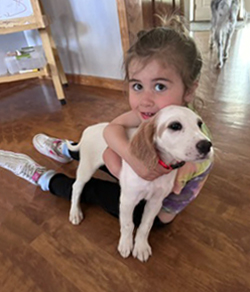
Caroline gives Tyler (Blue Shaquille x Houston’s Belle’s Choice, 2011) a big hug. According to Ken, “As you can see, we are getting along just fine. Tyler is a lover.”
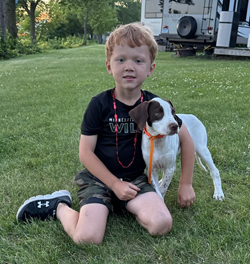
There’s something special about kids and puppies. Minnie (Houston’s Blackjack x Northwoods Chablis, 2013) recently flew off to her new home in Pennsylvania and settled right in for a nap on the lap of James’ daughter.
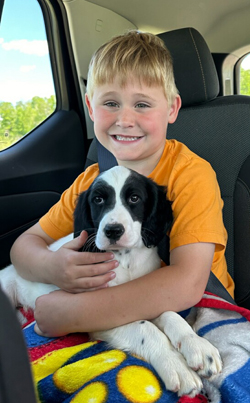
Mike’s son Jay with their puppy Orb (Blue Shaquille x Houston’s Belle’s Choice, 2013). “We love the pup! He is so calm and socialized.”
Even if the child is a teenager and the puppy is five months old, the bond remains strong. Kate gives Willow (Ridge Creek Cody x Northwoods Chardonnay, 2013) a hug before she leaves town.
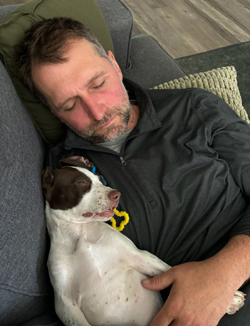
Who says pointers aren’t wonderful house dogs? Our own Vixen (Westfall’s Black Ice x Northwoods Prancer, 2011) comes from a long line of pointers—Dancer, Dasher and Prancer—that have lived in the house with Jerry and me.
Always-cool Roy (Northwoods Blue Ox x Northwoods Chablis, 2012) relaxes in his favorite spot. Chris wrote, “If we don’t make it to the river or lake, this is where he wants to be—in the shade of the deck in the water.”
Life is puppies! Barry is already working his new puppy Jack (Houston’s Blackjack x Northwoods Highclass Kate, 2013) in the field each day. “We keep heading into longer grass. A little whistle and a call of Jack and he comes right to you.”
Jerry softly commands, “Whoa,” to Northwoods Chardonnay while stroking her.
Every now and then, I meet pointing dog owners who don’t use WHOA as the command for their dogs to stop and stand still. They prefer HOLD, STAY or HUP instead. They further explain that they use NO to tell their dogs to stop an unwanted behavior and since WHOA sounds similar, they don’t want to confuse their dogs.
The theory is good and the explanation reasonable. The last thing pointing dog owners want to do is impart a negative association with birds. Even George Bird Evans, author, grouse hunter and breeder of the “Old Hemlock” line of setters, used HOLD for the same reason.
But I have another idea. Since the vast majority of owners use WHOA, choose another word—other than NO—to stop unwanted behavior.
Betsy and I like QUIT. A little wordier is STOP IT. Cesar Millan uses TSSSST.
Photo above by Chris Mathan, The Sportsman’s Cabinet.
Molly (RU-CH Northwoods Atlas x Houston’s Nelly Bly, 2023) backs Charlie (Northwoods Grits x Northwoods Carbon, 2017) ~ Ken and Caroline Taylor, Jim and Flo DePolo, respectively, Pennsylvania
Filly (May’s Pond Hank x Northwoods Stardust, 2024) ~ Tom and Lauren Strand Family, Minnesota
Rae (CH Ridge Creek Cody x Northwoods Chardonnay, 2013) ~ David Larson, Minnesota
Junie (HOF CH True Confidence x Northwoods Comet, 2021) ~ Joey Paxman and Amanda Allpress, Montana
Normanie (RU-CH Northwoods Nirvana x Northwoods Carbon, 2017) and her pal ~ Walter Manley, Florida
Archie (CH Miller’s Upgraded Version x Northwoods Comet, 2024) ~ Blake and Solveig Nelson, Minnesota
Caddie (CH Southern Confidence x Northwoods Comet, 2023) ~ Brian Smith, Pennsylvania
Frisco (Blue Riptide x Northwoods Carly Simon, 2014), on left, and Zion (CH Snyder’s Pioneer Scout x Northwoods Cedar, 2022) ~ Rick and Jodi Buchholz, North Dakota
Rip (CH Woodville’s Yukon Cornelius x Northwoods Redbreast, 2024) ~ Greg and Michelle Johnson, Wisconsin
Miles (RU-CH Northwoods Atlas x Northwoods Madrid, 2024) ~ Lars Totton, New Jersey
Vida (RU-CH Erin’s Prometheus x Northwoods Carly Simon, 2019) ~ Tom Condon, Montana
Suki (May’s Pond Hank x Northwoods Stardust, 2024) ~ Eric Beauregard, Massachusetts
Winnie (CH Miller’s Upgraded Version x Northwoods Comet, 2024) ~ Joe and Jess Nelson Family, Minnesota
Cosmos (RU-CH Erin’s Prometheus x Northwoods Carly Simon, 2019), on right, and his pal ~ The Collins Family, Georgia
Stanley (May's Pond Hank x Northwoods Stardust, 2024) ~ Johansson Family, Minnesota
Tyler (CH Miller’s Upgraded Version x Northwoods Comet, 2024) ~ Josh and Des Matel, Minnesota
Filly (May’s Pond Hank x Northwoods Stardust, 2024) ~ Tom and Lauren Strand Family, Minnesota
Sage (CH Miller’s Upgraded Version x Northwoods Comet, 2024), top, and Louis (CH Erin's Hidden Shamrock x Northwoods Nickel, 2018) ~ Joey Paxman and Amanda Allpress, Montana
Racer (CH Miller’s Upgraded Version x Northwoods Comet, 2024), right, and his very special pal JTH Cooper (HOF CH Rock Acre Blackhawk x Northwoods Vixen, 2015) ~ Doug and Nicole Miller, Oregon
Russell (CH Woodville’s Yukon Cornelius x Northwoods Redbreast, 2024) ~ Gregg Pike and Family, Montana
Abby (CH Woodville’s Yukon Cornelius x Northwoods Redbreast, 2024), on top of her new pal ~ Ben and Penelope Pierce, Montana
Annie (RU-CH Northwoods Nirvana x Northwoods Carbon, 2017) on her 7th birthday ~ Lynn and Kathy Olson, Iowa
Maisy (RU-CH Northwoods Atlas x Houston’s Nelly Bly, 2023) ~ Zenas and Susanne Hutcheson, Minnesota
Molly (RU-CH Northwoods Atlas x Houston’s Nelly Bly, 2023) ~ Ken and Caroline Taylor, Pennsylvania
Jordy (CH Elhew G Force x Northwoods Prancer, 2014). Look closely! ~ Mark and Janie Fouts, Wisconsin
Speck (RU-CH Erin’s Prometheus x Northwoods Carly Simon, 2018) ~ Mike Watson, Pennsylvania
RU-CH Northwoods Atlas (Northwoods Grits x Northwoods Nickel, 2017) ~ Greg and Michelle Johnson, Wisconsin
Zion (CH Snyder’s Pioneer Scout x Northwoods Cedar, 2022) ~ Rick and Jodi Buchholz, North Dakota
Harper (CH Snyder’s Pioneer Scout x Northwoods Cedar, 2022) ~ Tom Dosen-Windorski, Minnesota
Attie (Southern Confidence x Northwoods Comet, 2023) ~ Jeff and Carol Hintz, Arizona