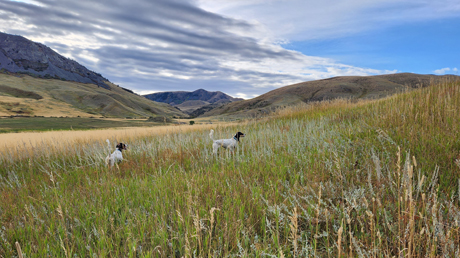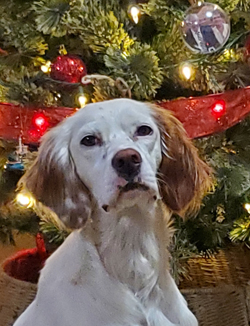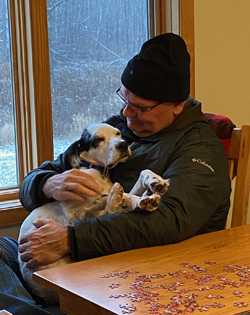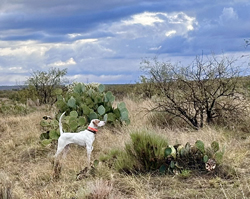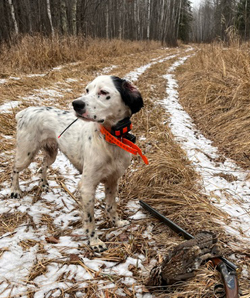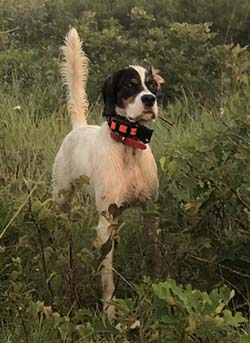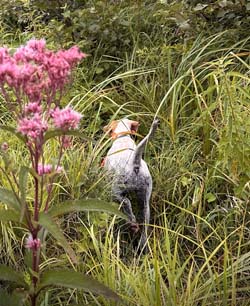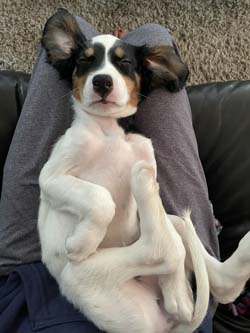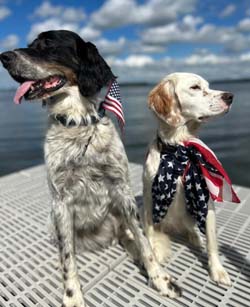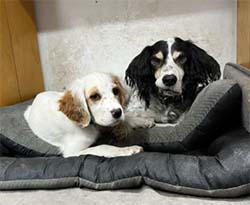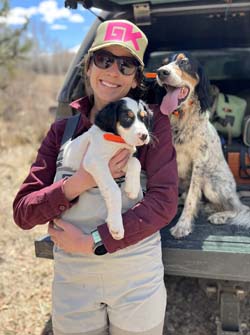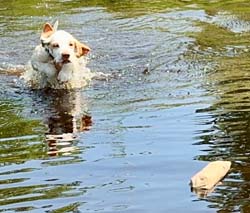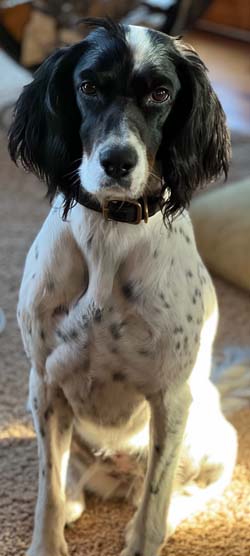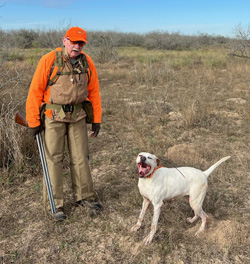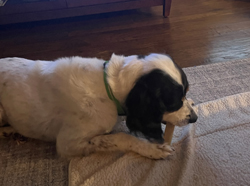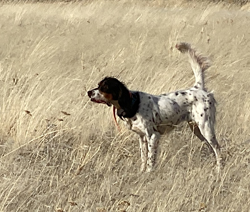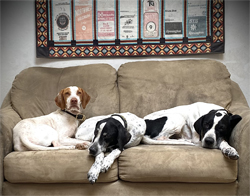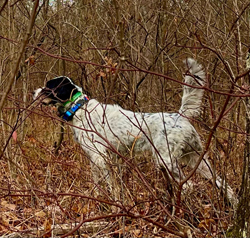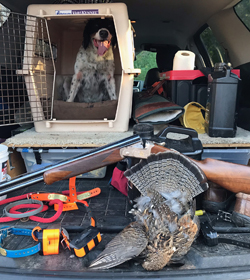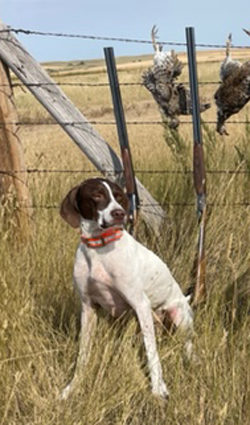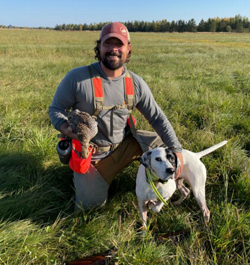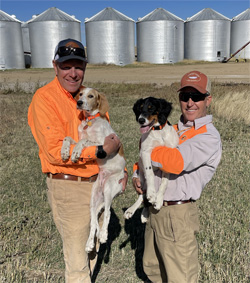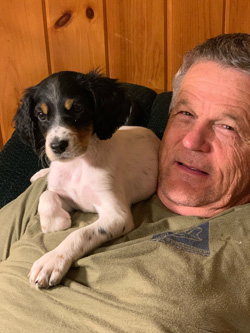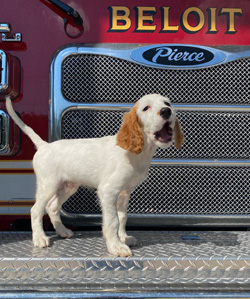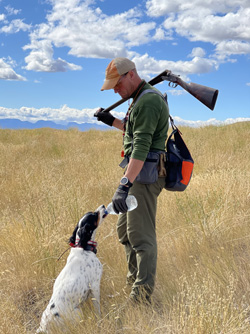

On a recent radiant morning complete with blue skies, gentle breezes and tweeting songbirds, Jerry and Jeff were out in the field.
Dogs are here for the first part of our Gun Dog Training Program. They can range in age from as young as eight months to two or more years-of-age but all must have been exposed to at least one season of birds.
Jerry developed his own training method that integrates a dog’s natural instincts, how dogs learn and proper ecollar use. Simultaneously, he teaches stauchness, backing, stop-to-flush and steady-to-wing-and-shot. All training occurs in the field—on, around and between birds.
This unique training method allows Jerry to move the dogs along at a fast rate while retaining and enhancing the dog’s intensity, focus and style.
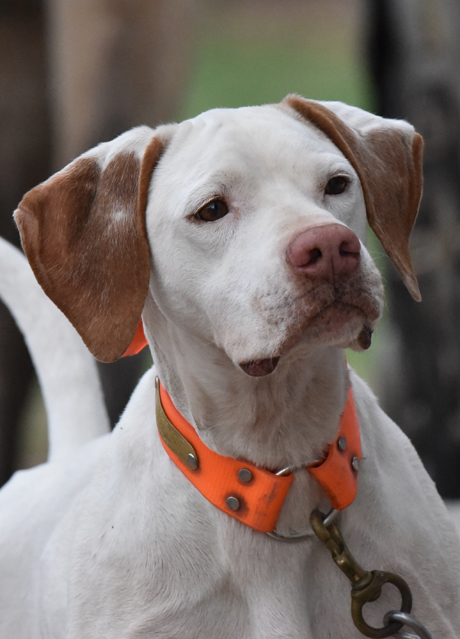
The first stop is a conditioning lesson to teach the dog (Dottie) to stop on stimulation from the flank. No bird is flushed.
Next the dog (Dottie) is lead to an area where a backing dummy is set up. Jerry teaches the dog to stop when another dog is on point and the association between another dog on point and a bird in the air. Jeff lets a pigeon go from his bird bag and shoots a blank pistol as it flies away.
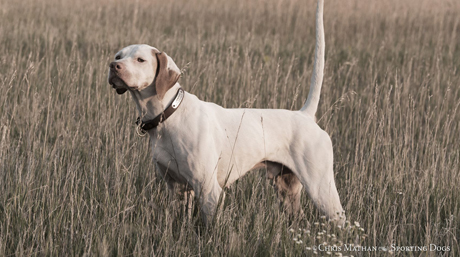
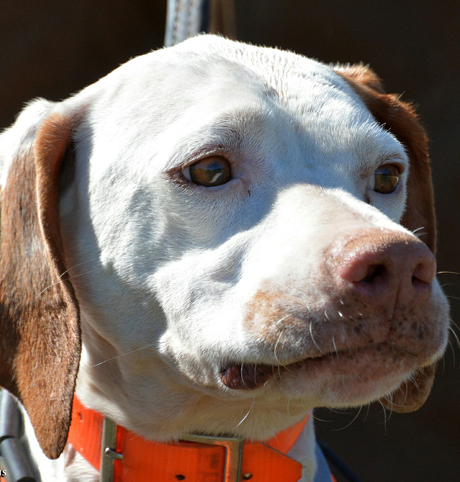
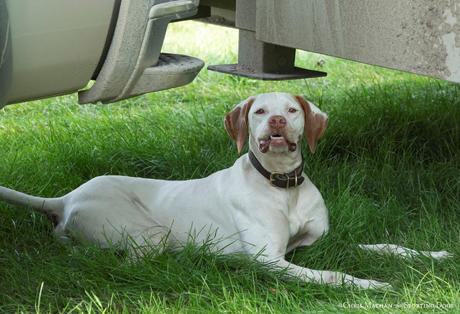
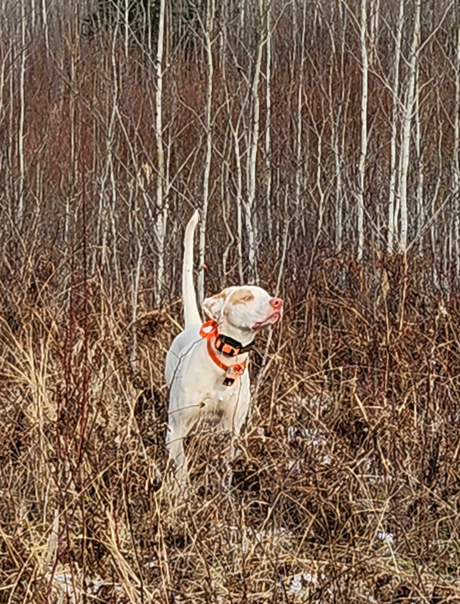
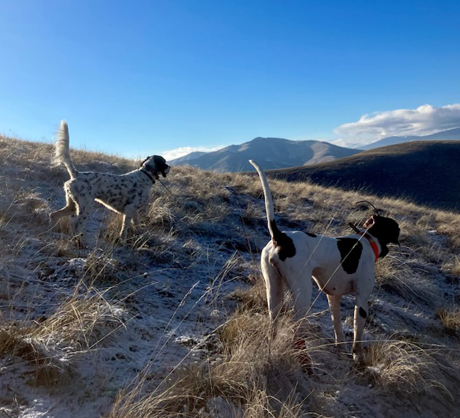
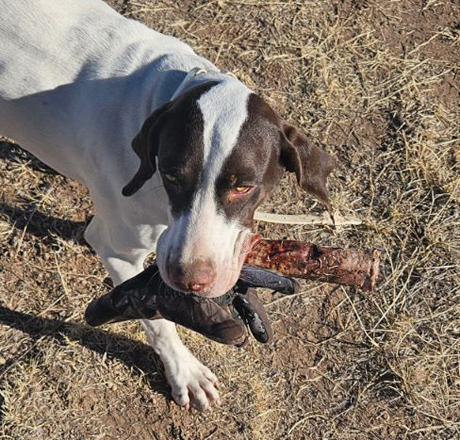
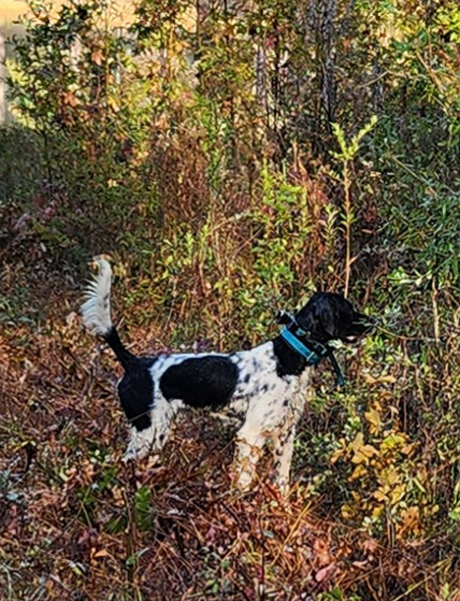
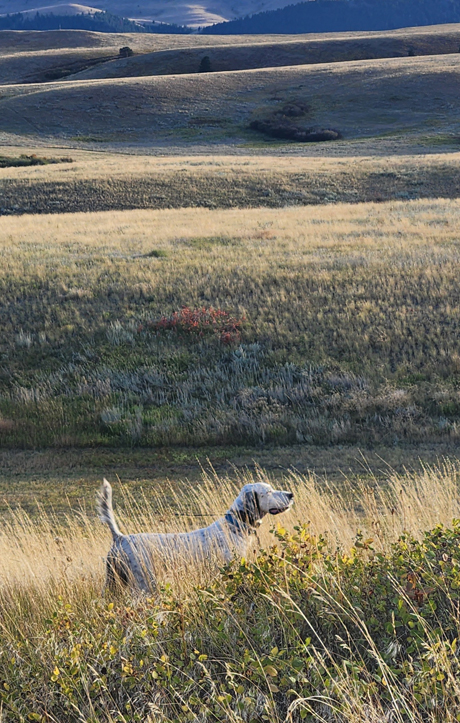
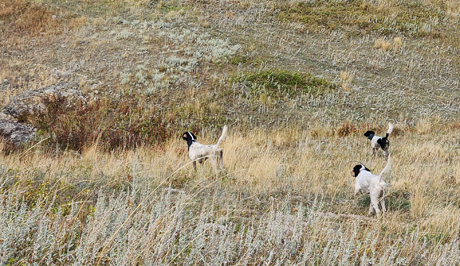
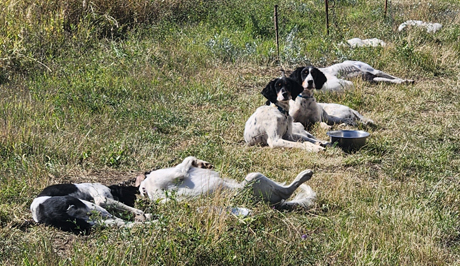
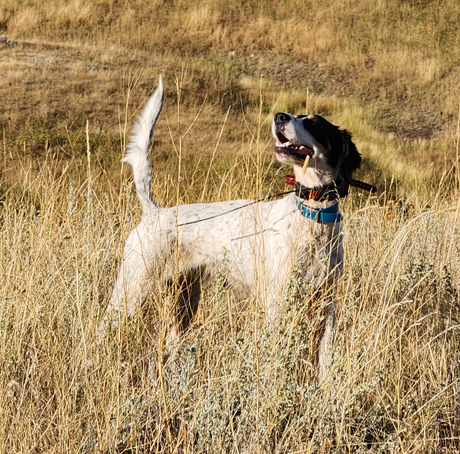
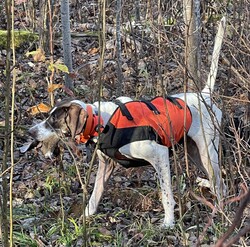
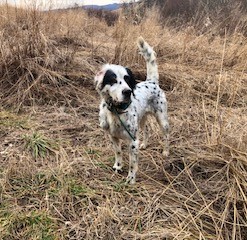
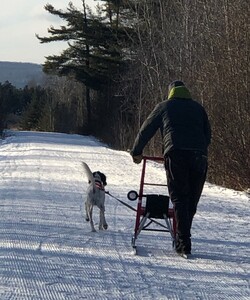
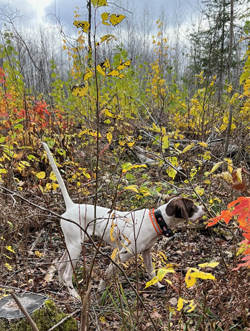
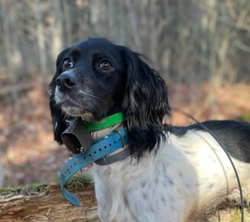
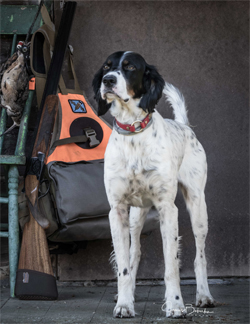
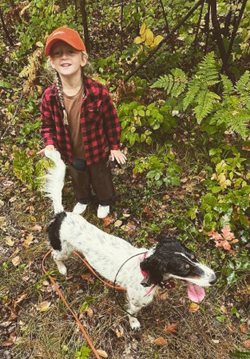
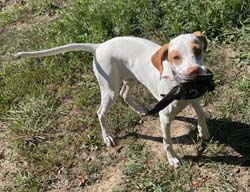
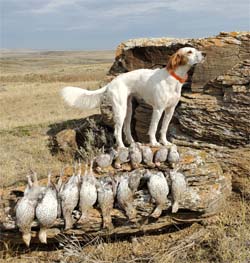
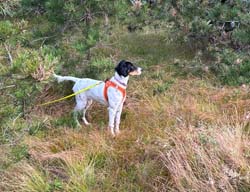
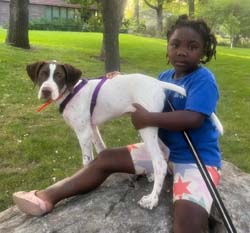
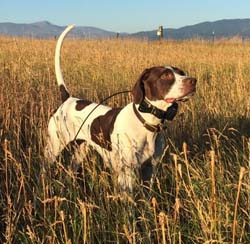
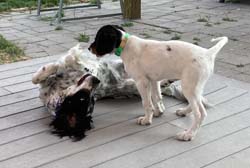
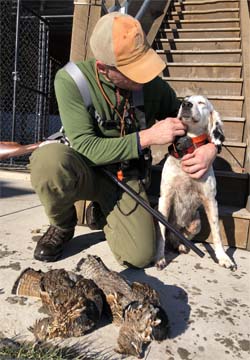
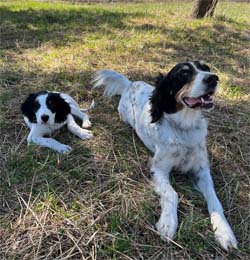
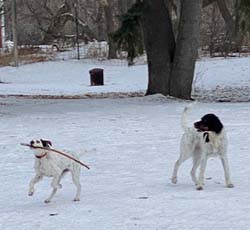
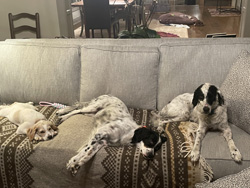
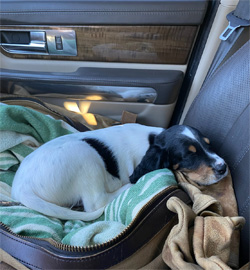
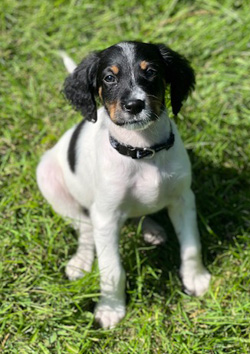
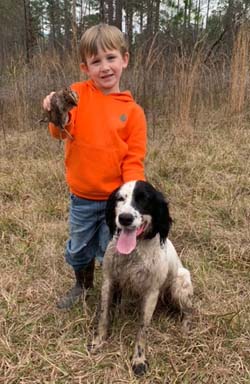
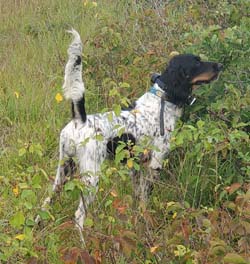
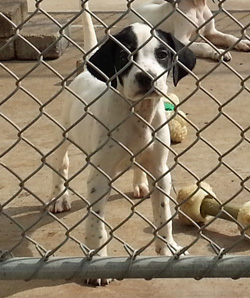
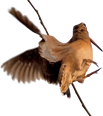
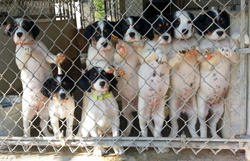
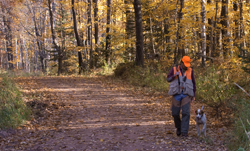
The dog is then lead to an area some distance away where a pigeon is hidden in a bird-releaser. Depending on the dog’s level of development, it might stop-to-flush (Riser, first photo; Dusty, second photo). As the dog advances, it will point the bird (Kiki, third photo).
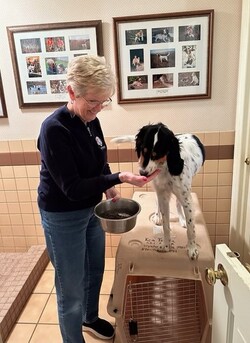
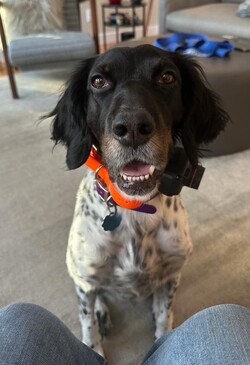
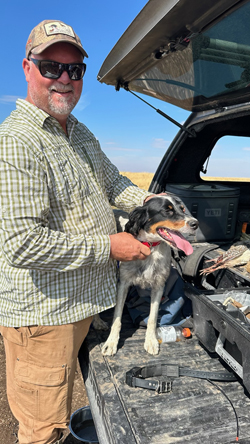
The highest praise is when Jerry touches the dogs. Kiki gets encouragement in the field and Dottie earns pets after her training session.
When I think of CH JTH Izzie, a two-year-old pointer female owned by Jeff Hintz, I’m reminded of the Enjoli perfume ad from 1980. Hopefully many readers are old enough to remember this evocative television ad with the catchy song. The woman who wears Enjoli can do everything. She can “bring home the bacon…fry it up in the pan.”
Izzie, too, can do everything but it’s due to a combination of inherited potential and Jeff’’s development, exposure and training.
In Minnesota and Wisconsin, Izzie has hunted woodcock and ruffed grouse in the woods and sharp-tailed grouse on the sand barrens. She has hunted three quail species of the desert southwest: Mearns, Gambels and scaled.
Izzie has placed in field trials on all those birds and in all those locations and she doesn’t seem to care whether Jeff is on foot or horseback.
Izzie is “dead broke… a strong marker…and retrieves to hand,” says Jeff.
Izzie swims. She rides shotgun in Jeff’s golf cart. And she loves to watch tv.
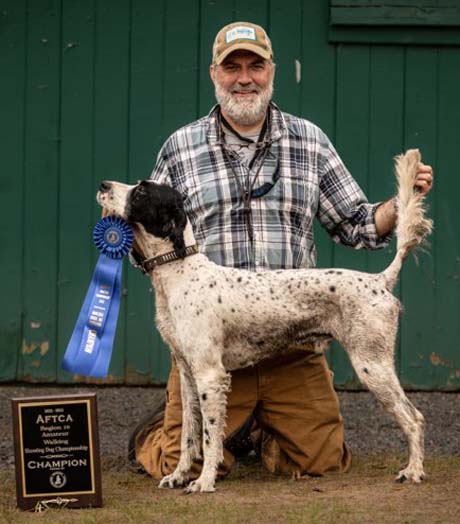
Oh, and did I mention that Izzie won a championship at the Region 12 Amateur Walking Shooting Dog trial when she was 20 months old?
Izzie was the last pick of an all-female litter out of CH Westfall’s Black Ice x Northwoods Prancer in 2011. Just like Izzie, Ice was evenly marked, black-and-white, compact, strong and talented. He was a 6X CH/7X RU-CH owned by Bill Westfall out of Missouri and campaigned off horseback. Prancer is a big, powerful female and beautiful with classic Elhew looks. We don’t compete her in field trials but save her for our guiding string where she is first-rate.
Here is Izzie’s impressive list of accomplishments…at just two years of age!
• Champion, Region 12 Amateur Walking Shooting Dog, January 2013
• Minnesota/Wisconsin Derby of the Year, 2013
• Minnesota/Wisconsin Amateur Derby of the Year, 2013
• Region 12 Walking Shooting Dog of the Year, 2013
• 1st Place, Moose River Grouse Dog Club Open Derby, Wisconsin, 2012
• 1st Place, Danforth Social Society & Fine Bird Dogs Open Derby, Minnesota, 2012
• 2nd Place, Region 19 All Age Derby, Wisconsin, 2012
• 2nd Place, Reuel Henry Pietz Derby Classic, Minnesota, 2012
• 2nd Place, High Country Bird Dog Club Amateur Derby, Arizona, 2013
• 3rd Place, Arizona Pointing Dog Club Open Derby, Arizona, 2013
The only field trial that Jerry competed in this spring was held over the weekend of May 3 at Crow-Hassan Park Reserve outside the Twin Cities. This is a horseback trial hosted by the Northwest Field Trial Association on liberated quail.
The Open Shooting Dog Derby was a big stake with 18 entries including 12 setters and 6 pointers. Our thanks to Frank LaNasa for the use of his horses and to Greg Gress for scouting.
Grits ran in the third brace under overcast and blustery conditions. From the breakaway, Grits had birds on his mind. His race was strong, forward and focused. His first find was forward and 300 yards to the right of the course on a tree line. Jerry flushed a quail and Grits was perfectly steady to wing and shot.
As they caught up to the forward party, his bracemate was on point. Grits backed and stood composed while his bracemate relocated several times. There was no bird.
Grit’s second find was at about 20 minutes, again along a fence row but dead ahead on the course. Again he stood high and tight throughout a lengthy flushing effort by Jerry. A single was seen twittering and running on the ground and eventually disappeared into the dense cover. Jerry shot his gun and took him on.
Grits wasn’t done yet, though. His last eight minutes were forward and reaching and at time he was still hunting far to the front.
Grits is owned by Bob Senkler and is out of our 2011 breeding of Northwoods Blue Ox x Northwoods Chablis.
We handled four other derbies and are proud of their performances: Trudy (Steve Snyder), Trixie (Greg Gress), Slash (Dan Stadin) and Chet (Nathan Friend).
Snyder’s Liz (Steve Snyder) competed in the Open Shooting Dog stake and did a fine job but had no birds.
This the second son of Ox to place in this derby stake. In 2012, Northwoods Parmigiano (Northwoods Blue Ox x Houston’s Belle’s Choice) won second.
Northwoods Parmigiano shows lofty style and precise bird location on point along a fence row.
The ability to find game is directly related to the scenting powers of the dog. It’s the most important natural quality. You can train a dog to come when called, point, back and retrieve but you can’t teach a dog to have a better nose.
There are a lot of dogs with a good nose and occasionally one with what may be called a “superb” nose. Of course, such a dog is a rarity. ~Er M. Shelley, 1921
Shelley was a bird dog trainer in the early 20th century. He also spent five years in Africa hunting lions and leopards with hounds and game dogs and knew about scenting ability. The hounds were hunted in packs of 20 to 30 and comparisons were simple. It was easy to determine which dogs had the best noses.
Often though, it’s difficult to differentiate between a good nose and a great one unless dogs are hunted in pairs. Too, one outing doesn’t prove anything. But if, over a period of time, certain dogs just find more birds than their bracemates, it’s logical to conclude that they have better noses.
The dog that points his birds with exact location, always going to them at a fast pace with his head up into the wind and getting as close as possible to the birds without flushing them, indicates that he has the better nose. ~ Earl C. Crangle, 2000
Some think a dog that points from the farthest distance has the best nose. I agree with Crangle. It’s just the opposite. The dog with the best nose points its birds as close as possible without flushing them. This dog smells the birds from afar but discerns the distance and then pinpoints their locations.
To be most useful, the scenting ability should work with the rate of speed at which the dog hunts. The faster the dog hunts, the better its scenting should be. In other words, I’d always prefer a 5 mph dog with a 10 mph nose. This also explains why, as some young dogs mature, they begin to find more birds. They finally hunt at a pace that allows their noses to work out ahead of them.
Another common belief is that certain weather conditions affect a dog’s scenting ability. Actually, bird movement, or lack thereof, is the culprit. Studies of radio-marked bobwhite quail show that high winds, high temperatures, low humidity, rain and the proverbial east wind cause quail to be less active.
Hard-core dog people and serious bird hunters know which end of the dog points the birds. They will always choose to live with other, perhaps minor faults in their dog if it has exceptional scenting ability.
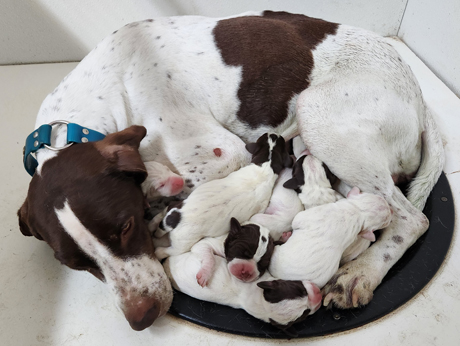
The litter out of Blue Shaquille x Houston’s Belle’s Choice is now about 3½ weeks old and growing like weeds. After Choice feeds them each morning, we clean the nest and add fresh wood shavings—all of which seems to invigorate the puppies. Even though they’re a little wobbly on unsteady legs, the play facilitates coordination and muscle development.
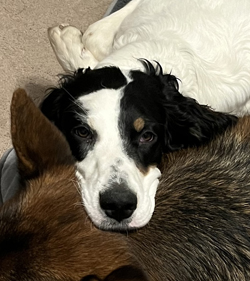
Meanwhile, puppies in the adjacent run out of Ridge Creek Cody x Northwoods Chardonnay are one week older and more mature in their play. They’ve begun a bit of dominance play, including biting and standing over. But they’re all pals and, in the end, fall asleep together in one big pile.
Across the kennel aisle, the multicolored pointer litter out of Elhew G Force x Northwoods Vixen is 10 days old. Right now, they spend all their time sleeping and eating.
Note: The background noises in the videos are dog doors banging as dogs go in and out.
Northwoods Roquefort, left, and Northwoods Parmigiano. (Photo by Chris Mathan.)
Chris Mathan recently asked if I wanted to contribute a piece to Strideaway, an online publication dedicated to promoting pointing dog field trials; particularly, trials for English setters and pointers that are sanctioned by The American Field.
Since the subject was raising puppies, I jumped at the chance. Her assignment was to discuss how we raise, socialize and develop puppies—all with a slant toward how that helps their future training.
The piece is titled Early Development of Bird Dogs and was published on Strideaway last week. Even if the subject isn’t interesting, the exquisite photos of setter and pointer puppies by Chris are worth a look-see.
Chris owns two businesses on her own—The Sportsman’s Cabinet and Chris Mathan Photography—and Strideaway, co-conceived and co-managed with Mazie Davis.
Many thanks to Chris for offering me the opportunity.
Northwoods Chardonnay puppies by CH Ridge Creek Cody at Day 24.
Sunday mornings can be pretty peaceful around the kennel. And the site of a dam sleeping with her puppies is the epitome of tranquility.
Chardonnay’s nine puppies out of CH Ridge Creek Cody are a bit more than three weeks old. The puppies now toddle around on their wobbly legs and have begun to play with each other. We’ve added wood shavings to the whelping nest for cleanliness. Plus, we’ve introduced softened dog food.
Blue Shaquille x Houston’s Belle’s Choice puppies on Day 17.
In the next run, Choice’s litter of six puppies by Blue Shaquille is one week behind at about two weeks of age. Their weights have more than doubled since birth and eyes are wide open.
Between about 4 a.m. and 9:30 a.m. on Sunday morning, April 21, Northwoods Vixen whelped nine puppies by CH Elhew G Force. There are two males (one liver and one orange) and seven females (four black and three orange). The birth process was about as smooth as we could hope for.
Within an hour after all were born, Jerry shot some audio and video. We’ve always liked the tiny peeping, squealing noises newborns make. The whelping process is a messing thing—with plenty of fluids and liquids—and the dam spends a lot of time licking and cleaning her puppies.
By late morning, every puppy was shiny white. And Vixen and her litter were sleeping.
During Gun Dog training, Anhiwake Grace demonstrates her mastery of “steady to wing” exercises.
The training programs we’ve developed at Northwoods Bird Dogs are geared towards our ultimate goal of a polished performer on wild birds. Specifically, we train for a dog that hunts with intensity, handles kindly and points birds with impeccable manners.
There are three levels. The Puppy Foundation Program develops a young dog’s natural instincts and exposes it to gunfire in preparation for its first hunting season. The Gun Dog Program teaches the dog how we expect it to act around game and puts in place the necessary means for the handler to enforce that behavior. The last piece is Wild Bird training which offers opportunities on ruffed grouse and woodcock, sharp-tailed grouse or bobwhite quail. This program takes all the dog has learned in controlled lessons and applies them to actual hunting situations.
The training programs are offered at specific times depending, mainly, on the birds. Gun Dog sessions are available only in May, June and July. The training focuses on staunchness and steadiness using pigeons in controlled situations. Not only is this essential training for a bird dog, it is also a prerequisite to further training.
One goal of the Puppy Program is to get the puppy excited about birds. Northwoods So Crisp takes off after the carded pigeon is released from the bird launcher. (Photo by Brad Gudenkauf)
In July, we offer Puppy Foundation when good quail have settled into our Johnny houses. This is also ideal timing for puppies whelped late fall or spring. The program is available through November.
During August and September, we finish out any Gun Dog trainees on both those strong-flying bobwhites and wild birds whether locally or our training camp in North Dakota.
Merimac’s Adda Girl is backed by Northwoods Parmigiano during a training session on sharp-tailed grouse in a North Dakota pasture. (Photo by Ben McKean)
The final option of the season is wild bird work for a limited number of young dogs in October and early November. Then begins Winter Training when we travel to southwest Georgia.
We’re taking reservations now for this year’s programs. Our training slots usually fill up fast so please contact us soon. We’d love to help you and your dog.
No one would rather hunt woodcock in October than I, but since learning of the sky dance I find myself calling one or two birds enough. I must be sure that, come April, there be no dearth of dancers in the sunset sky. ~ Aldo Leopold
Too often woodcock are overlooked for its larger and louder woodland neighbor, the ruffed grouse, but they are amazing little birds. The spring sky dance is famous, of course, but I also like its twittering flush and those big, brown eyes.
The March/April issue of Minnesota Conservation Volunteer magazine has a nice piece on woodcock with information on the sky dance, banding chicks and habitat needs.
Minnesota Conservation Volunteer, a bimonthly magazine published by the Minnesota DNR, has long been overseen and edited by Kathleen Weflen, who deserves, I think, most of the credit. This outstanding publication is always filled with beautiful photographs and all sorts of interesting, outdoors-y stories.
When they're not sleeping, the three-week-old puppies out of CH Elhew G Force x Northwoods Vixen are up on their wobbly legs and moving around the whelping nest. Of the nine, two are males and seven are females.
It’s fun to have three pointer colors represented—liver, black and orange (orange-black). All have nicely marked heads and a few have body spots. It’s a little early to tell much about ticking but since both parents are very white, we assume the puppies will be, also.
First-time dam Vixen is doing a wonderful job. All puppies are strong with full, round tummies and the nest stays clean and tidy.
Summer training
No matter the age or level of training, Northwoods Bird Dogs has a training program to help you.
For young dogs, Northwoods Bird Dogs offers a Puppy Foundation program that develops the natural instincts of your puppy and cultivates it to become bold and confident. Gun Dog Basics teaches handling, hunting, finding, pointing, stop-to-flush and backing while the Gun Dog Finished program puts the polish on your dog’s performance with steady-to-wing-and-shot training.
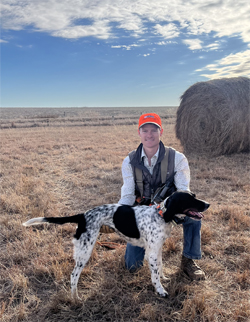
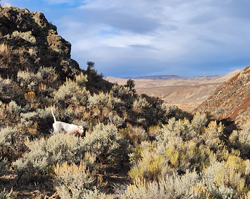
Please contact Jerry or Betsy for details about dates, costs and training programs. They are eager to bring out the best in your bird dog.