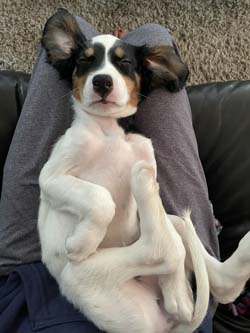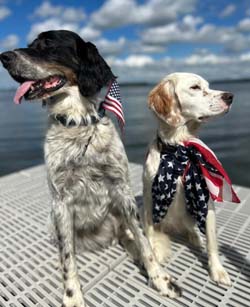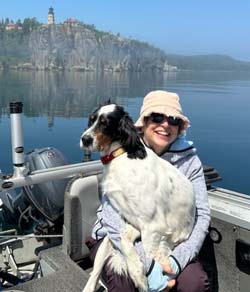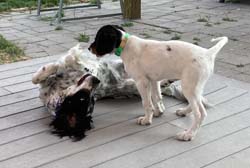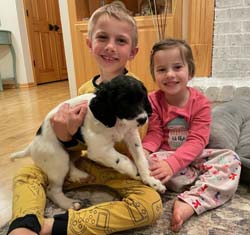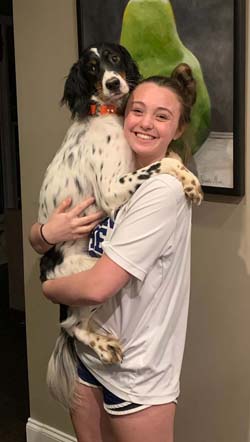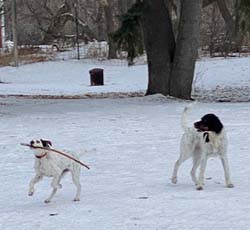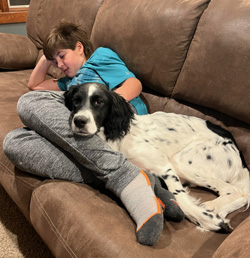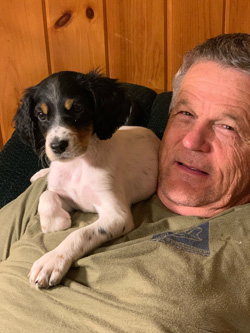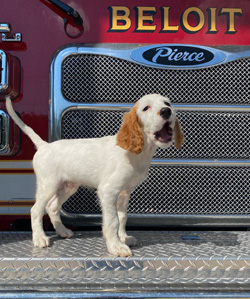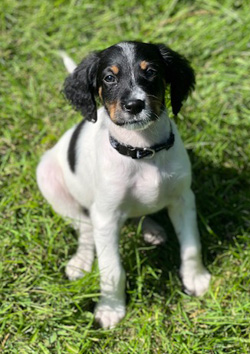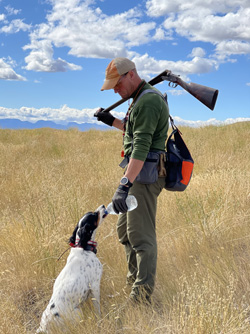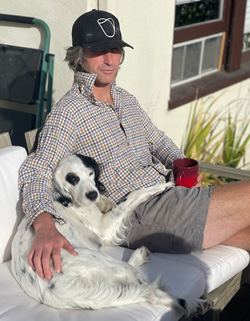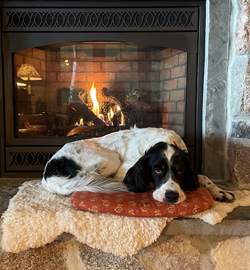
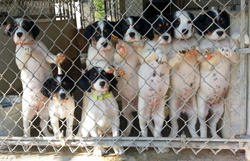

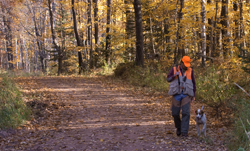
Hope no one is tired of puppy photos yet! Cute puppies can melt even the hardest of hearts…..and also can appeal to steadfast cat-lovers.
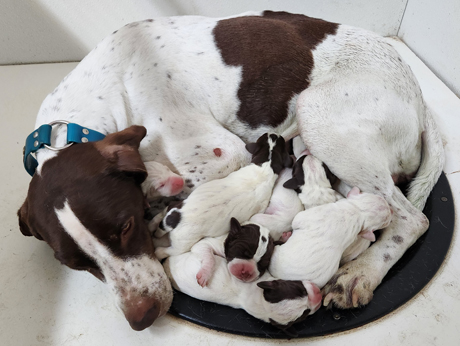
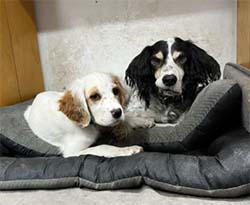
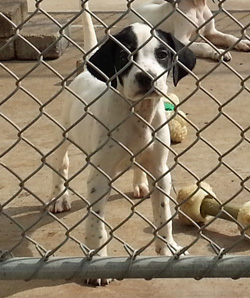
The nine puppies out of Elhew G Force x Northwoods Vixen are now seven weeks old. They are completely weaned and eating dry dog food. Their days seem idyllic—endless rounds of eating, playing and sleeping. The weather has finally warmed to near-normal June temperatures but the puppies still sleep piled together in their heated bowl.
Across the kennel aisle, Chablis and her litter of four females and four males (all tri-color) are healthy and growing fast. Their eyes have opened and they’ve begun to crawl around the nest.
Within days of Willow’s arrival at her new home, she’s fast asleep on the Knapp family couch next to her big pink toy.
It has been a busy spring around Northwoods Bird Dogs…and not just due to our nice group of dogs in for training.
The females we chose for breeding this year came into season within weeks of each other which, of course, puts their whelping dates close together. At one point—and we’re not done yet—we had 24 puppies in the kennel.
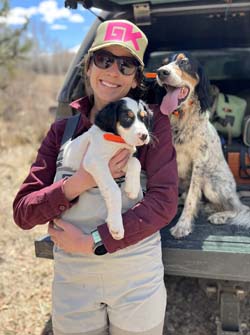
On her first day at her new home, the Knapp family’s puppy, Willow, looks pretty much at ease on a lawn chair with Kate.
The first two litters—Ridge Creek Cody x Northwoods Chardonnay and Blue Shaquille x Houston’s Belle’s Choice—are off to their new families. And there is nothing more gratifying to us than seeing those puppies with their new owners.
Gregg Knapp was quite eloquent.
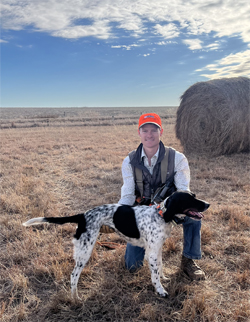
“She is much more bold and confident than my other pups, so I’m anticipating I’ll have my hands full, but in a very good way.
“Even though the ultimate decision on the particular pup was mine, and as you can imagine the rest of the family all had their own opinion on which pup they wanted, the best part of it is when we left your place on Friday we all agreed that we got the best one and she was meant to be for our family. Everybody loves her so much!
“I’m not in any hurry to see her grow up, but am excited for the wonderful fall days in the woods that are calling me and her.”
Chuck Brandes is a friend of Cody’s owner Larry Brutger. In lieu of a stud fee, Larry wanted first pick and offered it to Chuck, who chose a darling, feisty puppy (who also happened to be my favorite) and named her Piper.
Chuck wrote: “No fear of anything…not getting a bath in the shower, lawnmowers, boat rides and certainly no fear of being disciplined. Nothing phases her…I have my work cut out for me, but she is going to be fun.”
Jerry and I called two male puppies The Beach Boys because they were both going to Bill Owen in Santa Barbara, California. Bill also bought two puppies out of Tekoa Mountain Patriot (that are six weeks older) and now takes all four for walks.
Bill named his puppies, Charlie and Champ. “With Cody and Chardonnay as parents, I thought we ought to stick to the “C,” he wrote. Charlie and Red, the horse, check each other out.
This book was published in February 2013 by the married couple Brian Hare and Vanessa Woods. Hare is an associate professor in Evolutionary Anthropology and the Center for Cognitive Neuroscience at Duke University. Woods works there as a research scientist. Both are both dog lovers.
The authors set out to scientifically prove the intelligence of dogs and to find where this intelligence originated. They define intelligence in animals by how successfully a species has managed to survive and reproduce in as many places as possible. By this definition, it’s easy to argue that dogs are the most successful mammals on the planet.
The book is divided into three parts. The essence of Part One is that dogs are inherently able to read human gestures and signals to solve various intelligence tests. In addition, dogs have communicative skills that are amazingly similar to human infants. They traveled the world studying wolves, silver foxes, New Guinea singing dogs and bonobos, a species of chimpanzee.
They concluded that dogs domesticated themselves by becoming friendlier to humans and learned how to communicate and work with us.
Part Two discusses how dogs communicate with humans. Hare and Woods prove scientifically that dogs are pack animals and that “dogs are best in a social network.”
In Part Three they compare breeds to determine intelligence levels. Ultimately (and intriguingly), Hare and Woods concluded that it can’t be proven scientifically that one particular breed is smarter than any other. One significant finding was that working breeds are better at reading human gestures than non-working breeds.
Here, the questions of how to train a cognitive dog is posed. They never really answer it but they do discuss Pavlov’s classical conditioning and B. F. Skinner’s operant conditioning. In doing so they resolve that neither completely addresses the best way to train a cognitive dog.
Hare and Woods also “prove” several things:
• Strictly using reward-based training is not a good, long-term training solution as rewards lose their effect unless frequently increased.
• Dogs learn better and faster in short sessions spaced over a period of time than in long, frequently repeated sessions.
• Dogs can learn by watching others of their own species and other species.
• Dogs know when you are paying attention to what they’re doing.
• Petting a dog, especially gentle strokes in a smooth, calm matter, has a positive effect.
All in all, the book spends a lot of time trying to scientifically prove many aspects about dogs that have been anecdotally known and used by astute trainers for many, many years. While dogs can be trained to react to various stimuli and respond accordingly, there is much more than that to dog training. Being able to read the dog, communicate with it and adjust the training on the fly are just a few pieces of the “art” of dog training.
Hare and Woods write, “Hopefully, we can transform the art of dog training into a science.” I say: Good luck.
Bottom line: Nothing in this book is new and I don’t recommend it. A much better book is The Dog’s Mind by Bruce Fogle.
The nine puppies out of CH Elhew G Force x Northwoods Vixen are now six weeks old. They eat dry food and we’ve started weaning them off Vixen. The puppies seem extremely coordinated for their age and easily scramble in and out of their dog door.
Jerry shot some video of the puppies last week. As you can see, they are very friendly and have lots of energy.
Even though Jerry got up every couple hours to check on Northwoods Chablis, she waited until 9:00 a.m. on Tuesday, May 28, to whelp. Everything went very smoothly and exactly four hours later, there were four males and four females in the nest.
Third-time dam Chablis is sure and calm…not surprising given her sweet, easy-going nature.
Other good news! We can confirm that Northwoods Highclass Kate is pregnant and due to whelp on June 22. Kate is out of two of our best producers—Northwoods Blue Ox and Houston’s Belle’s Choice. She is owned by Barry Frieler.
The sire of both litters is the talented and ultra handsome CH Houston’s Blackjack, co-owned by Frank LaNasa and Leroy Peterson. With Paul Hauge, we co-bred Jack who is out of two champions—CH Can’t Go Wrong and CH Houston’s Belle.
Jerry works Northwoods Ahniwake Grace with a pinch collar and check cord.
There are no stupid questions…just stupid answers.
A client called recently with a question about how to stop his young setter from jumping up and putting its paws on the kitchen counter. An obedience instructor had suggested immediately putting the dog in a room by itself when it misbehaved. Our client tried that and it didn’t work.
Contrary to what some instructors believe, putting a dog in a time-out doesn’t work; neither does having a human conversation with your dog. Those methods apply human psychology to an animal. When it comes to a dog, we need to correct in ways that a dog understands.
Correcting a dog in the right way can be a refined and difficult skill. But for the happiness—and even safety—of both dog and owner, it’s one of the most important.
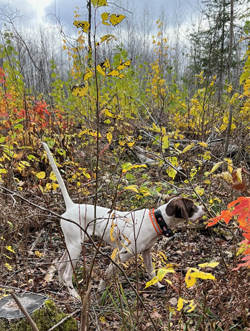
Considerations for corrections
There are five things to understand about administering corrections.
1. Make sure the dog knows why it’s being corrected. Correcting a dog that doesn’t know why can make it confused, fearful and insecure.
2. Always use a cue prior to administering a correction. The cue could be verbal, body language or something else.
3. Timing is everything! The best time to correct your dog is when it’s thinking about or just starting to do something wrong. The worst time for corrections is afterward. Too, your dog will learn more quickly with good timing.
4. Use only enough correction to stop the behavior.
5. Administer the correction with the right attitude. Use a calm, confident, assertive manner. Don’t lose your patience or get angry.
Options for corrections
Different means of correction need to be used in different circumstances. And since timing is crucial, the method must be able to be administered instantly. Corrections range in intensity from a simple verbal command to the use of tools to a physical shaking by the scruff of the neck.
Voice
We like the word QUIT. It’s an easy, one-syllable word and when combined with a low, growl-like tone, it usually gets a dog’s attention.
Tools
When the dog is a distance away, we prefer an ecollar. When the dog is closer, a pinch collar, check cord or leash should suffice. Even the old, rolled-up newspaper can come in handy.
Physical
Sometimes, this becomes necessary. Grab the dog by the scruff of the neck, look it straight in the eyes and sternly say QUIT. Never strike or kick a dog.
Examples
Let’s go back to the dog that continually puts its front paws on the kitchen counter. Here are the steps I recommend.
1. Take hold of the front paws and firmly take them off the counter. Say QUIT!
2. If the behavior continues, use a tool. Try a rolled-up newspaper and smack the edge of the counter. The noise alone may startle the dog into stopping the behavior.
3. If the dog persists, you probably need to use a physical means.
For a dog that’s not paying attention in the field, I’d use the following steps.*
1. Call the dog using a known command—HERE or its name.
2. If no response, repeat command and stimulate with a nick on the ecollar.
3. If still no response, repeat HERE command and escalate the level of the nick or use continual stimulation until it responds.
*This assumes the dog knows a recall command such as HERE and understands ecollar corrections.
Some final thoughts…
Consider your dog’s temperament and understand there are differences in learning capability. Dogs can be bold and fearless, others soft and timid and some with a difficult combination of submissive yet headstrong. Ultimately, you do have to convince your dog to respond—whatever it takes.
Properly trained, a man can be a dog’s best friend. ~ Corey Ford
On a recent radiant morning complete with blue skies, gentle breezes and tweeting songbirds, Jerry and Jeff were out in the field.
Dogs are here for the first part of our Gun Dog Training Program. They can range in age from as young as eight months to two or more years-of-age but all must have been exposed to at least one season of birds.
Jerry developed his own training method that integrates a dog’s natural instincts, how dogs learn and proper ecollar use. Simultaneously, he teaches stauchness, backing, stop-to-flush and steady-to-wing-and-shot. All training occurs in the field—on, around and between birds.
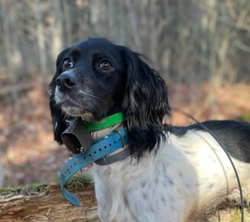
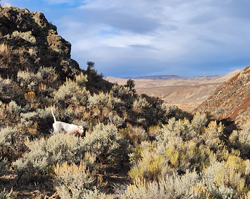
This unique training method allows Jerry to move the dogs along at a fast rate while retaining and enhancing the dog’s intensity, focus and style.
The first stop is a conditioning lesson to teach the dog (Dottie) to stop on stimulation from the flank. No bird is flushed.
Next the dog (Dottie) is lead to an area where a backing dummy is set up. Jerry teaches the dog to stop when another dog is on point and the association between another dog on point and a bird in the air. Jeff lets a pigeon go from his bird bag and shoots a blank pistol as it flies away.
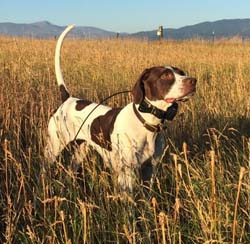
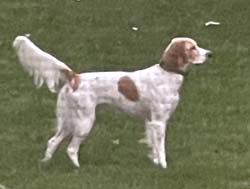
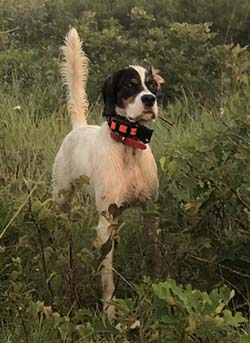
The dog is then lead to an area some distance away where a pigeon is hidden in a bird-releaser. Depending on the dog’s level of development, it might stop-to-flush (Riser, first photo; Dusty, second photo). As the dog advances, it will point the bird (Kiki, third photo).
The highest praise is when Jerry touches the dogs. Kiki gets encouragement in the field and Dottie earns pets after her training session.
When I think of CH JTH Izzie, a two-year-old pointer female owned by Jeff Hintz, I’m reminded of the Enjoli perfume ad from 1980. Hopefully many readers are old enough to remember this evocative television ad with the catchy song. The woman who wears Enjoli can do everything. She can “bring home the bacon…fry it up in the pan.”
Izzie, too, can do everything but it’s due to a combination of inherited potential and Jeff’’s development, exposure and training.
In Minnesota and Wisconsin, Izzie has hunted woodcock and ruffed grouse in the woods and sharp-tailed grouse on the sand barrens. She has hunted three quail species of the desert southwest: Mearns, Gambels and scaled.
Izzie has placed in field trials on all those birds and in all those locations and she doesn’t seem to care whether Jeff is on foot or horseback.
Izzie is “dead broke… a strong marker…and retrieves to hand,” says Jeff.
Izzie swims. She rides shotgun in Jeff’s golf cart. And she loves to watch tv.
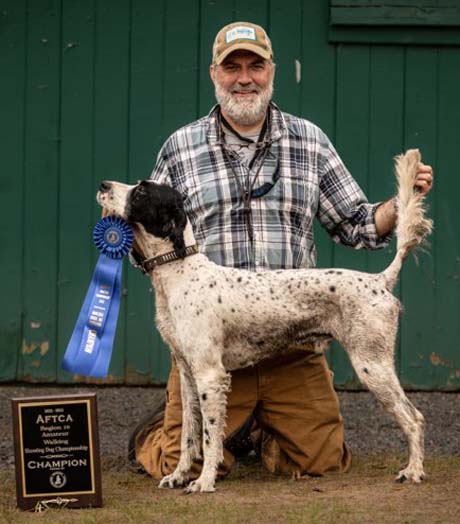
Oh, and did I mention that Izzie won a championship at the Region 12 Amateur Walking Shooting Dog trial when she was 20 months old?
Izzie was the last pick of an all-female litter out of CH Westfall’s Black Ice x Northwoods Prancer in 2011. Just like Izzie, Ice was evenly marked, black-and-white, compact, strong and talented. He was a 6X CH/7X RU-CH owned by Bill Westfall out of Missouri and campaigned off horseback. Prancer is a big, powerful female and beautiful with classic Elhew looks. We don’t compete her in field trials but save her for our guiding string where she is first-rate.
Here is Izzie’s impressive list of accomplishments…at just two years of age!
• Champion, Region 12 Amateur Walking Shooting Dog, January 2013
• Minnesota/Wisconsin Derby of the Year, 2013
• Minnesota/Wisconsin Amateur Derby of the Year, 2013
• Region 12 Walking Shooting Dog of the Year, 2013
• 1st Place, Moose River Grouse Dog Club Open Derby, Wisconsin, 2012
• 1st Place, Danforth Social Society & Fine Bird Dogs Open Derby, Minnesota, 2012
• 2nd Place, Region 19 All Age Derby, Wisconsin, 2012
• 2nd Place, Reuel Henry Pietz Derby Classic, Minnesota, 2012
• 2nd Place, High Country Bird Dog Club Amateur Derby, Arizona, 2013
• 3rd Place, Arizona Pointing Dog Club Open Derby, Arizona, 2013
The only field trial that Jerry competed in this spring was held over the weekend of May 3 at Crow-Hassan Park Reserve outside the Twin Cities. This is a horseback trial hosted by the Northwest Field Trial Association on liberated quail.
The Open Shooting Dog Derby was a big stake with 18 entries including 12 setters and 6 pointers. Our thanks to Frank LaNasa for the use of his horses and to Greg Gress for scouting.
Grits ran in the third brace under overcast and blustery conditions. From the breakaway, Grits had birds on his mind. His race was strong, forward and focused. His first find was forward and 300 yards to the right of the course on a tree line. Jerry flushed a quail and Grits was perfectly steady to wing and shot.
As they caught up to the forward party, his bracemate was on point. Grits backed and stood composed while his bracemate relocated several times. There was no bird.
Grit’s second find was at about 20 minutes, again along a fence row but dead ahead on the course. Again he stood high and tight throughout a lengthy flushing effort by Jerry. A single was seen twittering and running on the ground and eventually disappeared into the dense cover. Jerry shot his gun and took him on.
Grits wasn’t done yet, though. His last eight minutes were forward and reaching and at time he was still hunting far to the front.
Grits is owned by Bob Senkler and is out of our 2011 breeding of Northwoods Blue Ox x Northwoods Chablis.
We handled four other derbies and are proud of their performances: Trudy (Steve Snyder), Trixie (Greg Gress), Slash (Dan Stadin) and Chet (Nathan Friend).
Snyder’s Liz (Steve Snyder) competed in the Open Shooting Dog stake and did a fine job but had no birds.
This the second son of Ox to place in this derby stake. In 2012, Northwoods Parmigiano (Northwoods Blue Ox x Houston’s Belle’s Choice) won second.
When they're not sleeping, the three-week-old puppies out of CH Elhew G Force x Northwoods Vixen are up on their wobbly legs and moving around the whelping nest. Of the nine, two are males and seven are females.
It’s fun to have three pointer colors represented—liver, black and orange (orange-black). All have nicely marked heads and a few have body spots. It’s a little early to tell much about ticking but since both parents are very white, we assume the puppies will be, also.
First-time dam Vixen is doing a wonderful job. All puppies are strong with full, round tummies and the nest stays clean and tidy.
Summer training
No matter the age or level of training, Northwoods Bird Dogs has a training program to help you.
For young dogs, Northwoods Bird Dogs offers a Puppy Foundation program that develops the natural instincts of your puppy and cultivates it to become bold and confident. Gun Dog Basics teaches handling, hunting, finding, pointing, stop-to-flush and backing while the Gun Dog Finished program puts the polish on your dog’s performance with steady-to-wing-and-shot training.
Please contact Jerry or Betsy for details about dates, costs and training programs. They are eager to bring out the best in your bird dog.