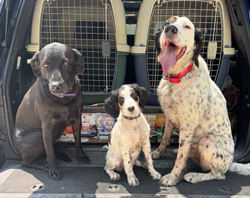
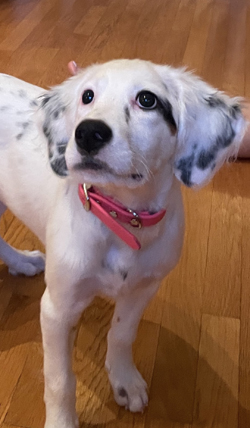
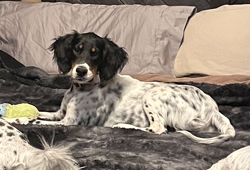
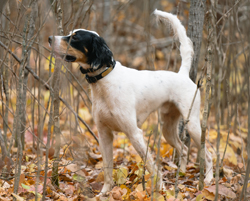
The best way to train a pup or dog is to let another pup or dog do it. ~ Bill Tarrant, Best Way To Train Your Gundog – The Delmar Smith Method
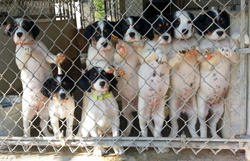
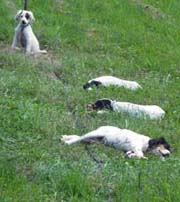
One of the tools we use in the education of our puppies is a stakeout chain. Sometimes called a chain gang, the stakeout chain is a long chain with huge eye bolts at each end through which stakes are pounded into the ground. Shorter chains are attached along its length to fasten individual dogs.
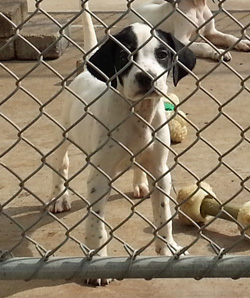
When first clipped to a stakeout chain, puppies are uneasy and often bark or howl.
The stakeout chain is also a great tool when traveling. It’s an easy way to care for multiple dogs…plus it keeps the dogs secure and out of trouble. We put them on the chain to relieve themselves, feed and water them and to allow them to simply relax and be outside.
Stakeout chains can be made various ways. For many years I have made my own and now know exactly what works best. My stakeout chains hold six dogs and are 32’ long. Six drop chains are evenly spaced about 65” apart along the chain and are 18” long. (You don’t want them too long or the dogs can get into trouble with their neighbors along the chain.)
We begin putting puppies on the stakeout chain when they’re about eight weeks old. They get accustomed to physical restraint in general and learn, specifically, to give to pressure on their neck. We attach each puppy to their own drop chain and then leave them alone.
The chain gives enough so that when one puppy tugs, those next to it get a tug, also. Most puppies are uncomfortable at first and bark, pull or sometimes, just freeze. In time, though, they give in to the tugs without thinking and that’s the response we want. The transition to the leash or checkcord is now fairly easy.
Within a bit of time, puppies are completely relaxed on the stakeout chain.
By leaving the puppies to figure it out on their own, we’re not perceived as causing the restraint. In fact, after they settle down and we bring fresh water, they think we’re the good guys!
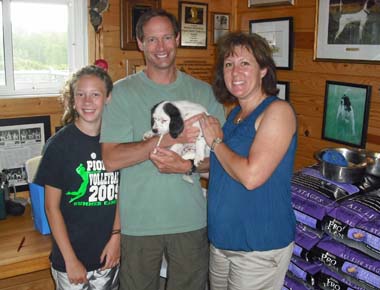
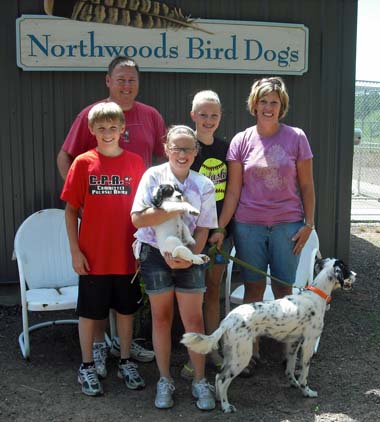
The puppies from our Blue Riptide x Blue Ghost litter were eight weeks old last weekend and Jerry and I had a steady stream of families here to pick out their puppy.
This was the second Northwoods Bird Dog puppy for two of the buyers. As we all know, it’s a small world. In 2006, Kevin Sipple first bought a wonderful tri-color female that is a littermate to this litter’s dam, Blue Ghost. This year he picked a matching, even-marked, tri-color female. Dwayne Splan is also back. His first puppy was a male out of Magic’s Rocky Belleboa x Old Glory Bluebelle in 2008 and, again, he was on the list for another male.
Splan clan
Other buyers included Chris Bye and Roberta Scherf from Wisconsin and the Nielsen and Head families from Minnesota.
It’s a sad day for me when the puppies go…but we’re grateful to the new owners and happy for the puppies.
"Great to see you guys…Again, we really appreciate all your care and attention to these pups for their first 8 wks. They are so very much better socialized, confident and relaxed among people as a result.
"Our pup took about a half hour to get acquainted with her new surroundings, and then she acted like she’d been living here for her entire life. My wirehair treated her gently, and they have been getting along fine. I’m happy to report that she didn’t make a noticeable sound last night–to our great surprise and delight. She regaled us most of the way home when she wasn’t sleeping, but I put her kennel right next to our guy Chance last evening, and that may have made all the difference."
Chris Mathan, a friend and owner of The Sportsman’s Cabinet, visited while she in Minnesota recently. We have known and worked with Chris for many years. She is a marketing specialist geared toward the outdoors and developed the brand and website for both Northwoods Bird Dogs and Dazzle Gardens, my horticulture business.
In addition, Chris is an excellent photographer and has provided us exquisite photographs of dogs, training sessions, flowers and landscapes. She has an extraordinary sense of style and a keen artistic eye. She perfectly captures her subjects and her photos are, literally, breathtaking.
Chris and I also collaborated on a 2010 calendar project, Why We Love Flowers.
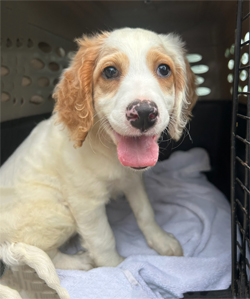
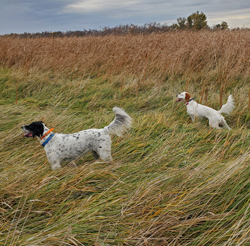
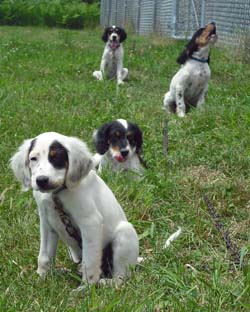
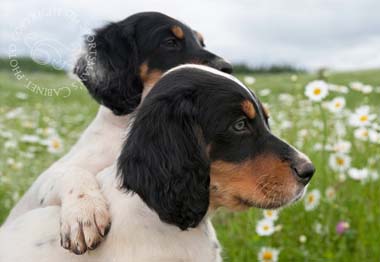
We feel fortunate that Chris brought her camera and took time to photograph some of our dogs. Luckily also, the pasture was in full bloom when Chris photographed Roquefort and Parmigiano, 9-week-old littermates out of Northwoods Blue Ox and Houston’s Belle’s Choice.
Check out more of Chris’ photography—including shots of Bird Dogs, Field Trials, Upland Hunting and garden photos—and her other work at sportsmanscabinet.com.
Touch remains forever the most potent reward that a dog can receive. ~Bruce Fogle, The Dogs Mind
Physical touch is a powerful way to communicate with a dog. By far the most common means is petting. While petting might seem like a no-brainer it is incredible that so many people do it incorrectly.
First of all, petting a dog is not “patting” a dog. “Patting” is a slap and similar in motion to dribbling a basketball. Dogs don’t like to be “patted” anywhere but especially on their heads. (I’ve seen dogs flinch when being “patted” on the head.) Watch while a dog is getting “patted.” It’s obvious by the expression and reaction of the dog that it’s not a pleasing or enjoyable experience.
What dogs really like is being touched with gentle, stroking motions. This petting can be applied differently to various parts of the dog’s anatomy and to convey specific messages. Long, slow, light strokes calm and quiet a dog while harder, short, quick pets will excite. Petting a dog under its chin is similar to how a submissive dog reacts to a more dominate dog and isn’t the message to convey. When petting the side of the head or cheek area in a front-to-back motion, the dog assumes a “submissive grin” which reinforces your status as the pack leader.
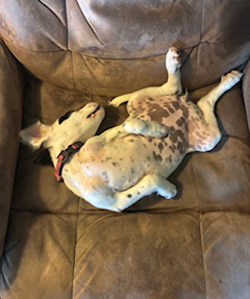
All dogs have a “sweet spot” where they love being petted. This spot is the area between and slightly behind the shoulder blades. When dogs roll on their backs on grass or carpet, they are really focusing on these parts of their bodies. It’s obvious how good it feels.
Petting your dog using the proper touch, technique and location is very important. You’ll be communicating the message you desire and the dog will be much happier, too!
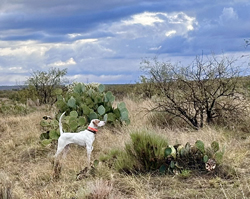
Last January, Betsy and I spent time in the country south of Tucson and I fell in love with it. The vast rolling oak savannas, beautiful desert and one million acres of public land with its three species of native quail are a bird hunter’s dream.
A friend, Rolly Reidhead, and I recently returned from a trip to the area both to hunt and to get out of the Minnesota winter. In years past, Rolly hunted there with his father and was excited to go again.
Jeff Hintz is a good friend and Minnesota neighbor and he and his wife, Carol, migrate to Tucson every year. He is a serious dog guy and avid bird hunter and works his experienced pointers on quail several days a week during, before and after the quail season. He provided invaluable help to Rolly and me.
My favorite Arizona quail is the mearns—over gambels and scaled. Compared to last year’s mearns population, the numbers are dramatically lower and we truly hunted for them more than we found them. We had better success with gambels quail when, for several days, we hunted their cover.
Rolly and I brought seven dogs and all performed quite well, considering the conditions. Traveling 1,600 miles from their snowy kennels and freezing temperatures to sunny, warm, dry Arizona was a big change. But it was fun to see young dogs in new country and witness their first contacts with the various quail.
We didn’t find as many birds as we hoped but had a great trip nonetheless. As Arnold Swartzenneger said in The Terminator: “I’ll be back!”
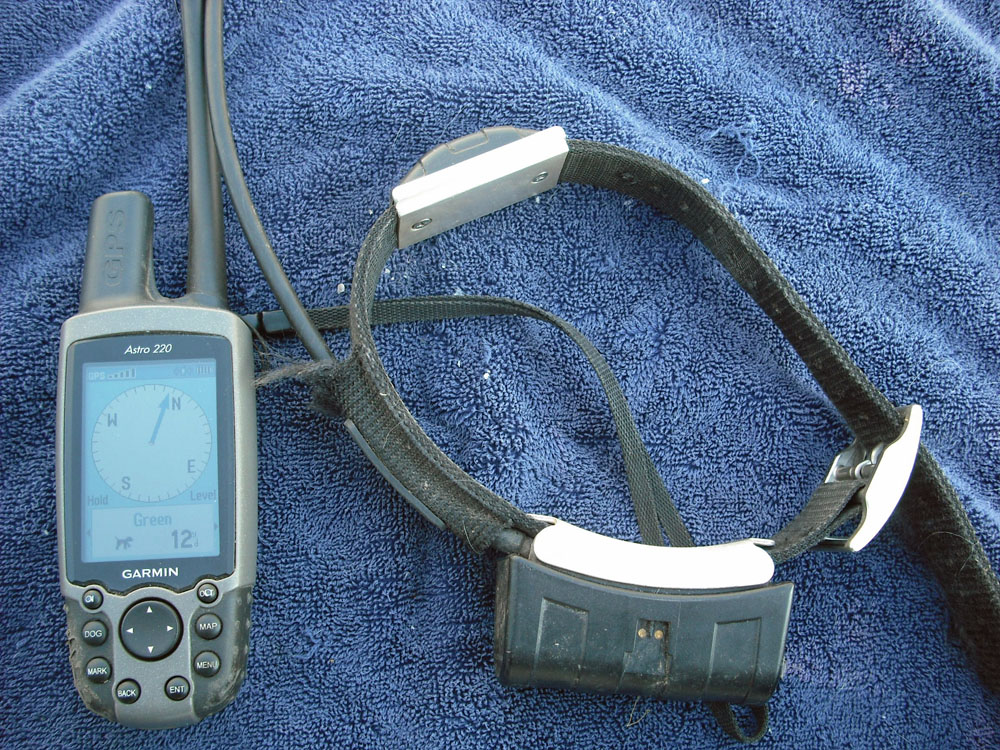
I bought a Garmin Astro 220 dog tracking unit in June and have been experimenting with different features and putting it through its paces. Using this unit in different dog training and hunting situations has given me some interesting and useful insight.
The Garmin Astro 220 is a high-sensitivity, GPS-enabled dog tracking system for hunters and sportsmen. This unique system pinpoints dog location—especially valuable when the dog can’t be seen or heard. The unit records the distance the dog has traveled and average speed. It is also a full-function GPS that can be used to navigate, mark vehicle location and record miles traveled by the hunter and total time out.
Flushes per hour or flushes per mile
Traditionally,
grouse hunters account for bird contacts in flushes per hour. I tried
something different. Using the Trip Computer feature of the Astro, I
tracked the number of miles I traveled, counted grouse flushes and then
computed grouse flushes per mile.
Another take on this
calculation is using the miles the dog has traveled compared to grouse
flushes. Is the dog that finds the most birds in the least miles
traveled the better bird dog? Certainly, it is more efficient!
Speed
Discovering
dogs’ average speeds in various terrains was enlightening. The first
thing to understand, though, is that the dog’s average speed is
calculated by dividing the miles traveled by the total elapsed time
without regard to time the dog is stopped on point.
Over
the course of a one-hour workout in fairly open, brushy terrain, my
dogs galloped 12 – 15 mph. Amazingly, my pace was 3 – 3.5 mph so the
dogs covered 4 – 5 times as much ground. In the woods, both speeds, as
expected, were slower. When I walked about 2 miles an hour, the dogs
galloped 5.5 to 7.5 mph. Also, my dogs were on point more often in the
woods, so the average speed was probably one or two mph faster than the
Astro calculated.
Putting those speeds in perspective, my dogs trot at about 8 – 9 mph when I condition them from a four-wheeler.
Fast or quick?
During
a day of guiding grouse hunts, I usually take three dogs and hunt each
separately for about two hours. Several times last fall, I started with
Shaq, a 54-pound setter that moves smoothly and easily through the
woods. Shaq is a medium-to-wide ranging dog and at times was 200 yards
away. His moving average was about 7 mph.
Often, Maggie
followed Shaq. Maggie is a 40-pound, hard driving pointer female that
rarely ranged farther than 100 yards but continually crossed the path
in front. Many hunters commented on how “fast” Maggie was compared to
Shaq. The Astro told me that Maggie was moving at only about 6 mph so
she perhaps was “quicker” but not faster.
For more information on the Astro, you can visit their website at www8.garmin.com/astro/
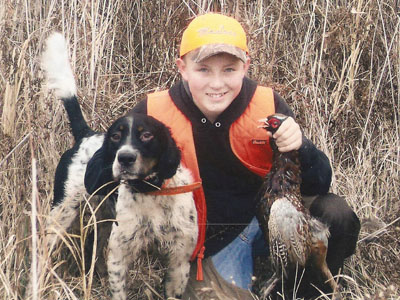
Proud Austin with a pheasant pointed by Blue Riptide.
I am often asked the question: “Should I hunt my grouse dog on pheasants? Or will that ruin it for grouse?”
My answer is another question about goals: “Do you want the ultimate grouse dog or do you enjoy hunting pheasants as much as grouse?”
If you want your dog perfected on grouse, my answer is no. Don’t use your pointing dog on pheasants. If, however, you like to hunt both grouse and pheasants, then I say okay. There are key differences between pheasants and grouse and one, rather unfamiliar, similarity. Pheasants tend to run out from a dog’s points and to not sit well. But so, occasionally, do grouse, especially wily, adult birds in late season. Many times I’ve spotted grouse running ahead of the dog in dense cover. When a pheasant does hold, it allows a pointing dog to approach it more closely. Most ruffed grouse don’t. The ability to point a grouse accurately—but at a distance—is what separates real grouse dogs from those that occasionally point a grouse.
Pheasants have a stronger scent because they are larger than a ruffed grouse and are likely to be in a group. Grouse are smaller birds and tend to be solitary which makes them more difficult to locate. Despite those distinctions, though, there are pheasant hunting conditions that favor pointing dogs…and those that don’t. The ideal situation is an expansive, grassy piece with mixed terrain. A running pheasant could stop and hide at various breaks in the cover and, thereby, provide a spot for a pointing dog to pin it.
I wouldn’t hunt my pointing dog where it’s unlikely the pheasant will ever hold—such as cattail slews, standing corn or sorghum feed strips. Even if my dog points a rooster in such cover, it usually evolves into a cat-and-mouse game that only serves to frustrate the dog. Another tough scenario is many birds in a small area, i.e., a food plot, when too much scent is difficult. A flushing dog is the better dog in these situations.
Ultimately, if you want your dog to be the best grouse dog it can be, then avoid more than the occasional pheasant hunt. If the goal is a good wild bird dog and you enjoy hunting pheasants as much as grouse, use you’re pointing dog.
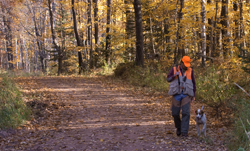
There are grouse hunting days and then there are those special days when everything just goes right. November 2 was one to remember.
Ben McKean is a friend from Minnetonka who was able to slip away from a day in the studio of his commercial photography business. We met at our kennel around mid morning, loaded dogs and packed a lunch of bread, cheese and apples in my truck and were soon off.
The weather was perfect—clear skies with slight westerly breeze and
temperature in the 40s. The forest was damp from previous rains which
also meant plenty of water in the woods.
Ben and his English setter, Merrimac’s Adda Girl, were the first to put
on a show. Addie literally tore up the cover searching for grouse. Five
times she pointed grouse in an hour and a half. Two times she relocated
perfectly to pin running birds. Several times we fired and finally
managed to connect on the last bird as reward for her outstanding
efforts.
Next on the line was our veteran, Blue Silk, also an English setter,
braced with her 10-month-old granddaughter, Northwoods Chablis. We ran
this pair for two, action-packed hours. Several times Silk pointed
grouse and was backed beautifully by Chablis. Twice Chablis was found
on point and stood until we flushed the grouse in front of her.
Together, Chablis and Silk worked running grouse, following the scent
cone in lofty walking points until pinning the bird.
Because I winged Silk’s final point, the bird ran for about 100 yards
and then buried itself in swamp grass. Both dogs searched hard for the
hiding grouse until, finally, young Chablis dug out the bird and
retrieved it to hand.
It was a day full of smiles and one that, for both Ben and me, won’t soon be forgotten.
So far this season, my days in the woods have produced more flushes than last year by not as big a bump as predicted but an obvious increase. This is corroborated by many of our clients, guiding customers and other serious grouse hunters.
And I do mean “flushes.” A majority of the grouse encountered were heard but not seen due to the latest leaf fall I have ever experienced. Leaves of most trees and shrubs hadn’t even begun to fall until well in mid October—and then many were still green. Later, the culprit was the foliage of hazel, the brushy shrub with foliage at just about eye level, which didn’t drop leaves until late October.
The season has been unusual in another way. Though the prediction was for higher grouse populations, during September I found fewer birds and broods than last year. Or at best, hunting was spotty. By the second week of October, though, I found substantially more birds. Where did they come from? Why couldn’t I find them earlier?
Despite years of research, no one really seems to completely understand ruffed grouse. They are still somewhat of a mystery. But that is okay with me and one of the reasons the ruffed grouse is called king of upland game birds.
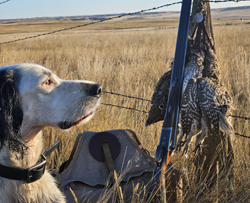
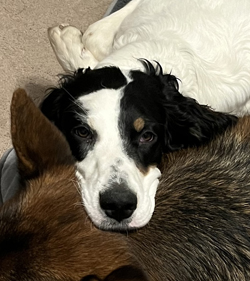
Molly (RU-CH Northwoods Atlas x Houston’s Nelly Bly, 2023) backs Charlie (Northwoods Grits x Northwoods Carbon, 2017) ~ Ken and Caroline Taylor, Jim and Flo DePolo, respectively, Pennsylvania
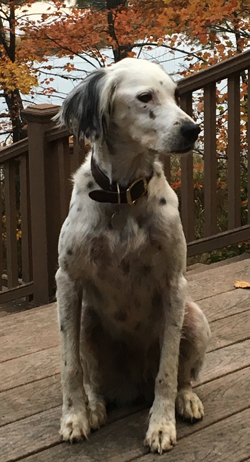
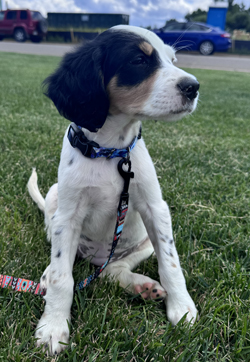
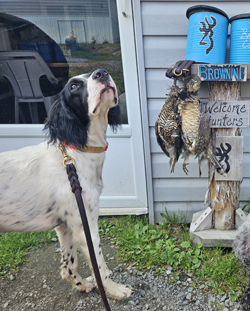
Filly (May’s Pond Hank x Northwoods Stardust, 2024) ~ Tom and Lauren Strand Family, Minnesota
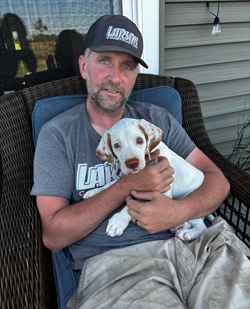
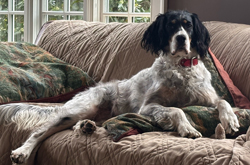
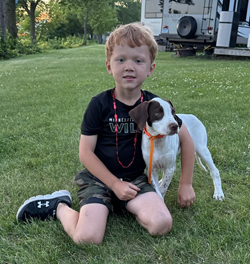
Rae (CH Ridge Creek Cody x Northwoods Chardonnay, 2013) ~ David Larson, Minnesota
Junie (HOF CH True Confidence x Northwoods Comet, 2021) ~ Joey Paxman and Amanda Allpress, Montana
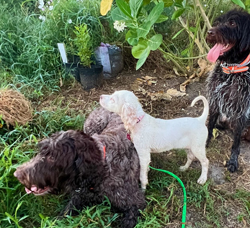
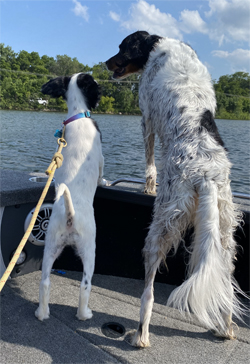
Normanie (RU-CH Northwoods Nirvana x Northwoods Carbon, 2017) and her pal ~ Walter Manley, Florida
Archie (CH Miller’s Upgraded Version x Northwoods Comet, 2024) ~ Blake and Solveig Nelson, Minnesota
Molly (RU-CH Northwoods Atlas x Houston’s Nelly Bly, 2023) ~ Ken and Caroline Taylor, Pennsylvania
Caddie (CH Southern Confidence x Northwoods Comet, 2023) ~ Brian Smith, Pennsylvania
Frisco (Blue Riptide x Northwoods Carly Simon, 2014), on left, and Zion (CH Snyder’s Pioneer Scout x Northwoods Cedar, 2022) ~ Rick and Jodi Buchholz, North Dakota
Rip (CH Woodville’s Yukon Cornelius x Northwoods Redbreast, 2024) ~ Greg and Michelle Johnson, Wisconsin
Miles (RU-CH Northwoods Atlas x Northwoods Madrid, 2024) ~ Lars Totton, New Jersey
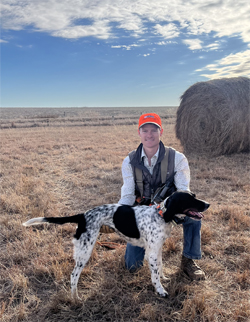
Rip (Northwoods Louis Vuitton x Houston’s Dancing Queen, 2022) ~ Mark Fitchett, Kansas
Vida (RU-CH Erin’s Prometheus x Northwoods Carly Simon, 2019) ~ Tom Condon, Montana
Suki (May’s Pond Hank x Northwoods Stardust, 2024) ~ Eric Beauregard, Massachusetts
Winnie (CH Miller’s Upgraded Version x Northwoods Comet, 2024) ~ Joe and Jess Nelson Family, Minnesota
Tally (May’s Pond Hank x Northwoods Stardust, 2024), on left, and Georgia (Northwoods Grits x Northwoods Carly Simon, 2015) ~ Joe and Deb Wech, Minnesota
Cosmos (RU-CH Erin’s Prometheus x Northwoods Carly Simon, 2019), on right, and his pal ~ The Collins Family, Georgia
Stanley (May's Pond Hank x Northwoods Stardust, 2024) ~ Johansson Family, Minnesota
Tyler (CH Miller’s Upgraded Version x Northwoods Comet, 2024) ~ Josh and Des Matel, Minnesota
Filly (May’s Pond Hank x Northwoods Stardust, 2024) ~ Tom and Lauren Strand Family, Minnesota
Sage (CH Miller’s Upgraded Version x Northwoods Comet, 2024), top, and Louis (CH Erin's Hidden Shamrock x Northwoods Nickel, 2018) ~ Joey Paxman and Amanda Allpress, Montana
Racer (CH Miller’s Upgraded Version x Northwoods Comet, 2024), right, and his very special pal JTH Cooper (HOF CH Rock Acre Blackhawk x Northwoods Vixen, 2015) ~ Doug and Nicole Miller, Oregon
Russell (CH Woodville’s Yukon Cornelius x Northwoods Redbreast, 2024) ~ Gregg Pike and Family, Montana
Abby (CH Woodville’s Yukon Cornelius x Northwoods Redbreast, 2024), on top of her new pal ~ Ben and Penelope Pierce, Montana
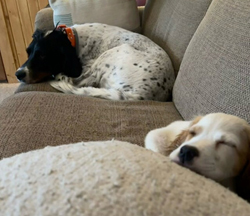
Annie (RU-CH Northwoods Nirvana x Northwoods Carbon, 2017) on her 7th birthday ~ Lynn and Kathy Olson, Iowa
Maisy (RU-CH Northwoods Atlas x Houston’s Nelly Bly, 2023) ~ Zenas and Susanne Hutcheson, Minnesota
Molly (RU-CH Northwoods Atlas x Houston’s Nelly Bly, 2023) ~ Ken and Caroline Taylor, Pennsylvania
Jordy (CH Elhew G Force x Northwoods Prancer, 2014). Look closely! ~ Mark and Janie Fouts, Wisconsin
Speck (RU-CH Erin’s Prometheus x Northwoods Carly Simon, 2018) ~ Mike Watson, Pennsylvania
RU-CH Northwoods Atlas (Northwoods Grits x Northwoods Nickel, 2017) ~ Greg and Michelle Johnson, Wisconsin
Zion (CH Snyder’s Pioneer Scout x Northwoods Cedar, 2022) ~ Rick and Jodi Buchholz, North Dakota
Harper (CH Snyder’s Pioneer Scout x Northwoods Cedar, 2022) ~ Tom Dosen-Windorski, Minnesota
Attie (Southern Confidence x Northwoods Comet, 2023) ~ Jeff and Carol Hintz, Arizona
Chester (RU-CH Northwoods Atlas x Northwoods Stardust, 2023)
~ The Milles Family, Minnesota
Millie (RU-CH Northwoods Nirvana x Northwoods Carbon, 2017) ~ Mercer Clark, Georgia
Belle (CH Southern Confidence x Northwoods Comet, 2023) ~ Kevin Sipple, Wisconsin
Piper (CH Northwoods Sir Gordon x Houston’s Nelly Bly, 2021) ~ Tom and Ashton McPherson, Pennsylvania


 Last January, Betsy and I spent time in the country south of Tucson and I fell in love with it. The vast rolling oak savannas, beautiful desert and one million acres of public land with its three species of native quail are a bird hunter’s dream.