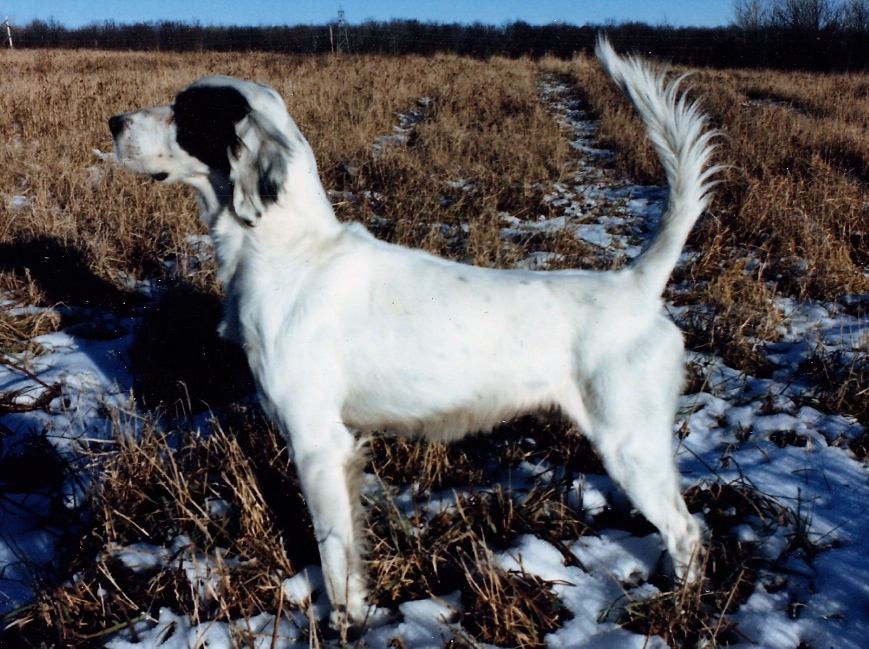
Houston was an extraordinary gun dog owned by Dr. Paul Hauge of Centuria, Wisconsin. He possessed all the trademarks of a Hauge dog: strong bird finder, extreme loftiness on point and a smooth, effortless gait.
Houston was an English setter with a solid white body and a tri-color patch on the right side of his head. He weighed about 48 pounds and was physically strong with a solid build, medium leg, medium coupling and a blocky head. He naturally backed and retrieved.
Leroy Peterson had a nice female called Summer and Smoke. She was a
daughter of CH Northern Zephyr Smoke and a dam that was a mix of
Crockett, Sam L and Wonsover bloodlines. Spring Garden Streak was a
male owned by Jack LeClair of Spring Garden Kennel. Streak’s mother was
a double-granddaughter of Wonsover Smokey Rebel, an Illinois shooting
dog and son of the famous Grouse Ridge Smokey. Streak’s sire was bred
back to National Champion Mississippi Zev. Leroy chose Spring Garden
Streak to sire a litter to Summer And Smoke. Of that litter of five
puppies came Houston.
The first setter we owned, Spring
Garden Tollway, was by Spring Garden Carrie, a litter sister to Houston
and owned by Jack LeClair. I had the pleasure of hunting Texas
bobwhites with Jack and Carrie in the late 1980s. We were also
fortunate enough to hunt wild birds over other Houston littermates,
including Jay Johnson’s BB, Dave Lunn’s Spot and Bob Glaser’s Holly.
They were all hard-hunting, tough, independent bird finders with that
characteristic easy gait and lofty pointing posture. All were setters
with which you could be firm. They could take training and just get
better and better.
Houston was bred sparingly and mostly
to local hunting dogs. Not until many years after his death did his
true producing capabilities become apparent.
Before
Houston’s death, Dr. Hauge had the foresight to freeze Houston’s semen.
Thus far, every litter by his frozen semen has produced field trial
winners. One of his first litters with Forest Ridge Jewel produced 2x
CH/4x RU-CH Houston’s Belle. A 2006 recent repeat breeding with Forest
Ridge Jewel produced derby winners Fireside Blue Zephyr and Fireside
Fleetwood. Another breeding to I’m Jet Setter produced I’m Houston’s
Image, both a winner and producer of field trial winners.
Another frozen semen litter out of Blue Silk, produced Blue Shaquille and Houston Blues, both field trial winners.
There
is a theory that bird dogs are improving over time and that using
frozen semen from dogs long gone is counterproductive. That today’s
dogs are different, possibly, but to say we can’t gain something from
the past, I disagree. At the 2005 Grand National Grouse Championship in
Pennsylvania, Blue Shaquille, then two years old, delivered a sterling
effort. Judge Harold Ray approached me after the brace to ask about
Shaq’s breeding and added this efficacious comment, “Shaquille runs and
points like dogs I saw in Pennsylvania 40 years ago.”
Based on greatly improved statewide drumming counts last spring, we were excited about the prospects for fall grouse hunting. Our expectations were quickly dashed, though, after our first few days afield in September. We didn’t flush the number of birds we expected and saw few legitimate broods. The grouse we did find were wily, ran a lot and were difficult to get pointed well enough for good shooting, even with veteran grouse dogs. This became the theme for the rest of the season.
The good news was that we found more woodcock than normal. These little birds sure helped us keep our interest up when the grouse were hard to come by.
Lately, we’re still finding a fair number of grouse when working the dogs. The birds are mostly in more mature cover where they will likely spend the winter. This cover lends itself to better dog work—the birds have more places to hide and tend to sit while you walk by instead of running for the next county.
As recently as November 16, we’ve even found a few woodcock.
While October is usually our favorite month, it was bittersweet this year as Blue Smoke was laid to rest. He was diagnosed with several lung tumors in late August and hung on like a true champion until the pain was too great to bear.
JR, to those who knew him, was whelped in our very first litter out
of two dogs we owned, Spring Garden Tollway and Finder’s Keeper. At six
weeks of age, he didn’t look well and had a slightly bloody diarrhea.
We took him to the vet where he was diagnosed with parvovirus…..we were
shocked! He had an extended stay at the vet with intravenous fluids and
other treatments, while the rest of the litter was quarantined and
given medications. (We are grateful that we didn’t lose a single
puppy.) When JR arrived home, he recuperated in the house with us for
several days and Betsy grew very fond of him.
JR had his
work cut out for him in field trials as his main competition was his
sister, CH. Blue Streak, who lived in the next kennel. However, compete
he did. In 2000 he won the Minnesota Grouse Dog Championship with
Sherry Ebert judging. The following spring he won the Pennsylvania All
Age with 50 entries and later that week was named reserve dog at the
2001 Grand National Grouse and Woodcock Invitational. He was also
runner-up for the 2001 Minnesota-Wisconsin Shooting Dog of the year,
being slightly edged out by his half-sister, CH. A Rolling Stone.
In
summer 2001 he started to limp on his right front leg and his ankle
swelled. The veterinary diagnosis indicated calcium buildup and
arthritis of his ankle caused by wear and tear. Even with this injury
he was named day dog on the first day of the 2002 Grand National Grouse
and Woodcock Invitational and went on to compete the final day.
After
the 2002 season we ran him sparingly in field trials and hunted over
him only for short periods of time. He became our camp dog on the North
Dakota prairie and enjoyed his time protecting our camp from strangers.
He
was bred selectively, but one of his first litters produced Milk Run
Jessi who won the 200x Minnesota Wisconsin Derby of the year. We bred
our dog, Blue Chief, to Jessi and to her sister. Several nice dogs from
those bloodlines are still in our kennel today.
JR was a
bull on his birds and was as lofty and intense as they come with a poker
straight tail and elevated head. He never went around anything if he
thought there was a bird straight through it. He always gave 110% in
whatever he did and was forever trying to anticipate what I wanted him
to do. Sometimes he was right and others, well, he was close most of
the time!
We have a family photo of JR, his sister Streak
and dam Keeper, all three backing Tollway. Now they are all hunting
together again in a place where the temperature is always in the 40s,
the sky is slightly overcast and all the birds sit tight to be
pointed—only this time the others might be backing JR!
It might seem like a cliché but the message still isn’t out to everyone who owns a bird dog.
Birds make bird dogs.
To wit: A couple brought their male German shorthaired pointer puppy to our kennel for an evaluation. They thought it needed to be taught obedience—especially heel and whoa—to be ready for the fall hunting season. When I asked if the dog had been exposed to birds and gunfire, both nodded enthusiastically.
But when I threw a freshly killed pigeon, he sidled up to it and sniffed from as far away as he could. And when I threw a couple live pigeons on the ground a short distance from the dog, he showed mild interest and little chase when they flew. I inquired further about the bird exposure and the couple replied, “He has seen three birds at the game farm and one was shot over with a shotgun!”
Maybe their expectations are different than mine, but I want a puppy that lives to find birds, enthusiastically busts cover, heartily gives chase to anything that flies and gets excited at the sound of gunfire. I want a young dog that is bold, confident and self-assured. No two dogs are alike and some are naturally more confident and birdy than others, but my experience is that developing a puppy to the level of desire I want does not happen in three or four field outings, much less three or four bird contacts!
We spend hours and hours working puppies in natural cover either on foot, from a four-wheeler or on horseback. The puppies experience woods, creeks, song birds, tall grass, short grass, cattle, fences and all other things they will be exposed to in hunting situations. Most importantly, we put out enough birds so they have several contacts each outing. We want to develop their desire for hunting and finding birds as much as possible. As they start finding and chasing the birds, we shoot a soft blank pistol and work up to a 20-gauge shotgun.
After a number of experiences like that, most will start to point and hold long enough for us to get to them. At this time, we stroke their backs and tail and push them towards the bird. This handling is very important as it increases their intensity and lets them know we approve. When they break and chase we give a hoot and shoot the gun again.
As they point long enough for us to flush the bird, we will try and kill a bird or two for them. And that is a huge reward as nothing fires up a young dog more. It is important not to overdo this stage, though. Two or three times a week at first and once or twice as they come to understand will be enough.
A young dog developed in this manner will have the foundation necessary to progress to more serious training and be well on its way to becoming a bird dog. Heck, you might even kill some birds during its first hunting season!
We have three extremely nice dogs for sale. Two of them are out of Blue Silk and one is out of Blue Blossom. Please visit our started dogs page for more information.